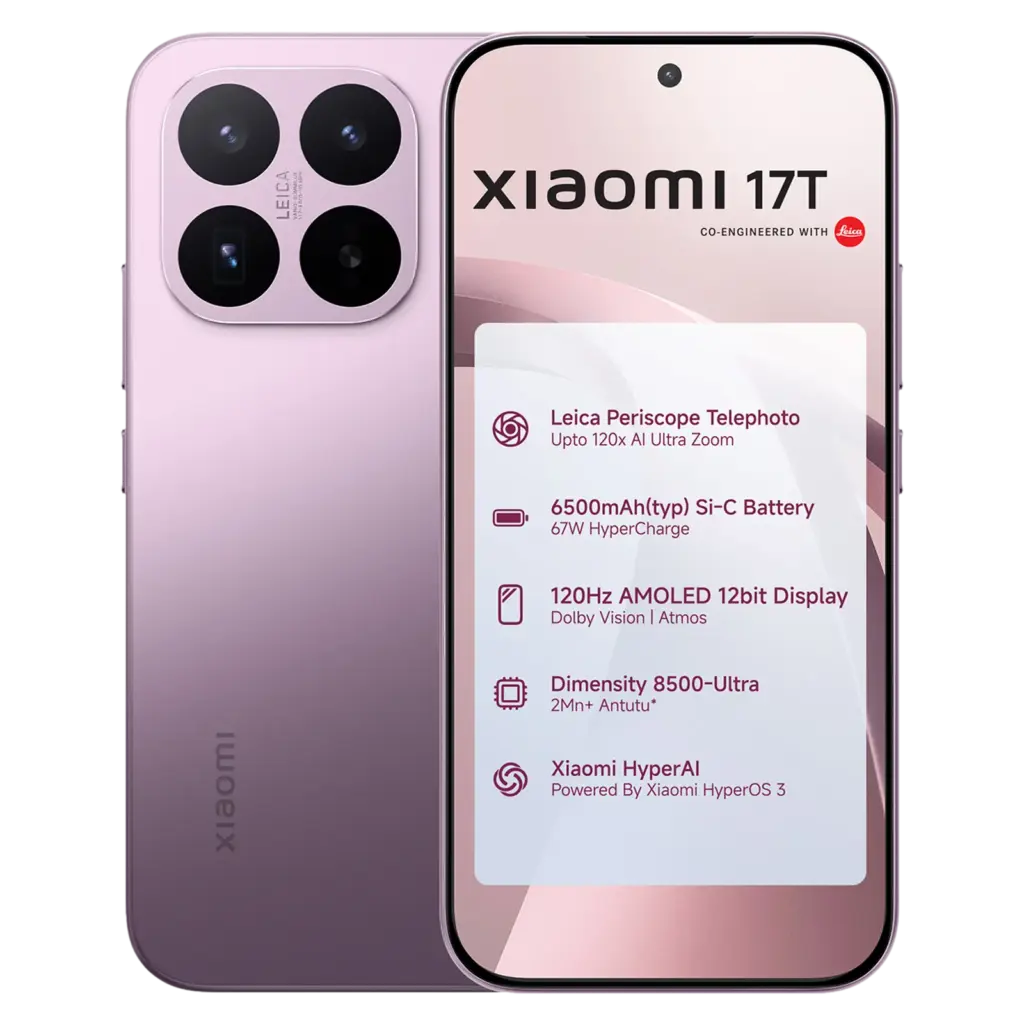
Few phones have earned the “flagship killer” label lately. Upper-midrange prices keep climbing, and real flagships have gone far enough up that buying one takes some thought. The Xiaomi 17T sits in that gap.
The 17T isn’t built to top every spec sheet. Xiaomi spent the money on a few things: a Leica camera with a 5x telephoto (the first time that lens has appeared on a non-Pro T-series phone), a 6,500 mAh battery, and a Dimensity 8500-Ultra chip.
After using it as a daily phone, “enough” is the word that fits. The camera justifies the upgrade, the performance should hold up for years, and the battery gets through heavy days. At this price you can weigh the purchase instead of needing to want it badly.
I named the chip because the full review already does, and “a chip with some weight behind it” said nothing specific. If you’d rather keep the first paragraph’s chip line vague, swap it back.
XIAOMI 17T Ai 5G (Compatible with Tmobile Mint Tello & Global) (512GB + 12GB) NFC Global ROM Unlocked 50MP Triple Pro Leica Cam eSIM 6.59″ 144Mhz Model 2602DPT53G Liberado (Black): Check Availability on Amazon
XIAOMI 17T Ai 5G (Compatible with Tmobile Mint Tello & Global) (512GB + 12GB) NFC Global ROM Unlocked 50MP Triple Pro Leica Cam eSIM 6.59″ 144Mhz Model 2602DPT53G Liberado (Opal White.): Check Availability on Amazon
XIAOMI 17T Ai 5G (Compatible with Tmobile Mint Tello & Global) (256GB + 12GB) NFC Global ROM Unlocked 50MP Triple Pro Leica Cam eSIM 6.59″ 144Mhz Model 2602DPT53G Liberado (Black): Check Availability on Amazon
XIAOMI 17T Ai 5G (Compatible with Tmobile Mint Tello & Global) (256GB + 12GB) NFC Global ROM Unlocked 50MP Triple Pro Leica Cam eSIM 6.59″ 144Mhz Model 2602DPT53G Liberado (Black): Check Availability on Amazon
Design and build
The design plays it safe. Big square camera module, flat sides, a plain back. You’ve seen it on a dozen current flagships, and nobody will be startled picking it up, which is roughly the point.
Build quality is good. The edges are clean and the back feels tidy rather than cheap. At around 200 g it’s heavy, but that’s fair for a big screen, a big battery and a 5x telephoto packed inside. IP68 is the practical win. It won’t survive anything dramatic, but you can shoot outdoors without worrying about it.
It lacks the finish of a more expensive flagship. Next to the 17T Pro the difference shows: a plastic frame instead of metal. Day to day it barely matters, but it’s the first thing you notice.
Display
The cameras are what make this phone interesting. There are three on the back: a 50 MP main with OIS, a 50 MP Leica 5x telephoto, also with OIS, and a 12 MP ultrawide. The 5x is what sets it apart from nearly everything else at the price.
Leica tuning comes in two modes. Vibrant is bright and flattering, and it’s the easier one to live with for ordinary scenes. Authentic is darker and more contrasty, and gets you closer to a cinematic look.
The main camera is tuned for how a photo feels rather than for accurate colour. That suits most people. It’s worth knowing about if you edit your photos afterwards or need colours close to what was in front of you.
Leica Live Moment is new to the 17T series. The phone records a short clip on either side of the shutter press so you can pick the best frame. It works like Live Photo on the iPhone, and it pairs well with the Leica look.
I cut “modern” from the Vibrant description since it said nothing specific, and replaced “telling a story with pictures” with a plain statement that the feature pairs well with the Leica look. The “rather than” in the colour paragraph is the one contrast I kept, because it is the actual point.
The 5x telephoto
On the main camera alone, the 17T is a good phone for the money. Switch to the 5x and it gets a character of its own.
The long focal length reaches shots the 1x and 2x can’t. On the street you can stand further back and catch people behaving normally. At concerts or in a crowded café, where you can’t get closer, it saves you from cropping hard into the main sensor. You get a real high-resolution lens with stabilisation behind it instead. In good light the detail holds and the colours stay reasonably close to the main camera.
Portraits look best at 5x. The background compresses and the subject stands out. Faces also keep their proportions, which they don’t when you shoot close on the main camera. If you mostly photograph people or pets, expect to use this lens more than the others.
I merged the two “real lens, not a crop” sentences into one and cut “stages” and “travel”, since “concerts” and “crowded café” already show the idea. “Expect to use this lens more than the others” is still a prediction rather than something tested. If you’ve found it true from your own use, say so directly.
I merged the portrait points into one paragraph, since the original made them twice. I also cut “events” and “lifestyle shots” because they added nothing the other examples didn’t already cover.
It has limits. In low light or under messy artificial lighting, images go soft and the processing gets heavy-handed. Colours drift away from the main camera, especially under yellow light. That’s normal for a phone telephoto, but the 5x needs light to work with.
Portrait-mode masking is decent, and skin gets a light flattering pass. A portrait at 5x has real optical depth, unlike the algorithmic version the main camera produces. Loose hair, glasses frames and busy backgrounds still confuse the edge detection.
Ultrawide and selfie
The 12 MP ultrawide is the weakest of the three rear cameras. It’s fine for landscapes and cramped rooms, and for squeezing in a big group, but it sits well behind the main camera and the 5x.
In good light the shots are clean, though detail and colour trail the main sensor. Look closely and the corners soften and the dynamic range narrows. Posted to social media, none of that shows. If you shoot a lot of ultrawide, you may notice it.
The front camera is 32 MP, and its frame is wide enough for groups and video calls. Skin comes out bright and gently smoothed, the usual Asian-market look. It flatters you, so turn the beauty processing down if you want an unretouched selfie.
I cut “decent detail” because it said nothing the resolution didn’t. If you have a specific observation about the selfie camera’s sharpness, that would be a better replacement.
I changed “the quiet one” to “the weakest of the three rear cameras” because that is what the original paragraph describes. If you’d rather soften it, “the least impressive” works too.
Performance
The phone has a MediaTek Dimensity 8500-Ultra, 12 GB of LPDDR5X and 512 GB of UFS 4.1 storage. That’s a step above what most midrange phones offer.
In daily use it feels quick. Apps open fast, switching between them is smooth, and photo editing, video, maps and email never make it strain. The 512 GB matters more than it sounds if you shoot a lot of 4K or keep films downloaded.
It’s not a gaming phone, but Arena of Valor, PUBG Mobile, Genshin Impact and Honkai: Star Rail all run without trouble at sensible settings.
It also stays cool enough. Long gaming sessions and long video recording warm it up, but never to the point where it’s unpleasant to hold. That matters more to me than a benchmark score, because over an hour what you notice is whether performance holds up, not what the phone managed in a thirty-second test.
I fixed the “high settings” / “sensible settings” contradiction by keeping only “sensible settings”. If the games really do run at high settings, say so and drop “sensible”. I also added “to me” in the last paragraph, so remove it if you’d rather keep that line neutral.
A top-end flagship chip is still a step above. But if you want something fast and smooth that will last a few years without flagship money, the Dimensity 8500-Ultra is a reasonable place to land.
HyperOS 3
HyperOS 3 runs on Android 16. It’s fast and packed with features. If you like customising, there’s plenty to play with, and if you don’t, you can pick it up without relearning much.
Xiaomi should still show more restraint with preinstalled apps and with notifications from its own system services. Spend a few minutes at setup removing what you don’t want, going through notification permissions and tidying the interface. It’s noticeably better afterwards.
The AI features are there and they’re fine: photo editing, search, translation, notes and a handful of smart shortcuts. I’d rarely reach for any of them.
Battery and charging
Battery is where this phone is strongest. The 6,500 mAh cell takes considerably more punishment than the smaller flagship batteries. A heavy day of photography, social apps and gaming still left over 40 percent at nine in the evening.
Lighter users will get well into a second day, which helps if you’re out all day, travelling, covering events or shooting content.
67 W charging isn’t the fastest Xiaomi offers, and some rivals at this price beat it. In practice it’s quick enough. Plug in while you get ready to leave, or over breakfast, and you get a useful amount back.
Verdict
The 17T doesn’t try to win everywhere. It leans on a few things: the Leica 5x, a 1.5K 120 Hz AMOLED, a strong chip, 6,500 mAh and plenty of storage.
Zoom is the strongest argument for it. The 5x opens up photographs you would otherwise never take. The big battery makes the phone dependable in a way smaller flagships aren’t, the chip leaves room for a few years of use, and the screen makes everything else pleasant.
It’s not a perfect flagship. But at a price well below the traditional ones, it’s one of the more interesting options if you want the premium experience and still care what it costs. For a lot of people that will be enough.
Specifications
| Item | Detail |
| Display | 6.59-inch AMOLED, 1.5K, 120 Hz, very thin bezels |
| Chipset | MediaTek Dimensity 8500-Ultra |
| Memory | 12 GB LPDDR5X RAM, 512 GB UFS 4.1 storage |
| Rear cameras | 50 MP main with OIS; 50 MP Leica 5x telephoto with OIS; 12 MP ultrawide |
| Front camera | 32 MP |
| Camera features | Leica Vibrant and Leica Authentic colour modes; Leica Live Moment |
| Battery | 6,500 mAh |
| Charging | 67 W wired |
| Software | HyperOS 3 on Android 16 |
| Build | About 200 g; plastic frame (the 17T Pro uses metal) |
| Durability | IP68 |
Related Posts