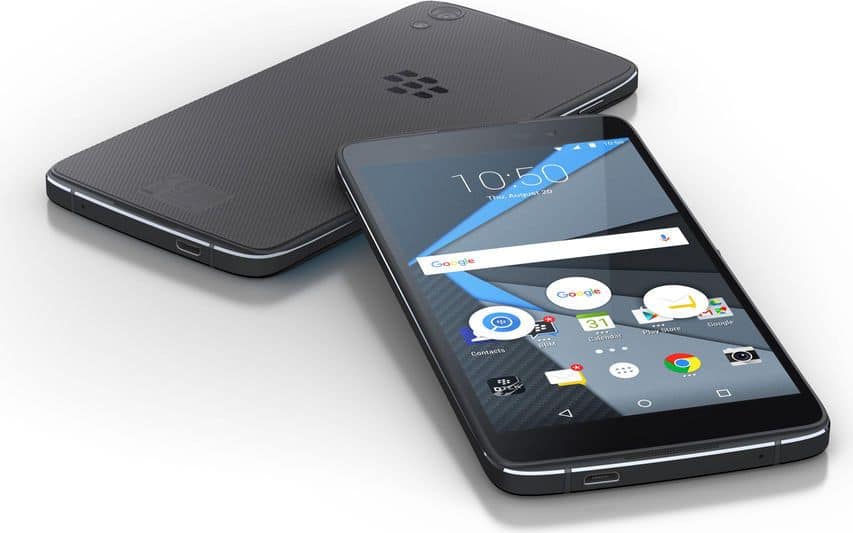
Design
Simple, compact, double-sided design with slim bezel, you can easily operate one hand with this Smartphone. The appearance of the BlackBerry DTEK50 is somewhat similar to the Nexus 4. The back of the DTEK50 is a soft plastic case with tiny dots, good grip on hand, aluminum frame.
The sim card slot and memory card, the volume up and down, are located on the right side of the camera body.
The headphone jack is located on the top of the camera body and the charging slot is located under the camera body.
Under the volume up and down buttons there is a large round button, which makes the user think it’s the power button, but that’s not the case. BlackBerry calls this button “Convenience Key”, programmed with many functions such as text editor, LED / Wifi control, open an application and screen lock. This button can not completely replace the power button because it can only lock the screen and the screen is not open.
The point deduction of this product is that the power button is located on the top left side of the machine, it is difficult to manipulate when the user uses the right hand. To overcome this, the manufacturer designed the “Double tap” mode to open the screen and lock the screen, although there are sometimes slower but more active than ever to touch the power button difficult.
Display
The BlackBerry DTEK50 is designed with a 5.2-inch IPS LCD screen, Full HD resolution of 424 ppi. This is not an amazing design, but it will not disappoint you.
You can still see clearly when using outdoors with this BlackBerry DTEK50. Wide viewing angles, consistent with cost.
Specifications
The BlackBerry DTEK50 uses the octa-core Qualcomm Snapdragon 617 processor, 1.5 GHz.
Internal memory: 16GB.
Ram: 3GB.
Display: IPS LCD 5.2 “, 1080p, 424 ppi.
Camera: 13 MP / 8 MP, support LED.
Support for up to 256 GB memory card.
Battery Capacity: 2610 mAh.
Operating System: Android 6.0 Marshmallow.
This is a mid-range product that is well-suited to the general user, so there is not a lot of need to play games that require high graphics configuration.
Good multi-touch, turn off / open / move the application is somewhat smooth. However, the game will not be as smooth as other midrange phones. This is a product not for gamers, but the remaining needs are perfectly suited to everyone.
With 16GB of internal memory, the DTEK50 supports up to 256GB of memory, so users can easily download applications, take photos, and store information in a comfortable way.
Great sound quality, you can play music with the largest volume and still hear each sound emitted. Clear sound at medium volume. The loudspeaker is designed for both the front and back of the unit, so you can place your phone anywhere and hear the sound. The minus point of the loudspeaker is that the holes of the loudspeaker are designed to be small so it is easy cling dust.
Performance
Hardware Specifications
Under the hood the BlackBerry DTEK50 is basically running on a Qualcomm Snapdragon 617 chipset, and this variant comes with an octa core lineup that is a bit of a mix, four Cortex-A53 cores clocked at 1.5 GHz , and another four Cortex-A53 cores idling at 1.2 GHz. On top of that you get 3GB RAM plus 16GB of internal storage, and yeah it can be expanded to around 256GB through a microSD card slot. Overall, this kind of hardware feels like a decent mid range base , for normal day to day use.
The Snapdragon 617 is basically built to keep a decent balance between grunt and power saving. It should handle everyday stuff, like web browsing, scrolling through social apps, and streaming multimedia without too much trouble. With 3GB of RAM, switching between apps stays pretty fluid, and the expandable storage gives people that extra room when photos , videos, or apps start stacking up.
Benchmark Performance
When it comes to benchmark tests, the BlackBerry DTEK50 lands where you’d expect for its category. For example, Geekbench 3 results are usually around 1,400 for single core performance , and roughly 3,500 for multi core performance. Those numbers suggest it can manage common apps, plus moderate multitasking, without turning into a mess.
For gaming, the DTEK50 can cope with casual games and some lower demand titles without major drama. Games like “Candy Crush” and “Angry Birds” tend to run smoothly, but the heavier titles might show occasional stutters ,or you’ll need to dial down the graphics a bit to keep things steady.
Camera
BlackBerry DTEK50 kind of comes with a 13MP back camera, and it has an f/2.0 aperture with phase detection autofocus, PDAF actually. Also there is this dual-tone LED flash, you know. On the front side, there’s an 8MP camera with an f/2.2 aperture, mostly for self portraits and those quick video calls, and well yeah that sort of thing.
About the back lens, it is meant to grab clear photos with solid detail, and decent color accuracy too. The dual-tone LED flash is there to help in darker places, while the PDAF kind of pushes fast focusing and more stable shots. For the front camera, it does what you would expect, decent selfies, decent video calls, and the 8MP resolution gives results that feel satisfactory. No dramatic surprises, just a steady performer.
Camera Performance
In bright light the rear camera looks pretty good, sharp captures, and colors that stay fairly true. The PDAF helps keep things locked in quickly which makes it practical for moving moments, like people walking or everyday action. But once the lighting gets worse, the camera can run into noise, and the detail may seem reduced. That’s pretty typical for mid-range setups, you know.
The front-facing camera is also decent for selfies and video calls. With 8MP you still get usable clarity for casual use, even if it doesn’t really compete with the higher-resolution front sensors some rival phones offer. It also behaves fine across different lighting situations, though it has no dedicated LED flash, so night selfies are never really going to be its strength.
Video recording on the DTEK50 works in Full HD ,so you get pretty sharp and usable clips for day-to-day situations. The picture is generally good enough for posting online or just saving memories, but it probably won’t feel as capable as what you see on more premium, higher-end devices.
Battery Life
Battery Specifications
The BlackBerry DTEK50 comes with a 2,610mAh non-removable battery. That mAh number is kind of modest, especially for people who expect long runtime, yet it’s meant to balance battery endurance with that slim profile. Charging is fairly standard, although it does not include fast-charging.
Battery Performance
In everyday use, the BlackBerry DTEK50 typically makes it through a whole day, assuming moderate habits. Think web browsing, scrolling social media, and the occasional media play. But if your use is more intense, like prolonged gaming or extended video streaming , then you may end up needing a recharge by late day.
Overall, the 2,610mAh battery is solid for most people, but it could be disappointing for those who want longer spans between charges. Since there’s no fast-charging feature, topping up quickly during the day is not really the strong point here.
BlackBerry DTEK 50 STH100-2 16GB Unlocked GSM Smartphone International Stock No Waranty – Black: Buy it now
BlackBerry DTEK50 – Unlocked Phone – Carbon Grey (U.S. Warranty): Buy it now
BlackBerry DTEK50 RJD211LW 16GB STH100-2 Factory Unlocked 4G/LTE Smartphone (Carbon Grey) – International Version with No Warranty: Buy it now
BlackBerry STH100-1 DTEK50 Unlocked GSM 4G Android Phone w/ 13MP Camera – Black (Certified Refurbished): Buy it now
With a battery capacity of only 2610 mAh, the BlackBerry DTEK50 has low battery life with other midrange products. If used for the purpose of playing games, watching movies, check FB regularly, the battery life is not enough one day. If you use the device with normal demand, you will have to recharge the battery after 7-8 hours. With the support of Qualcomm QuickCharge 2.0 mode, fully charged battery will not take too long, but if you are a frequent traveler, you should equip yourself with a spare battery.
Equipped with a 13 MP rear camera and 8 MP front camera, the BlackBerry DTEK50 will give you beautiful photos in good light. But given that the light is not enough, the picture will not produce the desired result.
The point of interest in this product is the software and security system. The DTEK name is set according to the DTEK security application built into the machine. With DTEK, your data will be encrypted, you can control the access of individual applications, you can rest assured that no application will access your data when not allowed by you.
Especially more is the default protection mode of recovery. If your phone is stolen unfortunately, the thief can not use your phone without knowing your Google account information. Although the phone has the best security in the world, but BlackBerry promised to update the security version as soon as possible.
When talking about the BlackBerry, it is hard to not bring up the keyboard, you know. The BlackBerry DTEK50 comes with a full-featured keyboard; there are no physical keys out on the screen, but the keyboard is built to work with the BlackBerry stylus in kind of a natural way. Text editing is simple, easy to manipulate.
However, BlackBerry software is not perfect, sometimes there are errors such as the arrangement of the application of the alphabet. But with the BlackBerry DTEK50 will bring you an exciting Android experience.
Comparison with Competitors
If you want a broader take on it, it helps a lot to put the BlackBerry DTEK50 next to a few of its peers from that mid range phone band. Like you could line it up with the Samsung Galaxy A5 (2016), the HTC One A9, and also the Huawei P9 Lite. Doing that sort of cross checking is useful, because then it becomes pretty obvious where the DTEK50 is more solid, and where it kinda stumbles a bit against the rest of the group, you know.
BlackBerry DTEK50 vs. Samsung Galaxy A5 (2016)
So, the Samsung Galaxy A5 (2016) feels like a kind of straight rival to the BlackBerry DTEK50 , with a price region that is sort of akin and a feature set thats pretty nearby too. In regular daily use , the Galaxy A5 (2016) brings you a 5.2 inch Super AMOLED screen, working at 1920 x 1080 pixels. That Super AMOLED panel is kind of famous for lively color output, plus those deeper blacks , so the screen overall ends up looking more dramatic than what you’d see from the DTEK50’s IPS LCD, essentially.
On the performance side, the Galaxy A5 (2016) relies on the Exynos 7580 chipset, along with 2GB of RAM and 16GB of built in storage. Even if the storage size lands near the DTEK50 for most people, the Galaxy A5 doesn’t include expandable memory , which can be annoying if you expect to add more space later. Camera wise, it uses a 13MP rear sensor and a 5MP front camera , and that stays in the same general vicinity as what the DTEK50 offers.
Design is kinda another point where it feels not the same. The Galaxy A5 (2016) goes with a metal and glass build , so it comes across as more “upmarket” than the DTEK50’s plastic chassis. On top of that, the battery is 2,900mAh, just a little above the DTEK50’s 2,610mAh, so you might notice a mild improvement in day-to-day endurance, between charges.
BlackBerry DTEK50 vs. HTC One A9
The HTC One A9 is also a sort of contender in the mid-range lane, it ships with a 5.0-inch AMOLED display. Resolution lands at 1920 x 1080 pixels. That AMOLED panel turns in punchy colors and deeper contrast, kind of like the Galaxy A5’s screen quality . The One A9 runs on the Qualcomm Snapdragon 617 chipset, and it’s teamed up with 3GB RAM and 32GB internal storage, which is more than what the DTEK50 offers, at least by raw capacity. You still get expandable storage too , in the typical style.
As for the camera, the One A9 has a 13MP rear sensor with optical image stabilization, OIS , for short, plus a 4MP front-facing camera. Having OIS is a small but real edge for night shots and dim environments, compared with the DTEK50. There’s also a premium aluminum body here, instead of the DTEK50’s plastic frame. The battery is 2,150mAh though, and that could translate to less overall endurance relative to the DTEK50.
BlackBerry DTEK50 vs. Huawei P9 Lite
Now the Huawei P9 Lite also shows up as a serious contender in the mid-range group. It uses a 5.2-inch IPS LCD display with 1920 x 1080 pixels. Display-wise it looks like it can keep pace with the DTEK50, in terms of general screen quality. The P9 Lite is driven by the Huawei Kirin 650 chipset, with 2GB RAM and 16GB storage , and yes it’s expandable through microSD.
Camera-wise, the P9 Lite brings a 13MP rear sensor and an 8MP selfie camera, those specs are pretty competitive against the DTEK50’s cameras. The design feels more refined too, it has a metal frame and a smooth, modern look, which gives it a more premium vibe than the DTEK50. Battery capacity is 3,000mAh, so it could last longer than the DTEK50’s 2,610mAh, generally speaking.
Strengths and Weaknesses
Strengths
Security Features: The DTEK50’s whole vibe is security, with the DTEK app plus built in security options, it kind of separates itself from a bunch of competitors. Honestly it’s pretty appealing for people who care about safeguarding their data, and privacy too, you know.
Design and Ergonomics: This phone comes with a sleek, ergonomic style, and the grip feels comfortable enough for long stretches. The buttons land where you’d expect them to be, nothing weird, no fuss. The matte finish adds a little sophistication, but it’s also practical, meaning it should hold up pretty well which is a nice bonus.
Display Quality: The 5.2-inch Full HD screen looks solid, with good color accuracy, and it stays clear for day to day use. The IPS LCD tech helps maintain wider sightlines and brings a decent brightness level, without trying to be dramatic about it.
Expandable Storage: The microSD card slot for expandable storage is actually handy, because it gives you room to breathe if you need extra space for apps, media, and all kinds of files. Basically it doesn’t restrict you too tightly, which feels more flexible in real life.
Battery life: The phone normally makes it through an entire day on a single charge, even with pretty moderate use, which is basically fine for most people. The mCharge feature isn’t really fast charging, not exactly, but it still gets you to full power in a pretty reasonable time, so overall it feels quite dependable.
Weaknesses
Performance limitations: The Snapdragon 617 chipset, sure it works, but it’s not really as powerful as some of the newer or more high end chips. So you might see small slowdowns every now and then , particularly when you run heavier apps or do more demanding tasks.
Camera performance: The camera output, especially in low light, comes off less convincing than what you’d get from higher end devices. Also, the absence of optical image stabilization hurts the steadiness and overall look of night photos.
Build material: It’s made from plastic which, on paper is fine… but in the hand it can feel a bit less premium compared with metal or glass builds from other brands. That can change how “quality” feels to you day to day.
Software updates: the DTEK50 can feel a bit behind when it comes to landing the newest Android updates, compared with devices from other brands. so you may end up with fewer opportunities to snag fresh features, and security fixes can roll in a bit slower than you would hope.
Battery capacity: battery life is fine, though the 2,610mAh size is rather modest versus some competitors. that means if you’re using it heavily, the charge may drain sooner than you think, kind of fast, even on normal days.
Conclusion
Overall, the BlackBerry DTEK50 really stands apart in the mid-range smartphone space, mainly because it goes all in on security, productivity, and even that distinct feel of the hardware. You still get a solid day to day experience, thanks to the 5.2-inch Full HD display, the Snapdragon 617, and the 13MP rear camera.
What makes it feel different is the security angle—through the DTEK app and its built-in features, it’s aimed at people who care about data protection, and well, privacy habits too.
That said, the DTEK50 isn’t perfect. It has a nice ergonomic feel, plus expandable storage, but there are tradeoffs. Performance can feel limiting at times, and the camera can struggle a bit when the lighting drops. Then there’s the usual list of “things to weigh”, like build material choices, battery capacity, and the chance of software updates arriving with some delay.
The BlackBerry DTEK50 delivers a fairly balanced mid-range phone that still feels secure and practical. It fits best for users who value security plus productivity tools, and it also brings a respectable design and display. Still, if someone wants top-tier performance, or more advanced camera results, there may be better options elsewhere. Even with its flaws, the DTEK50 stays a competitive pick in its price bracket, especially for anyone drawn to BlackBerry’s more specific focus on security, and that productivity-first mindset.


Tech Reviewer & Product Analyst
Định Bia has spent over 10 years testing consumer electronics with a focus on smart technology. He work as a product advisor at Biareview where he helped customers find the right devices for their needs. He personally tests every product featured on this site using a consistent evaluation framework covering quality, durability, and value. All reviews are based on experience, not influenced by the manufacturer.