Design and Build Quality
Build and Materials
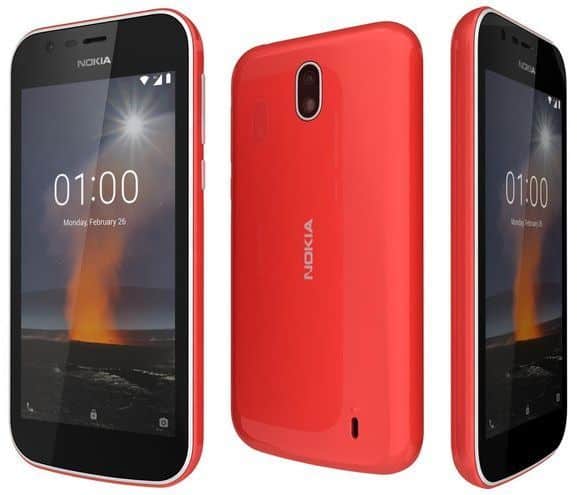
The Nokia 1 comes with a polycarbonate body, which is kinda standard for budget phones because it stays tough and keeps the price reasonable. On the back, the panel is removable , so you can get to the battery, the SIM card slots, and the microSD slot without much fuss. It’s a bit of a throwback to those older Nokia days, and honestly it gives a practical edge if you like to manage what’s inside your phone rather than treat it like some sealed box.
Dimensions and Ergonomics
In terms of size , it measures 133.6 x 67.8 x 9.5 mm and weighs 131.8 grams, so it feels compact and not too heavy. You can use it in one hand pretty easily , which helps if you’re scrolling, calling, or just browsing for a while. There is that 9.5 mm thickness though, so it feels a touch chunky , but that also helps with grip and gives the impression of being solid and sturdy.
The Nokia 1 comes with a 4.5 inch IPS LCD Display thing, and it runs at a resolution of 480 x 854 pixels. Because the resolution is kinda modest, the pixel density works out to roughly 218 PPI, so it’s not exactly super crisp in today standards. Still, for what the phone costs, it feels good enough for everyday stuff like browsing, and texting. The colors do look a bit muted, and the viewing angles have that limited vibe, but the screen itself is bright enough even outdoors.
Design Aesthetics
In terms of how it looks, the Nokia 1 keeps things simple, almost no fuss. You get a pretty typical 16:9 aspect ratio, plus a physical navigation button sitting under the display. The front-facing camera together with the earpiece are placed above the screen, and the back, on the other hand, has a single camera module along with the Nokia logo. You can also pick from a few vibrant color options like Warm Red, Dark Blue, and more, so users can match the handset to their personal style.
Nokia 1’s strength is its software – it runs Android Go, a fully-featured version of Android exclusively for low-profile devices.
With the advantage of saving system resources, Nokia 1 is expected to be the most smooth experience in the price range. So what is the reality?
Android Go – great software platform for cheap smartphones
If you are someone like me and a pure Android fan of Google, you will definitely feel very excited about Android Go. When other manufacturers try to integrate as much feature into their software as possible, a gentle Android Go, which includes only the most essential things that users really need, really brings a Very new experience.
Not only gentle, Nokia 1 also running the latest Android version Oreo 8.1, with security patch 4/2018 is also the latest. This is something that even many high-end machines can’t do, and it’s worth it to praise HMD Global.
We have a thorough analysis of Android Go’s differences that you can refer to here. Overall, with a cheap device and a weak configuration like Nokia 1, Android Go is a very suitable choice. I hope other manufacturers can also learn HMD Global to bring Android Go to more devices.
But, how good the software is cannot “save” a bad hardware
Although I really like Android Go, I can’t recommend that users own Nokia 1. The reason is that its hardware is not good enough for anyone to feel satisfied.
Nokia 1 configuration:
– CPU: MediaTek MT6737M
– RAM: 1GB
– ROM: 8GB (memory card support)
– Screen: 4.5 inches, 480×854, IPS
– Main camera: 5MP, does not support auto focus, movie recording 480p
– Secondary camera: 2MP
– Battery: 2150mAh
– Connection: microUSB, Wi-Fi 802.11 b / g / n, Bluetooth 4.2, supports 2 SIM
Performance and Software
Hardware Specifications
So, under the hood, the Nokia 1 uses a MediaTek MT6737M quad-core processor , running at 1.1 GHz. With that, you get 1 GB of RAM alongside 8 GB of built-in storage. The storage is expandable , up to 128 GB, and that’s via a microSD card. Overall the parts are pretty modest, it really feels like it was made for a budget friendly kind of phone, not for heavy power stuff.
Operating System
For the software, the Nokia 1 runs Android 8.1 Oreo ( Go edition ). It’s basically a more lighter Android setup ,designed for low-end hardware ,so it won’t feel overwhelmed all the time. Android Go is built so it can stay steady on phones that have 1 GB of RAM or even below, and it also brings stripped down versions of popular Google apps, like Maps Go, Gmail Go and YouTube Go. In day to day use, the system feels pretty smooth , for the most part. There’s also minimal extra clutter , and it leans very close to a near-stock Android vibe.
Performance and Usability
Because the specs are entry-level, the Nokia 1 really fits casual usage. It does the usual stuff like calls, messages, and simple web pages without much drama. Still, once you get into more demanding apps, or if you try to multitask, that’s where it can get a bit rough. Some apps might load slower than you would expect, and you may notice small pauses , or mild stuttering when jumping between apps, especially with heavier applications running. Performance is decent for the price, but yeah, it’s smart to keep your expectations steady about speed, responsiveness, and overall smoothness.
Camera Quality
Rear Camera
The Nokia 1 comes with a 5 MP rear camera , with an f/2.4 aperture. It’s a pretty basic setup, and yeah you can see that right away in the results. In decent lighting it works well enough , giving images that look acceptable, with pretty solid color accuracy. But once the light gets worse, the whole thing kinda falls apart, the photos turn grainy, and the finer detail just isn’t there anymore.
Front Camera
For selfies on the front, the Nokia 1 has a 2 MP camera. This one is even more minimal. It’s fine for casual video calls or quick snapshots, but the overall image quality feels weak. A lot of the small details disappear, and noise shows up in most of the images, pretty consistently.
Camera Software
The camera software is simple , and generally easy to navigate. You get the usual photo and video modes, but nothing more advanced like manual controls, or any really extensive editing tools. If you want a no drama camera experience, with fewer extras, then the Nokia 1’s camera software is more than enough.
Nokia 1 – Android One (Go Edition) – 8 GB – Dual SIM LTE Unlocked Smartphone (AT&T/T-Mobile/MetroPCS/Cricket/H2O) – 4.5″ Screen – Dark Blue: Buy it now
The biggest problem of Nokia 1 is its performance. Although running an optimized operating system for devices with weak configurations, don’t forget that there are still 2.8 million applications on the Play Store. Not every application will have a “Lite” version for weak configuration machines, and not all developers will spend time and effort to optimize the application on low-cost devices.
When using the basic features of Android as the main screen, the accompanying applications (Phone, Message …), the device runs quite well. However, when it comes to third-party applications, it seems to be quite slow. This is especially obvious for the game, when popular titles like CrossFire Legends, Lien Quan Mobile are all very low fps and can be said to be impossible to play. Overall, the Nokia 1 is only suitable for casual games, and for performance requirements games, this device is completely inappropriate.
In addition, Nokia 1 has a lot of hardware limitations that no software can fix. In particular, all three factors considered the most important of a phone today are design, screen and camera are cut to the maximum.
This machine is made entirely of plastic. Although Nokia tried to “compensate” with a variety of colorful colors, it did not make the cheap feeling disappear. The only possible plus of this design is the removable back and battery cover, making this the only rare device on the market that users can easily change the batteries themselves.
The Nokia 1’s screen, although advertised as IPS, is probably the lowest quality IPS screen you (or manufacturers) can afford. With a modest resolution of 480×854 and a pixel density of 218ppi, the characters shown for sharpness are not high.
Another problem I have is a modest 4.5-inch screen, but Nokia uses a virtual navigation key, making it even smaller. The limited display area makes it difficult to enter data using virtual keyboards, touch small icons or entertainment needs.
Nokia 1’s 5MP main camera gives very fast focusing speed, simply because it … can’t focus. Since focal lengths cannot be changed, users will only be able to capture common scenes without being able to get close to the object. To be honest, the only plus point of this camera is that it … can take pictures, but in terms of quality, no one can be satisfied, even with the most easygoing people.
Battery Life
Battery Capacity
The Nokia 1 comes with a 2,150 mAh removable battery . That s kind of on the small side compared to newer phones, but for the handset’s low-power parts it works out fine. Also the removable battery thing is a pretty neat touch, because you can keep a spare on hand, if you ever need one.
Battery Performance
When it comes to how long it lasts, the Nokia 1 generally does a decent job. In lighter use, like phone calls , texting, and the occasional bit of browsing, most people should be able to make it through a full day on one charge. If you go heavier, like streaming videos or playing games , then the charge drains faster, and yeah you might end up needing a top-up before night. So overall battery endurance feels fair, especially considering the price tier.
Connectivity and Additional Features
Connectivity
For connections, the Nokia 1 kind a does the basic stuff, like 3G, Wi-Fi, Bluetooth 4.0, and GPS. The only letdown is that it skips 4G LTE, so if you’re after faster mobile data speeds, it might feel a bit annoying, I mean kinda. Still , Wi-Fi tends to stay steady, and Bluetooth works well enough for pairing with wireless accessories.
Additional Features
The Nokia 1 has a standard set of sensors, including an accelerometer and proximity sensor. It lacks more advanced sensors like a gyroscope or fingerprint sensor. The phone’s lack of a fingerprint scanner is expected given its entry-level status, and users will rely on the traditional PIN or pattern unlock methods.
Not the best machine you can buy in the price segment
Although we appreciate HMD Global’s efforts by equipping Nokia 1 with an operating system version that is very suitable for low-cost devices, Android One, however, we cannot recommend users to buy the device.
Pros and Cons
Pros
Affordable Price: The Nokia 1 is pretty cost friendly, so it stays within reach for lots of different users, even when budgets get tight.
Durable Build: The polycarbonate body, plus the back panel that you can take off , gives it a bit more toughness and everyday practicality, honestly it feels more solid in day to day use.
Android Go Edition: This version is light, and it feels tuned for low-end hardware, in a way that actually helps.
Removable Battery: You can swap the battery out , which makes long use a lot easier rather than depending on one fixed cell.
Cons
Limited Performance: The hardware feels a little underpowered, especially if you’re trying heavier apps or lots of multitasking.
Low-Resolution Display: The 480 x 854 pixel screen, is kinda behind modern expectations, it looks less sharp than you’d want.
Basic Camera: The camera is just ok at best , and in low light it really struggles.
No 4G LTE: No 4G connectivity could be a dealbreaker, if you’re counting on faster data speeds for streaming or maps.
Conclusion
The Nokia 1 really feels like Nokia showing up with something simple, and still useful, for the lower end of the market. You get a basic but still functional smartphone setup for people who want essential features without paying a lot. It won’t really win on performance, screen clarity, or photo results when you compare it to higher-tier phones, but it does a solid job delivering a dependable, durable device.
If you’re searching for an entry-level smartphone and affordability is your main thing, plus durability and a clean software vibe, the Nokia 1 deserves a look. It fits best for users who mainly want calls, texts, and light browsing, and who don’t mind giving up a bit of speed and extra features to keep the cost down. If you need more advanced capabilities then yeah, looking at higher-end models makes more sense, but for many users the Nokia 1 stays a reliable pick in the budget smartphone space.
Related Posts

Tech Reviewer & Product Analyst
Định Bia has spent over 10 years testing consumer electronics with a focus on smart technology. He work as a product advisor at Biareview where he helped customers find the right devices for their needs. He personally tests every product featured on this site using a consistent evaluation framework covering quality, durability, and value. All reviews are based on experience, not influenced by the manufacturer.