Design and Build Quality
Aesthetic Appeal
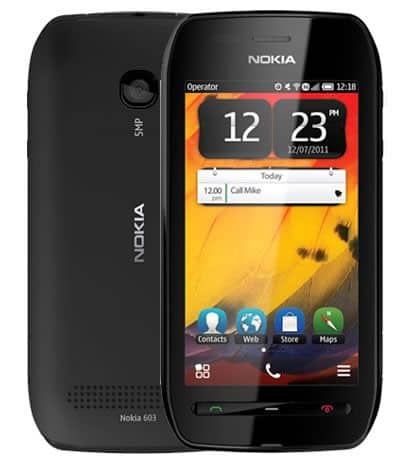
The Nokia 603 was kinda designed with vibrant aesthetics in mind, giving you several color options black , white , fuchsia , green , yellow , and blue. That choice felt pretty in line with Nokia’s tradition of making phones look distinct and kinda lively, so it would appeal especially to younger folks , or anyone who wanted to show off their personality through a device. On the front, there’s a 3.5-inch display that pretty much takes the spotlight, and the bezel plus the button placement stay minimal, no overcomplicated look there. The rear cover is removable too, and it comes with a glossy finish, which looks good but yeah it also tends to collect fingerprints and smudges, almost immediately.
Pros: Overall, the design of the Nokia 603 comes off youthful and modern. The variety of colors adds a small sense of personalization. Also the compact size helps, and the curved edges make it easier to hold, and usable with one hand without too much fuss.
Cons: That glossy back though , while attractive , ends up being like a fingerprint magnet, plus it can pick up scratches, so over time the look can fade. And even if the plastic build feels solid enough, it still does not really deliver that premium vibe you get from higher-end smartphones.
Build Quality
Nokia was pretty famous for its solid build quality, and the Nokia 603 kind of did not go off the rails here either. You got a sturdy, more or less no-nonsense construction that could take the usual little bumps and accidental drops from daily life. The back cover is plastic, yes, but it sat in place nicely, and it did n’t really creak or flex when pressure shows up. Overall it felt tough, dependable, like the whole Nokia vibe of long-running phones.
Pros: The Nokia 603’s sturdy frame helped it live through everyday wear and tear without fuss. Also the back cover pops off so battery swapping is straight forward, a practical little thing for people who actually change batteries.
Cons: Since the body was plastic, it might not feel as “premium” as the metal or glass looking finishes you’d see on more expensive smartphones. Plus the glossy back finish is kind of slick, so there’s an extra chance of it sliding out of your hand.
Display
Screen Specifications
The Nokia 603 came with a 3.5-inch IPS LCD display, 360 x 640 pixels resolution so kind of 210 ppi. Back then it was a pretty common choice for mid-range phones, giving okay-ish sharpness, and clarity for everyday things like web pages messaging, and just looking at photos. It also supported 16 million colors which helped with lively, pretty accurate color output.
Pros: The IPS LCD tech gave decent viewing angles, and the colors stayed more stable even when you look from the side. The screen brightness was also enough outdoors, so it stays usable across different lighting conditions.
Cons: While the display was adequate for most tasks, the 360 x 640 resolution was sort of starting to feel outdated, compared to those higher-resolution screens that competitors were offering. The pixel density was, ok, but it still wasn’t high enough to bring that same kind of crispness you’d notice on more premium devices.
Touch Responsiveness
The capacitive touchscreen on the Nokia 603 was responsive and supported multitouch gestures too , so it made it easier to move around the Symbian Belle interface. The screen reacted well to taps and swipes , and there was minimal lag or delay. That part helped create a smoother feeling user experience, overall.
Pros: Touch responsiveness was generally good, giving a fluid and smooth interaction with the phone’s interface.
Cons: Even so, the touchscreen felt a bit cramped at times, mainly because the display size was small, if you were used to larger screens. This came up especially while typing, or when you were trying to navigate more complex apps.
Sunlight legibility
One of the good parts about the Nokia 603 ’s display was how it handled sunlight, like it stayed readable even when you’re out there in direct sun . The brightness ended up being enough to keep the text and icons visible , and that was a real advantage for people who used their phones outdoors a lot .
Pros: Because it had that solid sunlight legibility, the Nokia 603 felt more usable across different lighting situations, especially the harsh kind , you know bright outdoor areas.
Cons: Even though the brightness was decent, the glossy panel still picked up reflections fairly easily, so in the very bright moments it could be a bit of a pain, like you couldn’t quite see the screen as clearly as you’d want.
Performance
Processor and RAM
The Nokia 603 ran on a 1.0 GHz ARM11 processor, with 512 MB of RAM along with it. Together they gave enough oomph to run the Symbian Belle operating system and most apps that people typically found on that platform . It wasn’t exactly a powerhouse, but the kit matched what you’d expect for a mid-range phone, and it covered the intended use, pretty well really.
Pros: That 1.0 GHz processor plus 512 MB RAM meant the Nokia 603 did, okay-ish, for daily stuff like texting, casual web surfing, and using simple apps. It wasn’t blazing fast but it worked in a pretty calm way most of the time.
Cons: Still, the hardware was pretty restricted next to stronger smartphones. Especially with multitasking, or if someone tried to juggle heavier apps. People could notice lag or stutters when multiple applications were open at once, or when doing something more demanding.
Storage
The Nokia 603 shipped with 2 GB of internal storage, which was kinda small even for that period. On the bright side, there was a microSD card slot so users could expand capacity by as much as 32 GB. That kind of upgrade mattered a lot for anyone who wanted to keep more software, pictures , music, and other media right on the device instead of leaving it out.
Pros: Having the microSD card slot, honestly, offered that good kind of flexibility , like customizing space to match personal needs without too much trouble.
Cons: The 2 GB internal space was still cramped, and it wasn’t “empty” either , because the operating system and preloaded apps already took part of it. So users would probably end up buying a microSD card pretty soon, otherwise it’s easy to feel like storage disappears fast.
Graphics and Gaming
The Nokia 603 came with a Broadcom BCM2763 GPU, an setup that was honestly enough for doing the basic graphics stuff and casual gaming. It could not really cope with the graphically heavy titles that people played on other platforms, but it did manage the simpler games and day to day applications on Symbian, without too much trouble.
Pros: it handled casual games pretty well, plus the basic graphics tasks too, so for light gaming it still felt practical.
Cons: the graphics power was still kind of limited compared to newer and more powerful devices, so the Nokia 603 often struggled when games got more demanding. Also Symbian’s app selection was rather narrow which meant users had fewer gaming choices than on iOS and Android.
Camera
Primary Camera
On the Nokia 603 you get a 5-megapixel fixed focus back camera , and honestly that was pretty standard for a mid range smartphone around that time. It can capture up to 2592 x 1944 pixels, and it came with the usual familiar touches like geo tagging, face detection, and even a panorama mode as well.
Pros: The camera feels able enough to pull decent photos when the lighting is decent, and the colors looked quite natural, with a fair amount of detail. The panorama mode, kind of gave you a bit more wiggle room in what you could shoot overall.
Cons: The lack of autofocus, was a major limitation, it made it pretty hard to get sharp results, especially for close-up scenes, or whenever you needed precise focusing. And yeah in low light it did not perform well either, the camera struggled to collect enough information without turning it into visible noise and that grainy texture.
Video Recording
The Nokia 603’s camera could record video at 720p, at about 30 frames per second, which is honestly a respectable option for a mid-range phone. The video result was decent, with fairly smooth frame pacing and acceptable detail if you just want something for everyday moments.
Pros: Recording 720p HD video was a good point, it let people capture clips with solid definition and clarity, for the most part.
Cons: Even so, the video quality wasn’t exceptional, and the missing autofocus meant the image could lose crispness while recording. In darker rooms, the camera struggled again, so videos made in dim conditions ended up looking worse than expected.
Front Camera
So, the Nokia 603 didn’t have a front-facing camera, which honestly was pretty glaring at the time ,since video calling and selfies were getting more popular by the day. Because of that, the handset felt a bit less attractive for people who wanted quick video chats or self portraits on the go. It’s one of those limitations that, you kinda notice fast.
Pros: N/A
Cons: The lack of a front camera was a meaningful downside, mainly for users who cared about snapping selfies or joining video calls.
Software and Ecosystem
Symbian Belle Operating System
The Nokia 603 was compatible with Symbian Belle , which is kind of a bumped up take on Nokia’s older Symbian operating system. Belle arrived with quite a few upgrades compared to Symbian Anna, like a fresher user interface, smoother multitasking, and more options for adjusting the look and feel. Also it kind of felt more responsive in day to day use. Overall, the platform was aimed at being easy to use, with the idea of keeping things feeling steady , and intuitive.
Pros: Symbian Belle turned out to be a notable step up from older Symbian builds, giving a more refined, snappier experience. Also, its multitasking tools were quite capable ,so switching between apps felt uncomplicated and quick.
Cons: Even with the improvements, Symbian Belle sort of stayed behind iOS and Android when it came to app availability, and also overall functionality. The platform’s narrow app ecosystem was a real downside, users had fewer options for tweaking things and productivity compared to Android and iOS. This drawback in the app world became even more obvious once developers started leaning toward those more mainstream platforms. In the end, Symbian users were left with a shrinking selection of applications.
User Interface and Experience
The user interface of Symbian Belle was meant to feel more touch-friendly than its earlier versions. There were multiple home screens , and people could customize them with widgets, shortcuts,and folders which made the daily use feel a bit more personal. The notification bar was improved too, with quicker access to settings and notifications, in a way that already felt familiar from Android.
Pros: The customization abilities in Symbian Belle let users shape the interface more closely to their own preferences , so it ended up feeling more approachable. With the multiple home screens plus widgets, it was also easier for users to reach frequently used features and info without too much digging.
Cons: Still, even with all that work, the interface felt a bit old-fashioned compared to the smoother, more intuitive looks from other platforms. Some users also mentioned that the navigation and menu layouts felt less direct , and certain tasks seemed to take extra steps, like more taps than necessary.
App Store and Availability
The Nokia 603 had access to the Nokia Store, which was previously called Ovi Store, being Nokia’s official app marketplace. The store did have a decent range of apps games, and utilities but overall it was way less packed than Google Play or the Apple App Store. A lot of well known apps were either straight up missing , or they showed up as less refined builds on Symbian. This is kind of what made the phone a bit less attractive to people who really care about apps first, you know.
Pros: Nokia Store gave you a solid selection for everyday stuff, like productivity add ons, social media , and entertainment.
Cons: The main issue was the lack of options, and that many popular applications weren’t there. As developers started putting more effort into Android and iOS , Symbian tended to get sidelined. So users ended up with fewer choices, and less backing for newer tech and patterns.
Connectivity
Network Support
The Nokia 603 supported GSM, HSDPA, and 3G networks so voice and data services worked in a fairly dependable way. It also included Bluetooth 3.0 and Wi‑Fi 802.11 b/g/n, which meant you could stay online or connected in different places , from home, to work, or while moving around.
Pros: For its era the network support was pretty strong, especially with coverage, and data performance on 3G. Bluetooth plus Wi‑Fi also gave you flexible ways to connect devices or share things.
Cons: Even though the 3G coverage was acceptable, there was no 4G LTE. So the phone couldn’t really benefit from the quicker data speeds that were showing up more often around that time.
NFC (Near Field Communication)
One of the more noticeable things about the Nokia 603 was that it came with Near Field Communication (NFC), a kind of tech that was still kinda fresh on smartphones back then. NFC let you do quick and pretty effortless sharing of content between compatible devices, and in some cases it could also support mobile payments and a few other up and coming uses.
Pros: Having NFC felt kinda forward-leaning, since it gave people a way to try different ways of interacting, not just with the phone, but with other electronics as well.
Cons: Still though, even with NFC there, the take up was in early days, and honestly there were few chances to really use it in a full sense. Because support for NFC payments and services wasn’t super common, many users might not have felt this feature was instantly practical.
GPS and Navigation
The Nokia 603 included A-GPS support, so it worked as a decent option for navigation and location type functions. On top of that Nokia Maps (later rebranded as HERE Maps), Nokia’s own navigation software, was already there. It offered offline map coverage, turn-by-turn guidance, and a range of location-based services, so you weren’t only stuck with online directions.
Pros: The GPS performance came off as dependable, and adding Nokia Maps was kinda a big deal, it gave a broad and easy to use navigation flow. Also being able to download maps for offline use was especially handy for people traveling around without constant coverage.
Cons: Even if the navigation stuff was pretty solid, it didn’t feel as tightly fused into the overall experience, or as polished as what you get from Google Maps on Android devices.
Battery Life
Battery Capacity and Performance
The Nokia 603 had a detachable 1300 mAh battery, which is not huge, not really, by current standards, but it still delivered pretty decent battery behavior alongside the phone’s hardware and software. Nokia said the battery could last as long as 16 hours of talk time on 2G, 7 hours on 3G, and up to 490 hours on standby on 3G.
Pros: Battery performance was usually good, the handset would more or less run through an entire day with moderate usage. The removable battery was also genuinely useful since users could swap it without much fuss if something needed replacing later.
Cons: Still, the battery endurance, while fine, wasn’t really outstanding, especially compared with newer smartphones that pack bigger batteries. If someone was a heavy user, or kept leaning on data hungry applications, they might end up needing a top up before the day was over.
Charging Time
The Nokia 603 charged through a standard micro‑USB port , which was kinda normal for that era. In general the charging times were average, like it usually needed roughly 2-3 hours, to go from an empty state to a full charge.
Pros: Having the micro‑USB port meant it was easy to grab compatible charging cables and add‑ons without much hassle.
Cons: The charging speed felt rather slow, especially next to the fast charging methods that were just starting to show up around then.
Multimedia Capabilities
Audio Quality
The Nokia 603 came with a built‑in music player plus an FM radio, so it was a decent little gadget for media, at least for basic listening. Sound from the internal speaker was okay , not amazing though. It delivered clear audio , but it could sound a bit tinny or thin. Also included was a standard 3.5mm headphone jack , which let you plug in your own headphones, or even external speakers if you wanted.
Pros: The 3.5mm headphone jack was a good win, it gave users more choice with their audio gear. The music player was straightforward and it supported a range of file formats.
Cons: The built‑in speaker wasn’t anything special, bass was limited , and the loudness wasn’t very strong. People who care a lot about richer sound, or anyone wanting a more immersive listening vibe, likely would feel it falls short.
Video Playback
The Nokia 603 could handle videos in common formats like MP4 and H.264, and it supported up to 720p resolution. The video player worked without fuss, with basic play controls so you could watch clips while you’re out.
Pros: Being able to play 720p videos was definitely a nice feature, especially since the phone was more mid-range sort of in spirit. The whole playback experience stayed smooth too, like there wasnt any real stuttering or annoying lag, at least not in a noticeable way.
Cons: The 3.5-inch screen, while fine for watching stuff, felt kinda tight for longer sessions. And yeah, the internal storage being limited meant youd probably end up leaning on a microSD card for keeping your video collection.
Camera Integration with Social Media
Symbian Belle came with built in sharing options so you could upload photos and videos pretty fast, to social media sites like Facebook and Twitter. In practice, it was the kind of convenience youd want if you were always on the move and just wanted to post without much delay.
Pros: Those built in sharing tools made it easy to upload content straight from the camera, or even from the gallery apps, instead of doing extra steps.
Cons: But, the camera quality itself kind of held the whole thing back. People who cared a lot about crisp, high-quality photos might have felt let down, because the results were not that impressive.
Conclusion:
Overall, the Nokia 603 felt like it was stuck between two realities. On one side, there was the classic Nokia era, where mobile phones were mostly about hardware and durability. On the other, there was that shift toward software-first smartphones, the one being pushed by companies like Apple and Google. So yes, it was a dependable phone with a few clever features, but it also got sidelined pretty quickly once the mobile tech scene started moving faster and faster.
Nokia 603 Factory Unlocked GSM Symbian OS 3G Touchscreen Smartphone – Blue/Black: Buy it now
Related Posts


Tech Reviewer & Product Analyst
Định Bia has spent over 10 years testing consumer electronics with a focus on smart technology. He work as a product advisor at Biareview where he helped customers find the right devices for their needs. He personally tests every product featured on this site using a consistent evaluation framework covering quality, durability, and value. All reviews are based on experience, not influenced by the manufacturer.