Best Phones for Battery Life in 2026 – All-Day, Multi-Day Picks Tested
In 2026, smartphone battery life kind of did a quiet revolution. For years, manufacturers were chasing thinner chassis, but then the endurance part kinda suffered. This year, the broad adoption of silicon–carbon (Si-C) anodes gave brands a way to stack massive capacities—like 6,000 mAh and up to 10,000 mAh – into normal sized devices, while still keeping the overall body pretty sleek, not suddenly bulky or anything.
Our Real-World Testing Protocol
To mimic actual daily use, each phone was tested with the exact same active conditions:
- Connectivity: real 5G networks, switching between stronger and weaker signal zones, plus Wi‑Fi still left on, in practice
- Display: Adaptive or Dynamic Refresh Rate, up to 120Hz or 144Hz, brightness kept at 400 nits (outdoor readable… pretty much)
- The Workflow Loop: about 1 hour of Google Maps turn-by-turn navigation then 2 hours of continuous video streaming (YouTube/TikTok), after that 1 hour of heavy 3D gaming (Genshin Impact / Honkai: Star Rail) → then another hour of mixed social media scrolling and camera use, and it just keeps going until the phone hits 0% .
Real-World Battery Drain Results (Tested May 2026)
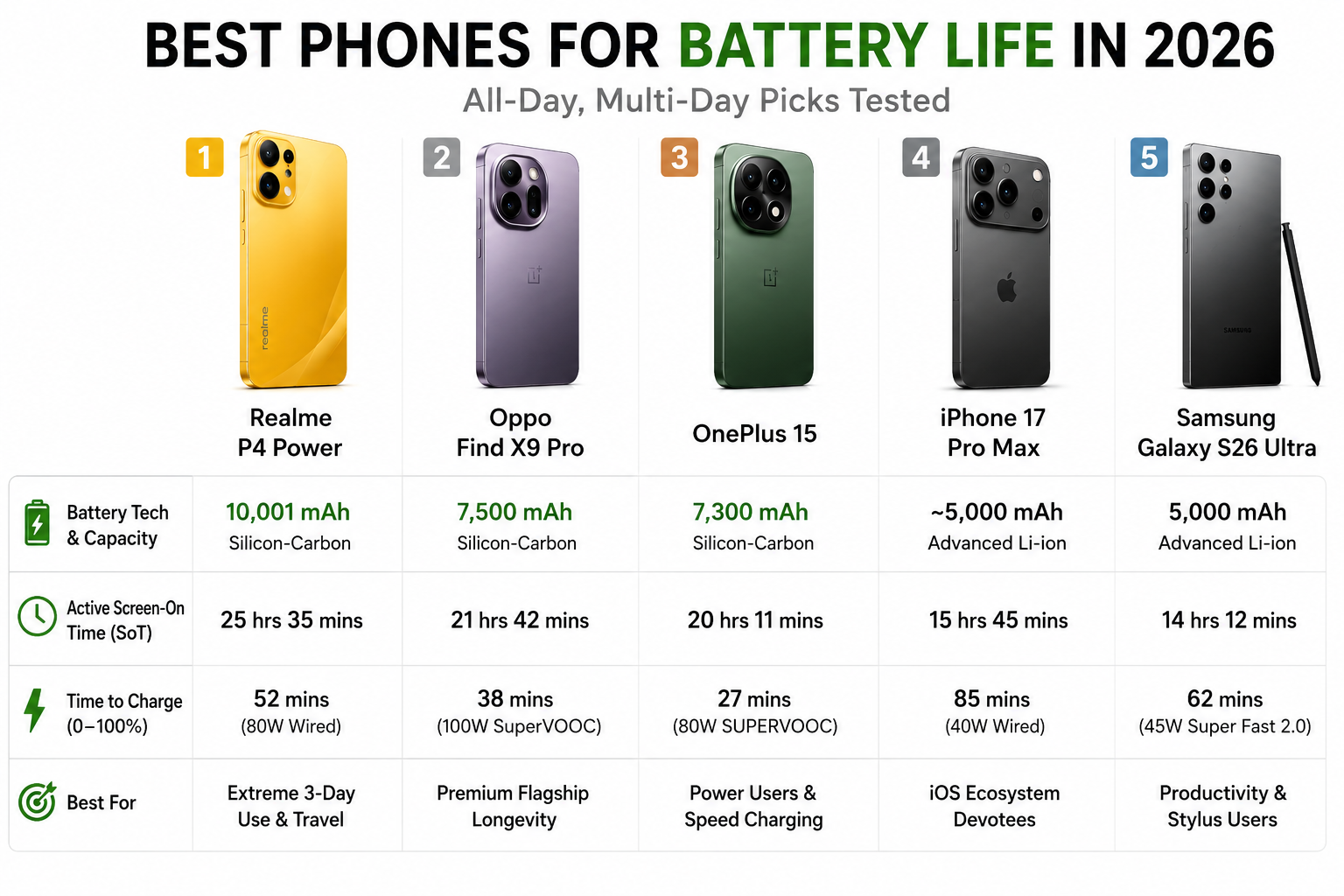
| Rank | Smartphone | Battery Tech & Capacity | Active Screen-On Time (SoT) | Time to Charge (0-100%) | Best For |
| 1 | Realme P4 Power | 10,001 mAh Silicon-Carbon | 25 hrs 35 mins | 52 mins (80W Wired) | Extreme 3-Day Use & Travel |
| 2 | Oppo Find X9 Pro | 7,500 mAh Silicon-Carbon | 21 hrs 42 mins | 38 mins (100W SuperVOOC) | Premium Flagship Longevity |
| 3 | OnePlus 15 | 7,300 mAh Silicon-Carbon | 20 hrs 11 mins | 27 mins (80W SUPERVOOC) | Power Users & Speed Charging |
| 4 | iPhone 17 Pro Max | ~5,000 mAh Advanced Li-ion | 15 hrs 45 mins | 85 mins (40W Wired) | iOS Ecosystem Devotees |
| 5 | Samsung Galaxy S26 Ultra | 5,000 mAh Advanced Li-ion | 14 hrs 12 mins | 62 mins (45W Super Fast 2.0) | Productivity & Stylus Users |
Deep Dives: The 2026 Battery Champions
- The Multi-Day Monster: Realme P4 Power
The Verdict: kind of a total juggernaut, it really changes what “standard” phone endurance is supposed to look like on one single charge.
Realme surprised the whole scene by sliding in a 10,001 mAh silicon-carbon battery inside a frame that feels no thicker than one of those regular rugged cases. And with the very efficient MediaTek Dimensity 7400 Ultra running the show, it just… didn’t quit during our testing, like at all.
Real-World Experience: During our intense daily workflow it easily sailed past a full day, then an entire second day and into night three, before it finally powered down. Even after a whole hour of heavy 3D gaming, the battery level barely moved, it dropped only 4% and that was it.
Charging Caveat: Sure, 80W charging brings this huge cell back to 100% in under an hour, but the phone does get noticeably warm during the busiest parts of charging periods, especially when it’s really ramping up.
- The Premium Endurance King: Oppo Find X9 Pro
The Verdict: Honestly, you don’t have to give up top-tier flagship cameras, or that peak processing might, just to get battery life that lasts for multiple days, which is kind of wild.
The Find X9 Pro utilizes a 7,500 mAh silicon-carbon anode paired with a highly optimized 3nm processor. Unlike budget battery phones, Oppo preserves every premium feature here: a gorgeous LTPO OLED panel and dual 200MP periscope cameras.
- Real-World Experience: It cruised through 21.5 hours of active, continuous use. Its standby power management is incredibly tight; leaving the phone off the charger overnight resulted in a 0% drop.
- The X-Factor: The 100W SuperVOOC charging is highly efficient, filling this massive tank to full in just 38 minutes without generating excessive heat.
- The Best All-Rounder: OnePlus 15
The Verdict: this is probably the most practical battery pick for the typical person, it mixes a 7,300 mAh cell with charging that feels like it’s going a bit too fast, maybe blistering is the right vibe.
OnePlus uses its own Silicone Nanostack method, and somehow it squeezes a 7,300 mAh battery into an extremely slim flagship chassis. Alongside that, you get the Snapdragon 8 Elite Gen 5, so peak speed and top-tier battery thrift can sit together, no drama.
- Real world Experience: during my testing it pulled past 20 hours of continuous screen-on time. It stays calm while you record 4K video, and it also manages heavy background sync without that fast drain feeling.
- Rapid Top-Ups: if you miss charging, and you’re like ok fine, just plug it in for 15 minutes, you should see around 45% capacity back. That’s usually more than enough for a normal workday, honestly.
- The iOS Zenith: iPhone 17 Pro Max
The Verdict: A kinda unmatched optimization that squeezes every last drop of juice out of what is, physically speaking, a smaller capacity in the first place.
Apple basically stepped out of the whole massive silicon-carbon capacity race, sticking with a more refined, classic lithium-ion setup around 5,000 mAh. Still, the combination between iOS 26 and the 3nm A19 Pro chip delivers this really standout efficiency, like you can feel it day to day.
- Real-World Experience: Even with a battery capacity that’s roughly half of the Realme P4 Power it lasted, an impressive 15 hours and 45 minutes on our workflow loop. It keeps background apps moving and social media scrolling going with noticeably less power demand than most Android alternatives.
- The Bottleneck: Apple is still behind in raw charging speeds though. Waiting close to an hour and a half to get fully topped up feels kinda sluggish, especially compared to what the 2026 Android ecosystem is offering.
Buy on Amazon
OnePlus 15 — 256GB, Unlocked
4.6 (250+ ratings)
- Massive 7,300 mAh Battery – Go longer between charges with power that lasts all day and beyond.
- Tri-Chip System – Combines the Snapdragon 8 Elite Gen 5 with our dedicated Wi-Fi chip, and CPU scheduler for faster performance, smoother connectivity, and superior efficiency.
- Triple 50 MP Camera System – Capture every detail with wide, ultra-wide, and telephoto versatility.
- Our Most Durable Phone Yet – Built tough to resist dust and water for reliable everyday protection. IP66/IP68/IP69 and IP19K rated.
- 6.78″ 165 Hz AMOLED Display – Experience vivid colors, ultra-smooth motion, and stunning clarity.
Link may contain affiliate commission
Buy on Amazon
iPhone 17 Pro Max — iOS 26, A19 Pro Chip
- BRILLIANT 6.9-INCH DISPLAY: Stunning screen paired with an aluminum unibody design that creates massive additional battery capacity for all-day use.
- A19 PRO CHIP: The most powerful iPhone chip yet, delivering up to 40% better sustained performance for demanding tasks and seamless multitasking.
- ALL 48MP REAR CAMERAS: Features 8x optical-quality zoom — the widest zoom range ever in an iPhone — plus Dual Capture for simultaneous front and rear video recording.
- BEST-EVER BATTERY LIFE: Enjoy up to 39 hours of video playback, and recharge up to 50% in just 20 minutes with fast charging support.
- ADVANCED PROTECTION & CONNECTIVITY: Ceramic Shield back is 4x more resistant to cracks; Ceramic Shield 2 front offers 3x better scratch resistance; plus Wi-Fi 7, 5G, Bluetooth 6, and eSIM support.
Link may contain affiliate commission
Buy on Amazon
Samsung Galaxy S26 Ultra — 256GB, Unlocked
$1,299.99
Save $250
4.6 (919+ ratings)
- PRIVACY DISPLAY: Automatically hide your screen from those beside you. The built-in privacy display can be preset¹ to turn on when receiving notifications, typing passwords, or using specific apps
- TYPE IT IN. TRANSFORM IT FAST: Enhance any shot in seconds on your smartphone by using Photo Assist² with Galaxy AI.³ Add objects, restore details, or apply new styles by simply typing or tapping
- NIGHTS, CAPTURED CLEARLY: From gigs to city lights, record and capture moments after dark with clarity using Nightography so your photos and videos stay crisp and clear on your Samsung Galaxy
- MAKE IT. EDIT IT. SHARE IT: Turn everyday moments into something personal with creative tools built right into your mobile phone, whether it’s a special contact photo, custom wallpaper, an invitation or more⁴
- HELP THAT KEEPS UP: Stay in the moment while Now Nudge with Galaxy AI helps you respond faster and stay organized with smart suggestions⁵ that appear exactly when you need them on your phone
- FIT EVERYONE IN THE SHOT: Group selfies are easier on your Samsung phone with a wider front camera⁶ that captures more of the scene, so no one gets left out of the moment
- FAST. POWERFUL. AI-READY: Power through your day with AI-accelerated performance from our fastest, smoothest and most powerful Galaxy processor yet, built to keep up with everything you do
Link may contain affiliate commission
Critical Insights: how to choose your next phone
When you’re scanning the market in 2026, keep these little structural changes in mind before you commit:
- Silicon-Carbon is the New Standard: If multi-day battery endurance is the real priority, aim for devices using Si-C, or carbon-silicon batteries. These can fit up to 40% more energy density than traditional lithium-ion cells in the same physical space, so it’s not magic but it is meaningful.
- 5G signal strengths matter: In our field tests, phones working in weak 5G regions drained as much as 25% faster, mainly because their modems are constantly spiking in power trying to hunt for a stable link. If you are moving through low-signal zones, dropping to 4G LTE can still save you hours of screen-on time.
- Don’t fall for the “mAh” trap alone: Like we saw with Apple and Samsung, software optimization, display tech (LTPO panels that can dip to 1Hz during static content), and chipset architecture all play a similar role in overall staying power, it’s never just the number.
Samsung Galaxy S26 Ultra after one month of experience
Related Posts





Tech Reviewer & Product Analyst
Định Bia has spent over 10 years testing consumer electronics with a focus on smart technology. He work as a product advisor at Biareview where he helped customers find the right devices for their needs. He personally tests every product featured on this site using a consistent evaluation framework covering quality, durability, and value. All reviews are based on experience, not influenced by the manufacturer.