Design, monitor and hardware
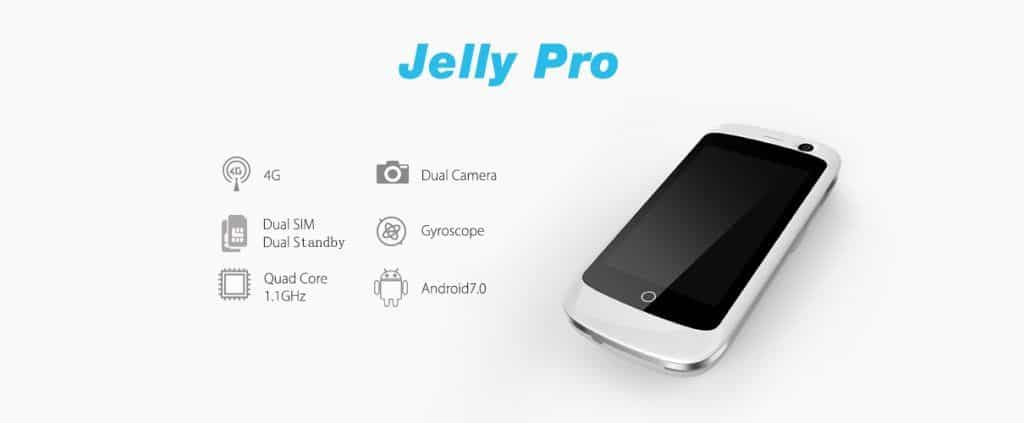
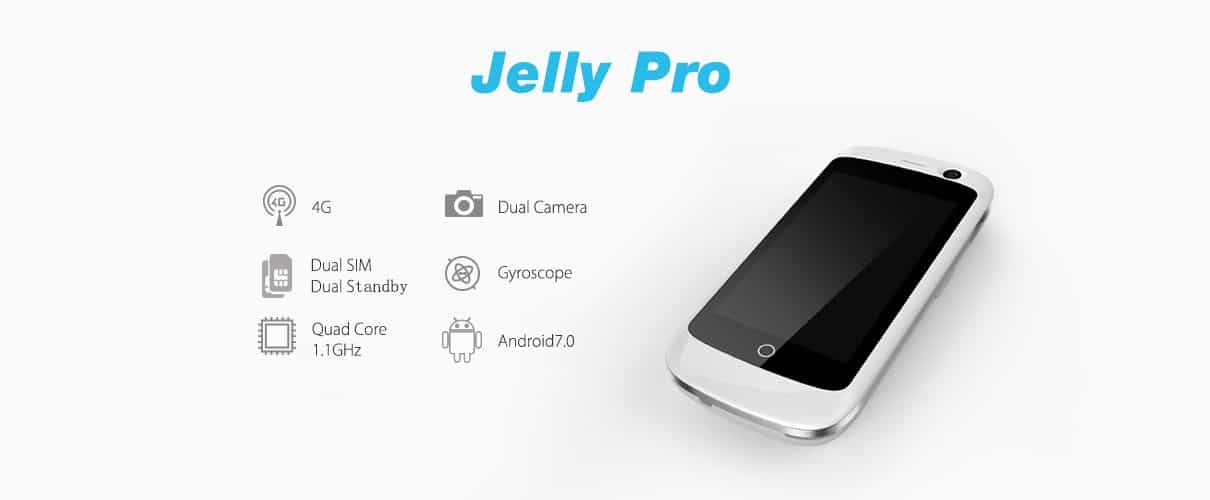
The first thing you’ll be impressed with is the size of the Jelly Pro. This phone is compact and can easily place on your hand, but it uses plastic material so the feel of grip is not that great. It has a 2.45-inch screen (240×432 pixels) – smaller than most smartphones on the market today. The display is average and the color is not as good as expected. Of course, Jelly Pro is not ideal for you to watch videos or play games. It comes with another mission.
There are three capacitive touch buttons below the screen, one of which is the round button home. All these buttons provide tactile feedback. The phone has curved edges on all sides. This makes it easy to use Jelly Pro with one hand in the simplest way. It is also not the smallest smartphone in the world when it is 92.3mm in length, 43mm in width and 13.3mm in thickness.
On the right is the power button and micro USB port. The volume down buttons on the left while the 3.5mm jack is located at the top of Jelly Pro. The phone also has a metal rim running around the body. Behind you will find an 8MP camera with LED flash. Unihertz branding and speakerphone at the bottom. It’s not really big enough but you can hear everything from the phone.
Beneath the removable battery, there are two nano dual SIM slots and a micro SD memory card slot for storage. In addition to the memory available, you can expand it up to 256GB.
Camera
The 8MP rear camera on the Jelly Pro will of course not be for those who are passionate about photography. Average quality, poor detail is what you might encounter with images captured from the phone. It has a macro mode, but the HDR is not very impressive. 2MP front camera is not for those who like selfie because it lack of beauty or smooth skin.
Software, user interface and applications
This phone comes with pre-installed apps like Gmail, Chrome, and Maps. Surprisingly, the YouTube app is not yet available, and you will need to download it from the CH Play app store. Users also have several other apps such as the Pedometer, FM Radio, Flashlight and Sound Recorder, Music and Pictures …
The phone has two SIM card slots. Both SIMs support 4G, but you can enable 4G in one SIM at a time, while the other SIM will be 2G. Other connectivity options include Wi-Fi, GPS, and Bluetooth 4.0.
The quality of the call is clearly the advantage of Jelly Pro but the message is not great for it. Baby monitors will make the display keys very small and no less annoying for people with large fingers. You can use the Gboard or SwiftKey with swipe gestures to avoid repeated errors when texting.
Unihertz Jelly Pro, The Smallest 4G Smartphone in the World, Android 7.0 Nougat Unlocked Smart Phone with 2GB RAM and 16GB ROM, Sky Blue: Buy it now
Performance and Benchmarks
Jelly Pro is set up with a MediaTek MT6735 chip and it includes 2GB. It also has an ARM Mali-T720 graphics unit. Day to day it feels fairly smooth on the phone, but once you push heavy applications, it can start to stutter and it might even close the app on its own, kinda suddenly. The point that I like on Jelly Pro is that it does not heat up even though it’s been used for a long time.
The battery
Jelly Pro has a removable battery capacity of 950mAh and can last up to three days in a single charge. In fact, the calls made by the smallest smartphone in the world come down faster. In addition, the Jelly Pro’s battery life in the standby mode is slow and can be used comfortably for a long day. There are several battery saving options that will help you extend the battery life for longer periods of time.
Connectivity: A Compact Device with Modern Features
Network Support:
The Jelly Pro can handle a pretty wide set of network bands, including 4G LTE. so it’s generally in line with a lot of GSM networks across the globe. It’s also a dual-SIM gadget, meaning you can run two SIM cards at the same time. This is especially handy for travelers , or for folks who want to keep work numbers and personal numbers separate. That said, there’s a small catch, the device only gives 4G LTE on one SIM slot , while the other slot is stuck with 3G or even 2G depending on what’s available.
Wi-Fi and Bluetooth:
On the Wi‑Fi side, the phone supports 802.11 b/g/n, which is pretty typical for phones in the budget segment, sort of. It usually behaves well on 2.4GHz networks and stays dependable, but on the other hand it does not really support 5GHz at all. So if you’ve got a dual-band router at home , and you like the cleaner less crowded 5GHz air , you won’t be able to take advantage of that here. Still, for everyday stuff like browsing, video watching, or social media, the Jelly Pro’s Wi‑Fi should be fine and “good enough”.
For Bluetooth, it includes Bluetooth 4.0. This means you can pair wireless headphones, small speakers and other add-ons. It’s not the newest Bluetooth generation, but it tends to work steadily for most real-world scenarios, like playing music, or taking hands-free calls while you’re on the go.
GPS and Navigation:
The Jelly Pro has GPS, A-GPS, and GLONASS support, so it can track location and help with navigation in a pretty accurate way. Even though it’s tiny, it still works decently as a GPS device , it locks onto satellite signals fairly fast and then gives directions that feel on point. So for people who want a small, easy-to-carry setup for route guidance, walking, cycling or driving, it’s honestly a pretty solid option.
Still, the screen is small , like really. That means when you use navigation apps such as Google Maps , the map itself is more difficult to read, and the on screen controls are smaller too. You might get the occasional mis-tap because of that. But overall, for simple navigation tasks, or as a backup “GPS thing” when needed , the Jelly Pro is surprisingly capable.
USB OTG:
One cool thing about the Jelly Pro is the USB OTG (On-The-Go) support. With that you can plug in external USB devices like flash drives , keyboards, or even game controllers to the phone. And yeah, because the internal storage is kinda limited, this becomes a handy trick to add extra room, or basically shuttle files around. However, in practice, using USB OTG on such a small device is kinda limited, it feels more like a neat extra than something you’ll rely on every day.
Storage: Not Much, But Expandable-ish
Internal Storage:
The Jelly Pro ships with 16GB of internal storage, but only about 12GB is really usable for the user once the operating system and pre installed apps are taken into account. By modern standards, that’s not a lot, and it can fill up faster than you’d hope if you install multiple apps, capture lots of photos , or keep media files stored on the device.
Expandable Storage:
Luckily, the Jelly Pro does have expandable storage, using a microSD card slot, so you can toss in up to 256GB of extra space. That’s kinda a big deal if you’re the type who keeps lots of photos and videos, music, or even more apps than you probably should. The microSD card slot sits underneath the removable rear cover, right near the dual SIM card slots, so it all feels kind of tidy in a “here it is” way.
Even if this expandable bit is a nice touch, it’s still good to remember that not every app will actually move over to the microSD card. So if you plan to install heavier games, or large applications, then keep an eye on the internal storage situation. In other words , plan ahead and manage your files from early on.
Software: A Near-Stock Android Experience
Operating System:
The Jelly Pro runs on Android 7.0 Nougat, which is not exactly the newest Android, but it still feels pretty current even if it’s a bit, yknow, behind. The look and feel of the menu is pretty close to stock Android, with only light tweaks from Unihertz, so it’s kind of familiar, in a calm way. This “almost normal” approach helps the device feel smoother too, since the hardware is modest, and it doesn’t really have room for heavy software changes.
Pre-installed Apps:
On the Jelly Pro, there’s very little bloatware. You mostly get a handful of practical apps already there, like the Google lineup (Gmail, Maps, YouTube, and similar), plus a basic file manager, and a straightforward camera app. Honestly, this is a good sign, because it saves usable space for you, and it also reduces the extra strain on the device’s limited resources, at least compared with phones that cram everything in.
Software Updates
One of the drawbacks with the Jelly Pro is, well, the software update policy. Unihertz is a smaller manufacturer, so it does not really have the same resources that bigger companies get to provide frequent software updates or the next upgrades to newer Android versions. Right now, there is no official word about if the Jelly Pro will ever get an update to Android 8.0 Oreo , or anything after that. so, this may mean users end up missing out on new features, security patches, and those performance improvements that usually show up with newer Android releases.
Customization and Features
Even with a near-stock Android experience, the Jelly Pro still comes with a few basic customization choices. Think themes, wallpaper, and different home screen layouts. Also, users can lean on Android’s built-in tools like split-screen multitasking, Doze mode for battery optimization and Google Assistant for voice commands. It’s not exactly a deep customization dive, but it’s enough for day to day tweaking.
User Experience: A Niche Device with Specific Appeal
Portability
If we’re talking about what really stands out, the Jelly Pro portability is the main thing. It’s basically a device that can go anywhere with you, whether it’s slid into a small pocket, clipped to a lanyard, or treated as a secondary phone. For people who are constantly moving and need something lightweight, not too noticeable, this handset feels made for that kind of lifestyle.
Usability Challenges:
Sure, the small size has its charm, but yeah it also brings some pretty real usability hiccups. Trying to type on that tiny keyboard can feel annoying , especially if your hands are on the larger side. And since the screen stays so small , reading text , checking photos, or watching videos in a comfy way becomes kind of a hassle. On top of that, the phone’s limited performance makes it hard to juggle multiple things at once , or run heavier apps that need more power.
Target Audience:
The Jelly Pro is more like a niche little device. It really fits specific scenarios, and not everyone. It can work fairly well as a second phone for people who want to stay connected without carrying around a bulky device, or you know, all that extra weight. It also kind of clicks for minimalists, people who want a barebones , compact handset for plain everyday tasks , nothings fancy. Still, it’s probably not a smart pick as a main phone for most users, especially if you count on your smartphone for media streaming, gaming sessions, or productivity-style work.
Price and Value for Money
Affordability:
A big part of why the Jelly Pro gets attention is how cheap it is. When it launched, it was set at about $100, and that puts it among the more budget-friendly options around. So if you’re looking for a basic, portable smartphone and you don’t want to spend too much, then the Jelly Pro delivers solid value for your money.
Competition:
In its price tier , the Jelly Pro seems to go up against other low cost smartphones that have bigger screens , stronger internal parts ,and maybe better cameras. But still , those phones dont really match the very odd sort of portability and compactness you get with the Jelly Pro. So the actual pitch is more like a niche thing, the smallest 4G phone you can buy, instead of a straight face to face fight with the rest of the budget crowd.
Conclude
It should be noted that although the Jelly Pro is small in size, it is still a fully functional smartphone running Android 7.0 Nougat. It is an affordable phone and therefore comes with some definite disadvantages. Jelly Pro looks like a good option for a second phone that you may want to use for special occasions like jogging or while going to the beach as it is convinient.
The phone is quite basic in all aspects like camera, screen and speaker. Jelly Pro is a mix between a smartphone and a traditional phone in a compact size.
Related Posts


Tech Reviewer & Product Analyst
Định Bia has spent over 10 years testing consumer electronics with a focus on smart technology. He work as a product advisor at Biareview where he helped customers find the right devices for their needs. He personally tests every product featured on this site using a consistent evaluation framework covering quality, durability, and value. All reviews are based on experience, not influenced by the manufacturer.