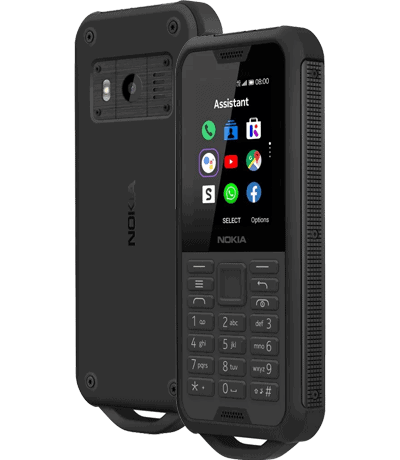
If you seek any durability, it will most certainly be found in the Nokia 800 Tough. With a rugged-as-nail design as US military standards, it is immediately appealing to those who would care for the most indestructible basic phone in existence.
The new strategy of Nokia is obvious; on the one hand, they want to hit smart devices as mid-range as low-cost. These two actions also would supplement reviving their name with quality devices associated with superior features and capabilities-numbers at this level.
Externals
You could see most clearly conceptualized the design of Nokia 800; simply put, it is a basic phone with a screen, T9 keyboard, speakerphone, camera, then put in a box with a durable frame sure with the necessary components will be exposed, and that is the Nokia 800 Tough.
When you first pick up the 800 Tough, it comes off feeling more like a protective case than a phone. They hard plastic encase the Nokia 800 ’embedded’ inside this hard plastic frame, which has three types of plastic finishes, the frame being hard plastic with a soft coating. The edges are covered with hard plastic using engraved motives to hold the user’s hand more; the back is a lumpy plastic with military gray tones, it looks like a large piece of metal covered.
The 800 Tough is proclaimed by Nokia to be impact resistant to a drop height of 1.8 meters and bears the IP68 rating for dust and water resistance.
At the top edge is a 3.5mm jack, micro-USB port for charging or connecting to computer and housed here is also a rubber seal to keep the water at bay; to the right edge is going to be the position of the SIM slot.
With a tough outer shell, the weight of the 800 Tough is matched with only some of the existing smartphone devices, 161g, considerably lighter to feel compact in the hand while lugging around.
Another highlight on the back is scratched metal covering the camera, LED flash, and speakerphone. This part is also placed a little lower than the back to protect the camera better and create a unique look for the device.
The bottom edge will make quite a significant ledge that seems hooked to a backpack or worn around the hand during excursions or picnics.
Display
The Nokia 800 Tough sports a 2.4 inch QVGA display, having a resolution of 240 x 320 pixels. It is a basic display among modern smartphone features but fits quite well within the context of use for this device. The screen is topped off with toughened glass, giving it resistance against scratches and minor impacts.
It is not too bright but can largely be read in varying light conditions. The issue, however, is very bright sunlight, which makes it quite difficult at times to view the screen well-as is often the case with lower-resolution displays. Also, small display means that one is not able to show an extensive content view at once, hence scroll down for viewing the entire content.
But all failings considered, the display is good enough. Functional and reliable, this is in perfect accordance to the over-all design philosophy of the Nokia 800 Tough. It was a screen designed to hold only essential information, such as calls, messages, and navigation, not one that was made to watch videos and surf the Internet extensively.
Performance
Powering the Nokia 800 Tough is a Qualcomm Snapdragon 205 processor; a dual-core chipset clocked at 1.1 GHz. This is coupled with 512MB of RAM and 4GB of internal storage that can be expanded via microSD up to 32GB. Modest this us, even for a feature phone-but sufficiently enough to perform the simplified functions that the handset has been designed to deliver.
The phone runs on KaiOS, a lightweight operating system for feature phones-running a simple user interface jacked full with large icons and easy menus that offer navigation ease. It boasts such basic applications as a web-browser and messaging service, basic productivity tools, to name a few. Also, this OS gets limited access to some apps in the KaiStore, for example, a couple of social media apps i.e. Facebook, WhatsApp.
In terms of performance, the Nokia 800 Tough makes a good hand for basic tasks such as making calls, sending messages, and browsing the web. The phone is expressly not designed to be used multipurpose or for running very heavy applications where some users may notice a delay when switching from one app to another or when a webpage is loaded. However, for the above intended use, the performance here is reasonable.
One of the key features of the Nokia 800 Tough is the support of vast LTE 4G connection to enable the user to achieve high-speed data transfers other than the old 2G and 3G technology speeds. Using this feature, one can browse, access social networks, send, and even stream music or videos. The activities, however, may leave a blemish on the experience because the screen size and processing power may not be the best available.
The phone features Wi-Fi, Bluetooth 4.1, and GPS. Thus, connectivity features are available with all the essentials. Considering outdoor activities, GPS becomes important, as it enables the user to navigate and track locations in remote areas.
Battery Life
Battery life is one of the tremendous features of the Nokia 800 Tough. This phone has a relatively big battery compared with feature phones, rated at 2100mAh. This was made possible because of power efficient Snapdragon 205 and the not so greedy Kai operating system.
In one’s typical usage scenarios, the Nokia 800 Tough can easily stretch into several days on a single charge. HMD Global claims up to 43 days in standby on a 4G network, and honestly that feels pretty impressive. Even with fairly active usage— calls , messaging, and a bit of occasional web browsing here and there—the device should go on for days before it has to be plugged back in again.
What stands out is that the phone charges via the older micro-USB port, which is kinda inferior compared with the more and more common USB-C standard. Still, for the people it is aimed at and the whole purpose of this handset, that downside is pretty easy to live with. Also the charging speed isn’t especially rapid and it can be brushed off, since the battery life is already so long.
They are, in fact, strongest at one of their features, so the battery life in the Nokia 800 Tough is as favorable as possible to those willing to endure the phone days sans a charger.
Camera
The N bezelled Nokia 800 Tough weighs an ultra-modern and single-in nature two-megapixel rear imaging camera. This phone does not have a front camera meaning there are no selfies, and the possibility of making video calls is out, although this might not mean anything to the common devices’ target audience.
Taking simple snaps from the 2MP camera would indeed suffice. The average quality of images can be termed contestable, with little detail and little dynamic range. One gets usable photos under good light conditions but a terrible decline in quality during low light, with evident noise and lack of clarity.
The camera app is quite simple and easy to use, and comes with very basic things like zoom, timer, and switching between movie and photo modes. There are no advanced features like HDR or high resolution as well as panorama, which most smartphones offer.
Video recording is, however provided, with the standard being almost the same. The camera records video at a maximum resolution of 480p, which sounds low in this new 21st century, with most smartphones able to boast HD and even 4K capabilities. This kind of video quality can be used to document happenings and small recordings but is not at all good enough to be used for video shoot.
There is nothing great about the camera in an overall aspect of the Nokia 800 Tough but it works and it is designed to meet the overall philosophy of the product. The camera is made for basic income and not for a professional photography-oriented design.
Software and Usability
The Nokia 800 Tough runs on its very lightweight operating system known as KaiOS, intended specifically for feature phones. KaiOS is built on the Linux kernel and has its ancestry traced from the defunct Firefox OS. It offers a relatively simple and intuitive interface for end users to navigate easily even by those who may not be used to smartphones.
Home screen divides into a grid of wide icons exposing phone’s different functionalities like Calls, Messages, Contacts as well as Apps. The navigation is simple as the interface is to be used in conjunction with the physical keypad. The D-Pad can be used to move between the icons while the center button selects any option. The soft keys then provide extra features as menu access or a back.
KaiOS gives you a limited selection of apps that you can grab from the KaiStore. It does not really claim a huge buffet like Android or iOS though, but still offers a bunch of well known tools, like WhatsApp, Facebook, and Google Maps. These apps are tuned for the KaiOS setup,so they run pretty good on the Nokia 800 Tough, even if everything is a bit more restricted than what you get on smartphones with more muscle inside.
The device also includes a simple browser, meaning you can hop around the web and open websites when needed. The browser works, sure, but because the screen is smaller and the processing power is not that high on the Nokia 800 Tough, the full web browsing flow feels less polished, and not as enjoyable as on a smartphone. Still, it does come in useful for fast lookups, quick info checks,or just doing a search while you are out.
Another key thing with KaiOS is that Google Assistant is already on the phone. To use it you just press and hold the dedicated button on the side, and then you get voice control options. Those let you make calls, send messages, search online, and also reach other functions without constantly diving through the phone menus, it s kind of the point. Sure, the Google Assistant on KaiOS isn t as capable as it is on bigger fully-fledged smartphones,but it still supports hands-free use, and that is pretty convenient on the Nokia 800 Tough.
Another thing that stands out is how KaiOS tries to get feature phones and smartphones to meet somewhere in the middle. It does that by giving you access to essential apps and services, so people using devices like the Nokia 800 Tough can stay informed, and generally have important digital tools around—without needing the full power of a modern smartphone. As a result, the Nokia 800 Tough becomes especially appealing for anyone who wants a strong durability, plus a simpler experience, but still wants connectivity and access to online services in the background.
Durability and Rugged Features
The Nokia 800 Tough’s main selling point is its durability and overall ruggedness, and honestly it totally does what it claims. It’s engineered so it can handle extreme conditions , and it matches military expectations for toughness. The MIL-STD-810G certification suggests the phone has been tested again and again for shock and vibration, humidity, extreme temperatures, plus a few other things. So yea , the Nokia 800 Tough becomes a solid, dependable buddy for outdoors people, for workers who face harsh settings every day, and for anyone who wants a phone that wont just give up after rough treatment.
Beyond the MIL-STD-810G stuff, it also has an IP68 rating, basically for water and dust resistance, not just “kinda” but for real. In practice that means you can submerge the device roughly 1.5 meters down for up to 30 minutes, and it should not get damaged, at least not in the normal sense. At the same time it’s fully dustproof, which makes it more fitting for a construction site , or the desert, or any location where there’s a ton of airborne grit, and you’re dealing with all that fine debris in the air.
The Nokia 800 Tough goes with a notably rugged layout, and it includes useful details like reinforced corners and a textured rear panel, so grip improves. There’s also less chance of slips, and fewer drops when the phone is in your hand. The rubbery outer layer helps absorb impacts too, and it really adds extra help for keeping the hardware safe. The whole design, with seals and ports locked down, basically reassures you that this phone can weather through almost any unpleasant environment, no matter how wild it gets.
Connectivity and Network
On the connectivity aspect, Nokia 800 Tough presents a reasonable array of connectivity despite rugged and feature phone embodiments. The device runs on 4G LTE, which allows data speeds and network performance much higher than the antiquated 2G and 3G terains. This becomes an important boon for users who are in need of connectivity in fretting environments where network strength can be questioned.
Apart from 4G LTE, the Nokia 800 Tough also has Wi-Fi, so when a Wi‑Fi network is around , it can jump onto it. In practice, using Wi‑Fi should help the phone save on mobile data and open up a few more pleasant ways for web browsing or downloading app stuff from KaiStore. Also, the device supports Bluetooth 4.1 , which can be used to link up with various wireless add‑ons like headsets and even speakers.
Then there is GPS, and yeah , it is kind of a big deal. It can genuinely save the day for people who hang out outdoors a lot or who end up in unfamiliar places, because it offers fairly precise location tracking along with navigation. With GPS added , the Nokia 800 Tough becomes a pretty suitable companion for hiking , camping, or moving around in remote areas where signal can be questionable.
Overall, it delivers good call quality, clear audio, and steady signal reception. The loudspeaker feels very loud and clean, so you can still hear it, even when things get noisy around you, like during outdoor chores or some industrial work. Network performance seems stable too, as the whole phone keeps doing its job without any major hiccups while placing voice calls, sending messages, and using data.
User Experience
Because the Nokia 800 Tough can be treated as a basic phone with features added from its older siblings and more recently from the Nokia 2720 Flip, it shall still remain KaiOS with a familiar interface, familiar setting buttons, and something similar in features.
It features a 2.4-inch display with a T9 keyboard that doesn’t offer much novelty from what was seen on the 2720 Flip, but the 800 Tough actually has the raised surface of keys giving a better pressing feel in comparison to the 2720. All said, the 2720 Flip serves to accompany a range of products from the better end towards harsher environments, which stress more on durability and less on comfort unlike the 2720 Flip.
For normal use requirements, the device has also been fitted in utility applications like the virtual assistant Google Assistant, Google Maps, Facebook, and Youtube. It works pretty well for the Wi-Fi playback feature also, with fairly good battery life from the 2,100mAh battery which can just about take you through a day or would give about 43 days of standby time.
The camera of the Nokia 800 Tough does not give very good pictures, but it is adequate for use or as a temporary solution for long journeys when your primary phone has gone flat.
Conclusion
Nokia 800 Tough will stir interest, along with the 2720 Flip, one tough and the other soft and thin. Not a great experience compared to a smartphone, but a classic experience nonetheless for those who treasure a sturdy product on long trips. It will take on anything the weather throws at it, even Wi-Fi without blinking for a full day.
Nokia 800 Tough 2.4″ 4GB 512MB RAM 2100mAh IP68 Rugged Cell Phone (GSM Only, No CDMA) Factory Unlocked – 4G LTE International Model No Warranty (Black): Buy it now


Tech Reviewer & Product Analyst
Định Bia has spent over 10 years testing consumer electronics with a focus on smart technology. He work as a product advisor at Biareview where he helped customers find the right devices for their needs. He personally tests every product featured on this site using a consistent evaluation framework covering quality, durability, and value. All reviews are based on experience, not influenced by the manufacturer.