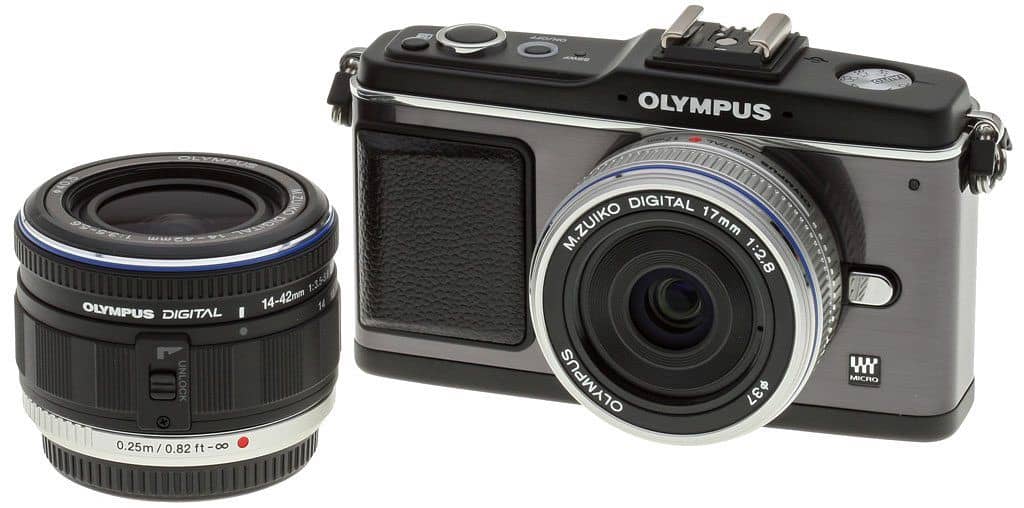
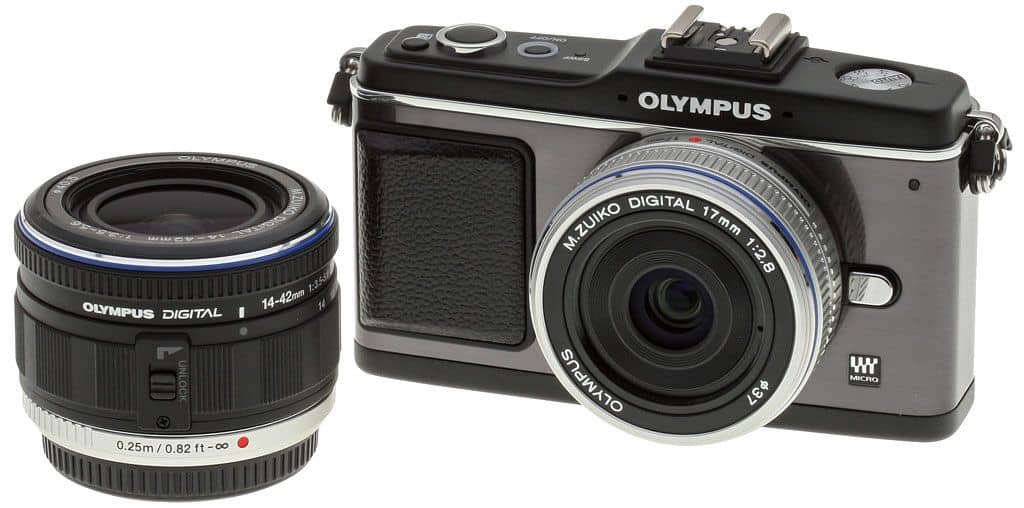
Continuing with the Pen series of cameras that combine shooting and lenses, Olympus offers another option for those who are passionate about photography with E-P2.
Still lightweight and sturdy design is detailed.
The back of the unit looks familiar with the LCD screen and the button sequence adjusts just like E-P1.
The top of the machine has a stand for lights and a removable optical viewfinder, the buttons are easy to operate and large.
The right side of the machine is HDMI output and USB connection to the computer.
Batteries and SD memory card slots are at the bottom.
The Olympus E-P2 uses a Four Thirds microphone, which is compatible with some Olympus cameras. If you want to use with Four Thirds lenses, you need to equip the adapter for the machine.
Included are Zuiko Digital 14-42mm lens, Micro Four Thirds lens.
This wide-angle lens goes with the body (kit).
Flash FL-14 in the kit (purchased separately) with the Olympus Pen series.
Flash stick with E-P2 looks quite stylish.
Optical viewfinder (purchased separately) exclusively for Olympus Pen series.
You can adjust the lens to a 90 degree angle for easy viewing at lower angles. This viewfinder also uses the base of the flash, so you can not use both the flash and the optical viewfinder at the same time.
The 14-150 telephoto lens (sold separately) also uses Olympus’s micro Four Thirds mount, compatible with E-P2.
This lens has quite special focal length, both wide-angle and telephoto shots.
Continuing with the Pen series, Olympus launched another “pen” named E-P2 following the popular Olympus E-PL1 and the high-end Olympus E-P1. E-P2 continues to accrue many of the outstanding features of the field-of-view camera and line of lenses. Design is not much different from the E-P1, the E-P2 body is still the look of a camera but taken care of meticulously in every detail. The frame is solid gray metal, adorned with steel bars on the top and the back is still a 3″ LCD screen on the right side. In general, the buttons layout is quite reasonable, easy to adjust but still a bit small. The machine does not have an integrated optical viewfinder that you still have to watch through the LCD as the viewfinder shooting. E-P2 uses the microphone Four Thirds. In addition, you can also use the universal Four Thirds lens (no “micro”) larger than the Olympus, Panasonic (with adapters), but the compatibility problems, speed get Sharpness, image … SD memory card machine, integrated lithium battery, for long periods of use (used throughout the day). The machine also has HDMI output for HDTV.
Olympus E-P2 12.3 MP Micro Four Thirds Interchangeable Lens Digital Camera with 14-42mm f/3.5-5.6 Zuiko Digital Zoom Lens (Electronic View Finder not included): Buy it now
In terms of features, the Olympus E-P2 with a resolution of 12.3Mp almost fully contributes to the current shooting functions: anti-shake, anti red-eye, capture effects, HD movie recording, shooting modes, edit photos after shooting … and resemble the Olympus E-P1 brother. Notably, the “professional direction” function of the machine is quite powerful: you can take raw or raw images combined JPEG format; 3 modes of anti-shake IS on the sensor, manual white balance, 11 focus points, compensation … However, E-P2 does not support focus point, continuous shooting mode only reached 3 frames Image per second, HD video recording at 720p and can be taken while shooting, but focus is relatively difficult.
In terms of picture quality, the Olympus E-P2 can achieve what Olympus expects. Try with the included 14-42mm lens in full auto mode, the image gives a very fresh, vibrant color and smooth color transitions, with depth. It can be said that E-P2 captures very well in low light conditions, perhaps due to the 4/3 “Live MOS Sensor, which has good anti-interference, very good anti-vibration, and focus (no lights). Light assist) works effectively. Photos in low light (indoor, night scenes, etc.), detail, clarity and color highlights. The E-P2 auto white balance detection is also quite good, recognizable precisely in a variety of lighting conditions.
For those who need true color, the Olympus E-P2 looks a bit “blazing” color, especially the “strong” colors like magenta, lemon yellow … HD video is quite good, The image is less likely to jerky from “panning” or spinning fast-moving subjects.
Overview
Sensor: 12.3MP Live MOS · Processor: TruePic V · ISO: 200-6400 · Autofocus: contrast-detection · Viewfinder: optional external EVF · Screen: 3.0-inch LCD, 230,000 dots · Stabilization: in-body · Design: compact, retro-styled, optional mic adapter · Connectivity: HDMI, USB 2.0 · Battery: Li-ion rechargeable
Retro looks, in-body stabilization, and an optional clip-on viewfinder — that combination is what made the E-P2 stand out when mirrorless cameras were still new.
Design and build
It’s small, light, and looks like an actual camera rather than a black slab, which is most of the appeal here. Metal body, leatherette grip, controls that stay comfortable despite the compact size. No weather sealing, though, so this isn’t a camera for shooting in the rain.
Screen and viewfinder
The screen is fine — 230,000 dots, bright enough, nothing special by current standards but perfectly usable. The real feature is the optional EVF that clips onto the accessory port, giving you something closer to a real viewfinder instead of composing everything off the LCD. Worth having, if you’re willing to buy it separately.
Sensor and processor
12.3 megapixels, accurate colors, sharp detail — the sensor does its job, and the processor keeps things responsive. In-body stabilization backs it up by cutting down on shake.
Autofocus and ISO
Contrast-detection autofocus, which was the norm for mirrorless at the time: reliable in good light, sluggish in the dark, and not built for anything moving fast. ISO covers 200 to 6400. Clean at the bottom, grainier at the top, with stabilization softening some of that trade-off.
Usability
Manual and automatic modes both work well, menus are simple, and the customizable buttons let you set things up your own way instead of the factory default. Live View covers awkward angles. HDMI and USB handle file transfers — no wireless, though, so don’t expect to beam anything to your phone.
Against the competition
Panasonic’s GF1 matches it closely but builds the EVF in instead of selling it separately. Sony’s NEX-5 beats it on resolution and video but drops the retro design and stabilization. Canon’s EOS M pushes resolution further still, same trade-off. None of them do exactly what the E-P2 does if stabilization and that classic handling matter more to you than raw numbers, it’s still the one to pick.
Bottom line
Slow autofocus, modest resolution, basic connectivity, none of that’s a surprise for a camera this old. What still holds up is the feel of shooting with it: retro styling, real stabilization, an optional viewfinder that actually improves the experience. For a small system camera with personality, that’s enough.
Related Posts

Tech Reviewer & Product Analyst
Định Bia has spent over 10 years testing consumer electronics with a focus on smart technology. He work as a product advisor at Biareview where he helped customers find the right devices for their needs. He personally tests every product featured on this site using a consistent evaluation framework covering quality, durability, and value. All reviews are based on experience, not influenced by the manufacturer.