Although the Pioneer Elite Kuro PRO-111FD is still considered the top-of-the-line product of image quality, Pioneer has retired from the plasma, so it has been shaken by the likes of Panasonic. Plasma TC-PG10 is a concrete demonstration.
With smooth image quality, impressive black levels, plus some additional features such as THX image mode, Internet content VieraCast, TC-PG10 series is climbing to the top of the village of Plasma.
Like most TV manufacturers, the TC-PG10 is further refined by Panasonic in terms of design. Although not the same style as the V10 but the edge design is thinner. The entire screen is painted in black, with a highlighted silver band on the bottom.
The feet are also redesigned to round instead of square as in the lower ones, but unfortunately they are not rotatable. The speakers are cleverly hidden so as not to lose the charm of the edges.
Besides the 1080p resolution, the TC-PG10 features the THX display and VieraCast features. In THX image mode (which is actually a kind of automatic image alignment mode), color accuracy, shadow detail, and a variety of other image properties are significantly improved. No need to refine anything.
Internet content VieraCast, which appeared on the TH-PZ850U model, allows viewers to access content such as YouTube videos, Picasa photos, financial information on the Bloomberg site, and weather channels via Ethernet network port on the back. Unfortunately, the TC-PG10 does not come with a built-in Wi-Fi adapter.
Compared to other HDTV names on the market, Panasonic does not have many fine-tuning features beyond some basic adjustments. The four default custom image functions like Standard, THX, Game and Custom are simple but good quality, especially the THX mode.
In addition to the image correction features, Panasonic also offers the ability to change the scan image to 48 Hz, although at this rate the jerk phenomenon can occur. Some of the other major options are also set by default, such as five color temperature modes, environmental light sensor function, color management mode, picture noise reduction and black level adjustment.
The TC-P46G10 does not support in-picture and pause modes, making it an integrated SD card reader that allows easy viewing of images.
Connectivity is also quite diverse. The TC-P46G10 provides three HDMI inputs (two back, one side), common AV ports such as composite, S-Video, RF ports, digital audio outputs and especially VGA (supports resolution Maximum 1,366 x 768 pixels) is arranged on the side for easy computer connection.
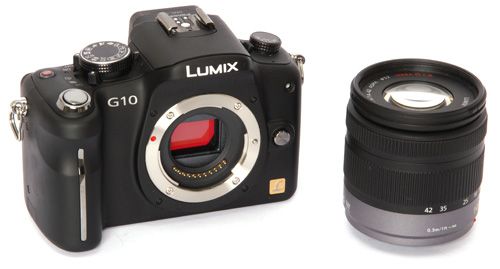
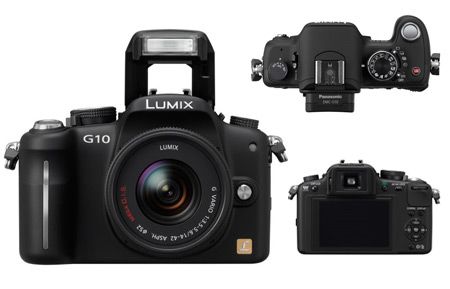
Panasonic Lumix DMC-G10 12.1 MP Live MOS Mirrorless Digital Camera with 14-42mm Lumix G Vario f/3.5-5.6 MEGA OIS Lens: Buy it now
The Panasonic TC-PG10’s image quality is excellent, surpassing the S1 in terms of both black levels and color accuracy when in THX mode. However, in this mode, the color is not perfect, still slightly bluish / yellow compared to other monitors used (Pioneer PRO-111FD and Sony KDL-55XBR8).
Although using the same plate with the TC-PS1 series, the TC-PG10 is a deeper and deeper black. Although not equal to Pioneer’s Kuro, the black depth of G10 screen is closer to Kuro than most other monitors on the market. Dark areas are also well controlled and it is difficult to spot the differences when placed near the top of Pioneer’s screen.
For color accuracy, PG10 is excellent, but compared to the comparison screens are still less accurate. Although the blue / yellow tones are not too revealing and affect the quality of the picture, but when placed next to other screens, the videophile picky can still see right away.
The G10’s video resolution tests pass easily with excellent quality, both 1080i and 1080p. The monitor also comes equipped with custom “24p direct in” when it detects a 1080p / 24 signal (as on the blue-ray disk) input.
With its standard definition content, the TC-PG10 handles well despite the sharpness that still lags Samsung’s product. Although serrations in diagonal lines are not standard but the ability to reduce noise is stable.
Connect your computer via HDMI and turn on the THX mode, the picture is perfect, well processed 1,920 x 1,080 pixel source without exposure effects. If through the VGA port with a maximum resolution of 1366 x 768 pixels, the image looks more blurry and grainy than the HDMI port.
The TC-PG10 consumes far more power than other monitors. In standard mode, the product only consumes 168 Watt, but is slightly dark. When aligned, power consumption is up to 281 Watt, just over TH-46PZ85U (329 Watt). Compared to its competitors, the G10 consumes more than twice as much power as the 2008 Sharp LC-46D85U (123 Watt), the Samsung LN46A550 (101 Watt), and the Sony KDL-46Z4100 (124 Watt).
Image Quality
12.1-megapixel Live MOS sensor, Venus Engine HD II processor. It’s not chasing higher-resolution sensors, but it does solid work for what it is — plenty for prints and sharing online, just don’t expect much room to crop in aggressively.
Color’s genuinely good, which tracks with Panasonic’s reputation — vibrant, accurate, good saturation, skin tones that look right across most subjects. Dynamic range is decent in normal lighting; obviously it’s not matching a more advanced sensor, but it doesn’t fall apart either.
ISO goes 100-6400. Clean at the low end, noise creeps in as you push higher — usable up to 800 with a little cleanup, but past 1600 the noise starts getting in the way of actually using the shot.
Autofocus is contrast-detect, 23 points — not fast next to phase-detect, but accurate and reliable most of the time, though it slows down in dim light or with anything moving quickly. Continuous shooting is 3 fps, fine for casual action, not built for anything faster. No in-body stabilization here — some other Lumix G bodies have it, this one doesn’t — but a lot of Panasonic lenses carry their own optical stabilization to make up for it. Battery’s decent too: around 380 shots on the DMW-BLB13, enough for most days, spare recommended for longer ones.
Day to day, this camera’s pleasant to use — clean menus, a Quick Menu for the stuff you reach for constantly, and enough customizable buttons for someone who wants things set up their own way. The built-in EVF is a genuine plus, even at low resolution — outdoors in bright light, it’s a lot easier than squinting at the LCD. Small enough to actually carry around, and being Micro Four Thirds means the lens selection is wide open across Panasonic, Olympus, and third parties.
Video’s 720p at 30fps, standard for when this came out, fine for casual use. You get manual control over aperture and shutter speed while shooting video, which helps in mixed lighting. Audio’s the built-in mono mic and nothing else — no input for anything better, so don’t plan on serious video work here.
Set against anything current, the differences are predictable: modern sensors run 20-40MP or more, autofocus is faster now with phase-detect standard, video goes up to 4K with real stabilization, Wi-Fi and Bluetooth are just expected, and battery life across the board has gotten better.
Even well over a decade old at this point, the G10 still has something going for it — solid build, sensible design, image quality that holds up fine. It’s easy to find used, often bundled with a lens or two, and it’s still a genuinely reasonable way for someone to get into interchangeable-lens photography for the first time. Enthusiasts and collectors seem to like keeping one around too, and it’s not hard to see why.
Related Posts





Tech Reviewer & Product Analyst
Định Bia has spent over 10 years testing consumer electronics with a focus on smart technology. He work as a product advisor at Biareview where he helped customers find the right devices for their needs. He personally tests every product featured on this site using a consistent evaluation framework covering quality, durability, and value. All reviews are based on experience, not influenced by the manufacturer.