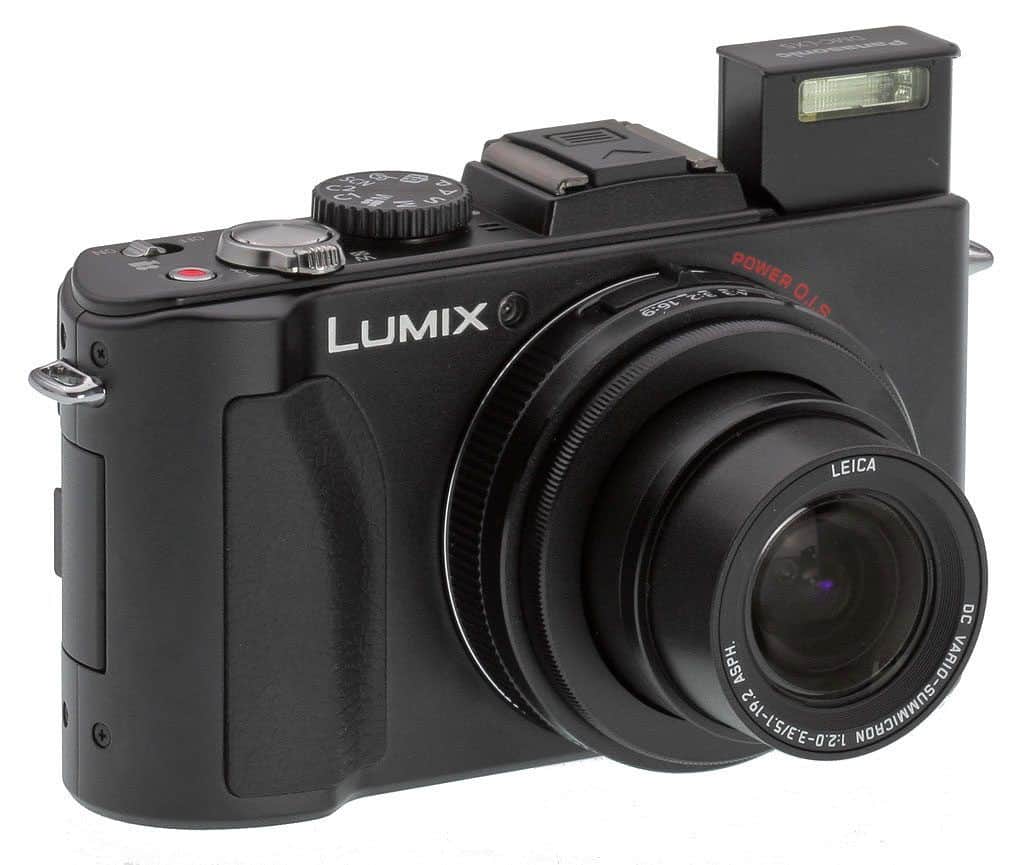
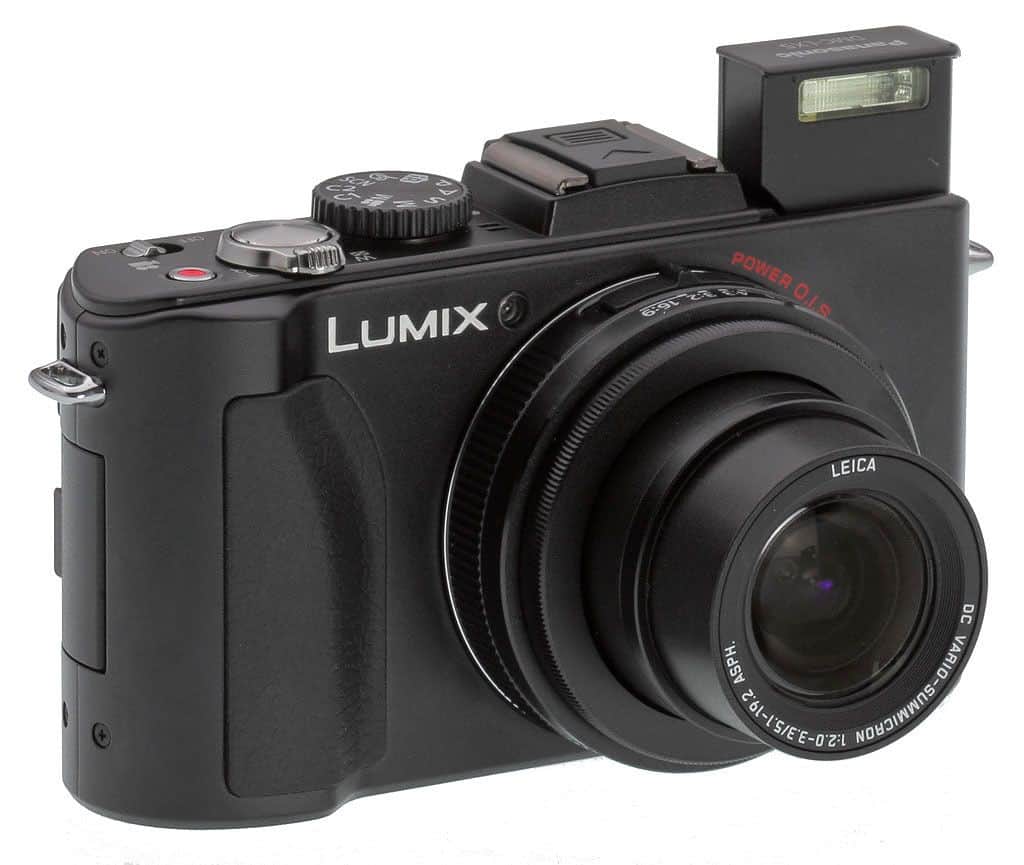
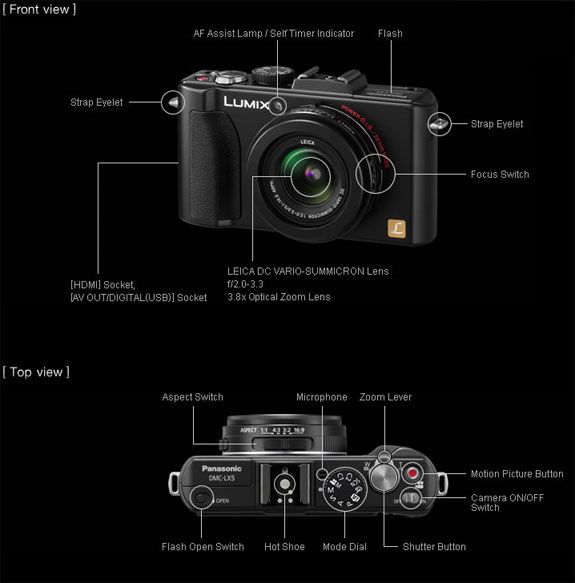
The Panasonic LX5 is quite handy thanks to its metallic shell. Although the handle has been improved but due to the design towards neat pocket is not enough yet sure. The entire front is a fixed lens ring with manual or manual focus, 4: 3, 3: 2, 16: 9, and 1: 1 image ratios (new to Panasonic LX3). Contrary to the cleanly designed front, the top and back are packed with a lot of buttons. The top-of-the-range rotation gives you instant access to PASM or scene modes and customizable users. Beside the power switch and the shutter button / zoom ring is the direct video button, which instantly switches to the recording mode regardless of the mode. The flash form is hidden on the right side and can be manually activated via the mechanical switch instead of automatically. The external flash is used in conjunction with the digital viewfinder slot of the GF, but is covered by a cover by default.
The back side of the large LCD panel is the Menu access buttons and quick access keys for ISO, flash, timer or Fn buttons can be assigned more customizations. There are two new improvements to the LX5 compared to the LX3. The first is that the joystick has been replaced by the adjustable ring as shown on the DSLR and can be clicked similarly to the GF line, quite useful when used to adjust the aperture and shutter speed in manual or aperture mode. And compensation in other modes. However, the rotation is designed slightly deep that the rotation or rotation and click is not favorable. The second is that the switch between shooting and viewing mode has been replaced by an electronic view. This design allows users to view still images, and can quickly switch to capture mode just by pressing the shutter button rather than changing the switch rather confusing switch on the LX3.
The ports on the right side are also minimalized with only two HDMI ports and a USB port. Underneath the bottom is the card slot with a slot for the battery. The layout of the tripod socket is sideways a bit inconvenient when it is mounted on small tripods, but it is also useful when users want to replace batteries or cards even when they are mounted on their feet withouht affect anything.
The LX5’s menu system allows users to intervene in a variety of different customizations, but the on-screen layout is confusing and complex enough to dazzle newcomers to the camera for the first time.
The lens of the LX5 continues to impress with the Leica lens class (Vario-Summicron) and aperture up to f / 2. Maintaining a 24mm wide angle, the LX5 has a zoom range slightly above its predecessor, up to 90mm, ideal for portraits. Although the zoom range is not large, the LX5 is still equipped with the new MEGA O.I.S image stabilization system to ensure the best possible image or video. Along with the ISO enhancement from the 3200 on the LX3, the LX5 supports ISO up to 6,400 and 12,800 without the need for an extended mode. Combined with a large aperture, the LX5 is ensure to capture images in any dimly lit environment.
However, the noise level of the LX5 does not exceed the limits of conventional digital travel cameras. Up to 3,200 photos are still acceptable. But when it continues to push up to 6,400 or 12,800, the image breaks completely, the color is stained and the details are lost. But for those who only need document images, having a high ISO is an advantage when the LX5 is able to capture motion pictures even when the weather is still dark.
Panasonic Lumix DMC-LX5 10.1 MP Digital Camera with 3.8x Optical Image Stabilized Zoom and 3.0-Inch LCD – White: Buy it now
Panasonic Lumix DMC-LX5 10.1 MP Digital Camera with 3.8x Optical Image Stabilized Zoom and 3.0-Inch LCD – Black (OLD MODEL): Buy it now
The images are smooth, noise-free, even with the finest noise and distortion when placed at ISO 80, an ideal low level compared to the default ISO 100 and 200 for most current travel cameras. Due to the large aperture of f / 2, taking portraits or live images in daylight conditions for large-scale shooting is not a problem for this version.
The new ultra-quiet zoom system of the LX5, which the company calls Intelligent Zoom, is very useful, with silent, near-digital zoom, so users can take advantage of this optical zoom. We both filmed without fear of noise. In addition to the usual Motion JPEG format, 720p HD movies are also stored in the compact AVCHD Lite format. Only thing to read this format, users have to connect the camera to the computer and read by the software of the company, not copy and read from the card reader is normal. In return, with built-in software, users can save pictures from video clips or simply edit video clips on the camera without a computer.
With compact design, advanced features with various customizations, the LX5 contributes to the segment of advanced travel cameras replacing the DSLRs alongside the Canon Powershot G12 or the new NEX and NX of Sony and Samsung.
Related Posts


Tech Reviewer & Product Analyst
Định Bia has spent over 10 years testing consumer electronics with a focus on smart technology. He work as a product advisor at Biareview where he helped customers find the right devices for their needs. He personally tests every product featured on this site using a consistent evaluation framework covering quality, durability, and value. All reviews are based on experience, not influenced by the manufacturer.