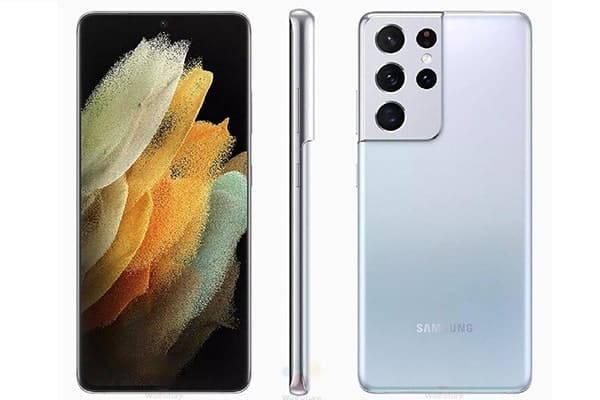
The design is easy to hold, more square, very close to the Note series.
The first improvement comes from the design. With the S20 Ultra, Samsung has received many complaints about its appearance, especially in the oversized, somewhat rough camera cluster.
Many curves on the back make the device unnecessarily “bulky” set. On the S21 Ultra, the Korean technology company has made changes.
The back of the latest S can be considered as the successor to the Note 20 Ultra when it is made square and neater. The design of the camera cluster is renewed when it is almost completely covered from the back to the frame, creating the feeling that this is a seamless block and looks “catastrophic.” The camera lens is also more prominent with a large size.
When observed at close range, it can be seen that the camera cluster and the border are still separated, not a monolithic form. The rear camera cluster can be seen as the most unbalanced detail in the design of this phone. The lens part is concave compared to the bezel to avoid impact and reduce flare.
This year, the S21 Ultra has a kinda fancy silver version, and it sort of shifts into tones like purple, pink, and blue when you tilt the device at different angles. The color is what makes it pop, and also it seems to push back dirt, sweat, or fingerprints more effectively than the usual black version.
The point that S21 Ultra has not overcome is the thickness and weight. Due to having to “carry” a battery of up to 5,000 mAh with a large 6.8-inch screen, two telephoto lenses, the device has a thickness of up to 8.9 mm and a weight of 229 g (S20 Ultra is 8.8 mm and 222 g). The feeling of holding will be like a small “dumbbell” in hand, more suitable for men than women. Putting it in a pants pocket can also clearly see the sharpness. For ease of visualization, the iPhone 12 Pro Max also weighs the same at 228g but is only 7.4mm thick due to a mere 3687 mAh battery.
Samsung has “solved” this problem on the Note 20 Ultra (8.1 mm, 208 g) when reducing the battery capacity to 4,500 mAh, but perhaps the new 5,000 mAh battery is enough to “balance” the 120Hz QHD + screen with the same 120Hz QHD + screen. 4-camera system on the most advanced S21.
The screen has no longer “Achilles heel,” maintaining a clear, bright style and thin borders.
Contrary to the back, the front of the S21 Ultra is completely similar to the previous generation with a central mole, softly rounded corners, the typical femininity of the S series, and four slim edges. The edge of the screen is still 3D curved, but the curvature has been reduced much compared to the Note 20 Ultra. I still prefer the square screen like on the Note series because it creates a personality different from dozens of other phones on the market today.
The most valuable point on the screen of the S21 Ultra is probably the 120Hz refresh rate that has run at the highest resolution WQHD +, no longer having to reduce to Full HD + like previous generations. In a detailed review of the Galaxy Note 20 Ultra, I once said that only running at 120Hz refresh rate at Full HD + is the “Achilles heel” of this machine. Because with a size as large as 6.9 inches, the Full HD + resolution sometimes proves to be “out of breath,” causing the Note 20 Ultra’s screen to appear blurry, less sharp, especially when displaying large-sized web pages. Small letters or when observed at a close distance of 20cm or less.
The whole “Achilles Heel” thing on the screen seems to have gone, and now on the S21 Ultra it just doesn’t exist anymore. So, the device can really use the full benefit of that big 6.8-inch display, with WQHD+ 3200×1440 pixel resolution and a 120Hz refresh rate, which means a sharper more detailed view and smoother, kind of silky page scrolling. Even when you’re in the hot sun, the screen still stays clear, no real trouble at all.
As for the camera, it brings in a bunch of useful new tools, especially Zoom Lock, and also automatic night shooting.
The S21 Ultra is also kind of a first, because Samsung for the first time has equipped up to 2 telephoto cameras in a single smartphone setup. One is with 3X optical zoom, and the second is a periscope camera with as much as 10X optical zoom. Some Chinese brands did this earlier though, like Huawei or Xiaomi. On the S21 Ultra, Samsung keeps the 108MP main sensor, and it still supports up to 100X maximum digital zoom, pretty much in the same style as the S20 Ultra, just like, double the 50X level you’d get from the Note 20 Ultra. The 12MP ultra-wide-angle camera has been upgraded too, it now has autofocus, so you can shoot close up and get macro type photos.
Thanks to the two telephoto cameras and the new generation 108MP sensor, Samsung claims that the S21 Ultra’s 100X zoom capability will be significantly improved than the S20 Ultra, delivering sharper photos and less shaky photos. A new feature on the S21 Ultra is Zoom Lock. As soon as a zoom level above 20X is selected. A white sub-viewfinder will appear in the corner of the screen. You only need to hold your hand firmly for about half a second on the subject to be photographed. This viewfinder will immediately turn yellow, and the image will also significantly reduce shake.
Samsung has likely used more digital stabilization like recording video and optical image stabilization (OIS). Through experience, I found Zoom Lock very useful, making taking photos with high zoom levels on the S21 Ultra much easier than previous generations.
Photos are taken from the S21 Ultra still retain the inherent features of Samsung flagships so far. Bright colors, high contrast, somewhat brilliant, flattering eyes. Good detail, sharpness, wide light range. However when shooting in low light , Samsung still suppresses noise quite strongly. The image looks clean, with very little noise, but the sharpness and the fine details get noticeably reduced.
Luckily, the device includes a night mode, and it can be used across all four cameras, so the quality for low light shots improves a lot. A new detail with the night mode on the S21 Ultra is that it can automatically switch on when the phone detects the environment is too dim , kind of like what the iPhone does. This makes the whole thing more convenient . Of course you can still turn the Night mode on manually if you prefer, but honestly it’s not really required anymore.
One annoying point, when taking photos on the S21 Ultra, is that the device heats up quickly . After just a few minutes of taking photos or filming, you can feel the heat coming out from the rear camera cluster, the frame and also the screen around that area.
Other new features such as Director View allow displaying the entire image from all four cameras, including three rear cameras and one front camera, or Vlogger View, which allows both front and rear camera images to be displayed simultaneously. Like the video format of streamers, vloggers are also quite interesting, helping to create new videos. The 8K 24fps video recording feature is still equipped, but no longer is Samsung’s promotion too much. Instead, the company equipped the ability to record 4K 60p video for the entire lens on the S21 Ultra.
One small note is that with recording 4K 60fps, the S21 Ultra will not let you hop between lenses while the video is running. You can change lenses only before you start recording or else you’ll need to drop it down to 4K 30p, or go Full HD 60p, something like that.
On the performance side, the Exynos 2100 feels pretty steady, and it is clearly more capable than the prior generation. Not in a vague way, like, it’s actually improved.
As for the real deal S21 Ultra in Asia, it keeps using the top tier Exynos 2100 chips that Samsung made. Exynos 2100 is Samsung first flagship chipset with a built in 5G modem, and yeah it’s also the second chip to lean on Samsung 5nm EUV manufacturing process after Exynos 1080. Still, in their usual habit, in a few places like the US, Korea and Hong Kong, the S21 Ultra ends up with the Snapdragon 888 model.
For the RAM and storage, it’s pretty much the same tale as last time: 12GB of RAM and 128GB internal storage. And there’s also a different arrangement, up to 16GB of RAM, paired with 512GB of internal memory.
During my time with the S21 Ultra, I noticed that the Exynos 2100 had noticeably improved compared to the Exynos 990 on the Note 20 Ultra or S20 Ultra.
Samsung’s new chip helps S21 Ultra operate faster and smoother. Latency with common tasks such as browsing the web, surfing, switching multitasking, performing gesture operations is significantly reduced. 12GB of RAM is still too much, and I rarely have to reload an application. Facebook can be left overnight, turned off the screen, reopened the next morning, and still displays the same comment that is being read, very convenient. The phenomenon of overheating when browsing the web normally also no longer appears.
SAMSUNG Galaxy S21 Ultra 5G Factory Unlocked Android Cell Phone 256GB US Version Smartphone Pro-Grade Camera 8K Video 108MP High Res, Phantom Black: Buy it now
Samsung Galaxy S21 Ultra 5G SM-G998B/DS 256GB 12GB RAM International Version – Phantom Black: Buy it now
Samsung Galaxy S21 Ultra 5G SM-G998B/DS 256GB 12GB RAM International Version – Phantom Silver: Buy it now
SAMSUNG Galaxy S21 Ultra 5G | Factory Unlocked Android Cell Phone | US Version 5G Smartphone | Pro-Grade Camera, 8K Video, 108MP High Res | 128GB, Phantom Black (SM-G998UZKAXAA) (Renewed): Buy it now
The Exynos 2100 also delivers pretty decent gaming ability with familiar games like League of Legends, Arena of Valor Mobile, Call of Duty, PUGB , or Dead Trigger 2. The stable frame pacing at 60fps with higher graphics settings is… honestly okay.
Only, when you run something more “close to the hardware” like Genshin Impact, the fresh Exynos 2100 starts to look a bit out of breath. In that case you should pull the settings down to low, if you want it to stay steady around 30 to 40fps. Also remember the S21 Ultra runs hot during long sessions, so you should think about how long the “battle” goes, and trim the settings to reduce the stress on the device.
A small cut on the S21 Ultra is the microSD card slot. Since the internal storage starts at 128GB, many people will probably not need that option. Still, a memory card slot is one of the little wins Android has over iOS, especially if you often record video, shoot high quality photos, or just keep a collection of movies, plus install a lot of big games.
The S Pen is interesting, but it still isn’t as convenient as the Note line; the ultrasonic fingerprint is noticeably faster, so the everyday unlock experience feels more snappy.
Another important feature of the S21 Ultra is the S Pen. However, as you know, this pen will need to be purchased separately or reused the S Pen pens on the Galaxy Note or Tab S6 and above. Unfortunately, I do not have an S Pen to experience more features that first appeared on the S series.
Earlier in the post, I tried using the Note 20 Ultra’s S Pen with the S21 Ultra and found the pen completely stable. As soon as the pen is inserted, the S21 Ultra immediately receives the command without requiring any connection operation. The feeling of writing and drawing is smooth and agile, not inferior to the Note series. That can be seen as a fresh attempt from Samsung to bring the S and Note lines nearer together, rather than keeping them apart. Still, the S21 Ultra doesn’t come with a pen hole like the Note, so you’ll have to get some separate accessory to fit the stylus. Also, the protective case plus the leather case that includes the S Pen slot will end up being noticeably thicker on the S21 Ultra.
S21 Ultra uses Qualcomm’s ultrasonic in-display fingerprint sensor but has been upgraded to the latest 2nd generation. According to Qualcomm, the reader area of the new sensor is 77% larger, collects 1.7 times more fingerprint data, and most importantly, 50% faster reading speed than the original sensor. Indeed, when using the fingerprint on the S21 Ultra I noticed that the speed felt noticeably faster than it did on earlier generations. The commendable part is that even when my fingers are wet, the phone can still identify me and unlock as normal.
Battery life is good, but fast charging is still “stagnant.”
With a large 5,000 mAh battery, the S21 Ultra gives a relatively comfortable duration with high usage intensity. Statistics from the AccuBattery application show that the screen time is about five and a half hours, the mixed-use time is about 25 and a half hours.
With BiaReview’s standard battery tests such as watching movies, surfing the web, playing games in QHD + 120Hz screen mode, the S21 Ultra achieved 14 hours of 16 minutes watching movies, 10 hours 4 minutes surfing the web 4 hours 37 minutes playing games.
If you reduce the screen to Full HD +, 120Hz, the battery life will increase significantly with 17 hours 21 minutes watching movies, 13 hours 34 minutes surfing the web, and 5 hours 12 minutes playing games.
The point that made me quite disappointed is that Samsung went to “follow” the “environmental protection” movement that Apple initiated, removing the included charger and headset. The accessories only have a USB-C charging cable, sim stick, and user manual in the box. Users will have to buy more 25W chargers or take advantage of old chargers if available.
I plugged the S21 Ultra into a 25W charger I had from the Galaxy Z Fold 2 , and after about 30 minutes it seems to be charging roughly 55% of the battery. Then the phone is at 100% about 1h15 later, which I’d say matches the last 2 Ultra generations pretty closely , honestly.
This charging speed of S21 Ultra can meet the most common needs. Now, competitors like Oppo and Xiaomi are offering 65W and yes even 120W fast charging, that kind of thing can top up a 4200mAh battery like the Oppo Find X2 in about 40 minutes and the 4500 mAh unit in the Xiaomi Mi 10 Ultra in just 25 minutes too. And if you don’t want to be left behind, Samsung should keep pushing to make the charging speed even faster on their flagships.
Summary
Constantly facing fierce competition from fierce rival Apple accompanied by the strong rise of Chinese smartphone “army” such as Oppo, Xiaomi, OnePlus. Samsung itself may well understand that the company is no longer there can be “frugal” in upgrading elements of design, camera, screen, or performance…
S21 Ultra marks Samsung’s bold change in design, adding features that first appeared on its S-series smartphones such as dual telephoto cameras, QHD + 120Hz screen, 5nm processor, S Pen. At the same time, the company also has small but useful tweaks in software such as Zoom Lock, automatic night shooting to perfect the camera experience.
It can be seen that the Korean technology company is perfecting itself. Making progress after each generation and drawing the bloody lesson that a high-end smartphone is not necessarily perfect, but only needs to meet customers’ needs fully meet the most practical factors that users care about.
Related Posts


Tech Reviewer & Product Analyst
Định Bia has spent over 10 years testing consumer electronics with a focus on smart technology. He work as a product advisor at Biareview where he helped customers find the right devices for their needs. He personally tests every product featured on this site using a consistent evaluation framework covering quality, durability, and value. All reviews are based on experience, not influenced by the manufacturer.