Key Parts of a Digital Camera
The lens is the whole story with the RX10 IV: a fixed Zeiss Vario-Sonnar T*, 24-600mm, which is a genuinely absurd range for something that’s permanently attached wide enough for a landscape, long enough to shoot a bird across a lake. And it holds f/2.4-4 across that entire zoom, which most superzooms can’t do; they usually lose a stop or two of light by the time you’re fully zoomed in.
Sensor’s a 1-inch Exmor RS at 20.1MP bigger than what you’d find in a typical point-and-shoot, still smaller than an interchangeable-lens camera’s sensor. That’s the trade being made here: you get an insane zoom range in one lens, but you’re not getting full-frame low-light performance to go with it.
All images and videos captured are processed quickly by a BIONZ X processor.
A 3.0-inch tilt-angle LCD display provides a resolution of up to 1.44 million dots.
Storage: A total of 24GB internal memory can hold 400 photos or approximately 40 minutes of video with an expandable memory capacity through a memory card.
Battery: The camera is operated with a rechargeable battery that lasts for almost 400 shots on full charge.
Digital Camera Specifications
The above-mentioned features of the Sony Cyber‑Shot RX10 IV are as follows:
20.1 megapixels not a headline number anymore, but plenty for normal printing and cropping. ISO goes from 100 to 12,800, comfortably covering most everyday lighting without you thinking twice about it.
The shutter’s the more interesting spec: 30 seconds on the slow end, up to 1/32000 electronically, which means you can shoot wide open in blazing sunlight without an ND filter, or freeze something moving stupidly fast. Aperture’s f/2.4-4, solid for a built-in zoom rather than a prime.
White balance has auto plus manual override if the auto guess is off. Autofocus is hybrid, 315 phase-detection points, and it tracks moving subjects without much hunting. Stabilization’s 5-axis, smoothing out shake in both photos and video.
The camera has the benefit of being very portable and can be made to carry almost anywhere. Lightweight and compact design make it relatively easier to take it around without wasting space in baggage.
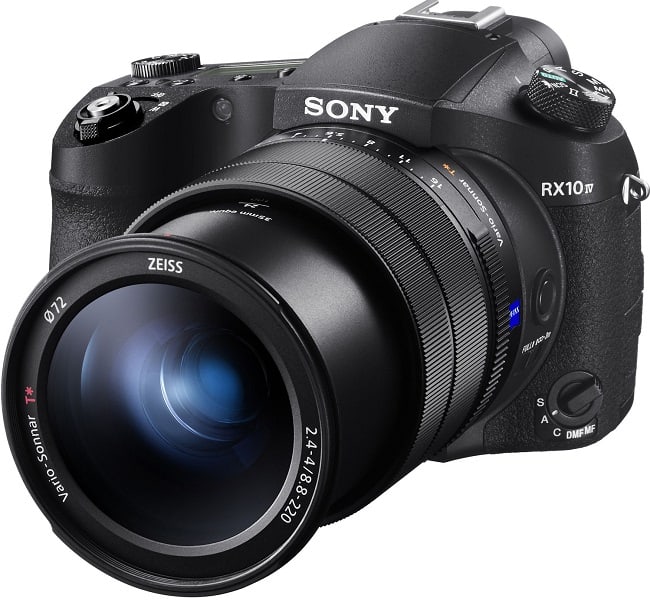
There are a few major benefits you will enjoy when you go for the Sony Cyber-shot RX10 V:
Immediate playback and editing: Thanks to its tilt-angle LCD screen, instant playback and editing is possible with both still photographs and videos.
Great Images: The camera’s 1.0 Exmor Rs CMOS sensor and the Zeiss Vario-Sonnar T* lens work beautifully together in producing high-quality pictures with razor-sharp detail and vibrant colors.
Versatile: The camera is ideal for a large array of photography-portraits, landscapes, and wildlife photography all in one-the camera shows its stuff through the combination of a 24-600mm focal length with fast aperture.
Sharing and printing are made easy: You can transfer your images and videos directly to your computer or mobile device, share them, and print them.
Cost-effective: It is quite costly, but just like all other Sony models, the RX10 offers nothing short of optimum performance and versatility for the price.
Practical Applications and User Experience
A single camera-the RX10 IV-can perform a lot of things and excel in much wider photographic and videographic applications. Here are some hotspots of RX10 IV where it can make you go wow:
Travel Photography
Just perfect for travel photography. Very wide ranges of zoom, which go to the big wide areas and all one can capture for very remote distance shots. Pack it into …
Wildlife and Sports Photography
Good news for so-called wildlife and sports photographers is that the RX10 IV offers a fantastic autofocus system together with an impressive rate of continuous shooting speed. The fast-moving subjects can be portrayed with 24fps burst rate and decent tracking capacities of the camera. It’s forever difficult to go close enough; as per still photography, their very long zoom range allows you to stand as close as possible while disturbing the action. But, again, image stability has the power to such extreme telephoto lengths that guarantees sharp pictures.
Macro Photography
Macro’s a real strength here. A 3cm minimum focusing distance means you can get right on top of small subjects a beetle, the texture on a flower petal closer than most lenses with this kind of zoom range typically allow. And the sharpness holds up at that distance, which isn’t always true once you push a lens to its closest focus point.
Video Production
The RX10 IV does have potential of far more talking, great video features like high frame rate options, 4K recording, and, last not least, professional audio capabilities. Besides using S-Log3, H-Log3, and HLG profiles, videographers will find the opportunity to weigh their works toward cinematic results and wider dynamic ranges in the footage. The full pixel readout allows for the recording of videos in 4K, ensuring that sharpness and detail are maintained, allowing the RX10 IV to be highly reliable in overall professional video production.
Handling and User Experience
The user-experience element, therefore, of the RX10 IV would be excellent to bring to bear on its quite varied features and controls, as well as its application in different shooting scenarios.
User-friendly Menu System: The menu system of the camera is very extensive and quite logically structured; hence anybody should find it quite easy to navigate around and find specific settings. The options might intimidate a beginner, however, the learned photographer would certainly appreciate the control and customization aspect.
Physical Controls: The RX10 IV is fully loaded with lots of different physical controls like dedicated buttons and dials to control ISO, shutter speed, aperture, and exposure compensation. The above controls help in giving room for quick adjustments at the field without having to go through menus while shooting.
Customizable Buttons: The camera has multiple customizable buttons that can be assigned various or favorite functions so that users can deal with them quickly when shooting. This improves the camera’s flexibility and assists photographers to adapt its operation to their shooting style.
Touchscreen Interface: There is the tilting touchscreen LCD for even greater versatility when selecting the kind of focus point you want to use to navigate through the menu. Touch operation responsiveness and straightforwardness make it quick and easy to use the camera in various shooting situations.
Battery Grip Option: The battery grip option doubles the life of the batteries without making the handling cumbersome, since this grip increases the size of the camera for one to hold onto it in use-it-for-my-hands. Besides, it also comes in handy for the person who wants an extended shooting time or prefers a rather larger grip.
Integration of Connectivity and Workflows
This RX10 IV connectivity options could once again facilitate integration into a more modern workflow for sharing images and remote camera control.
NFC and Wi-Fi: Built-in Wi-Fi for quick and easy user pairing with NFC (Near Field Communication)-equipped devices is the wireless shooting transfer of images and videos to smartphones, tablets, and computers.
Bluetooth: It also has Bluetooth for things like remote camera control and geo-tagging. Also, the use of this app is through the Sony PlayMemories Mobile app, from which the photographer can remotely control the camera, adjust the settings, and trigger the shutter.
USB & HDMI: The two standard connection types found in this camera are the USB 2.0 port for data transport and charging, including a micro HDMI port for external displays. The output HDMI supports clean 4K outputs, which make these outputs also suitable for external recordings and monitoring during the video production phase.
Memory Card Slots: Only a single SD card slot on the RX10 IV supports UHS-1 memory cards. This storage can suffice for most shooting situations, but the absence of dual card slots may not be ideal for professionals with redundancy needs.
Image Stabilization and Low-light Performance
4.5 stops of stabilization is the number, and it’s not just a marketing spec at 600mm, the far end of that zoom, even tiny hand tremors get blown up into visible shake, this is what actually keeps a shot usable without a tripod.
Low light works the way you’d expect from that big-for-its-class sensor and reasonably fast lens: noise shows up as ISO climbs, same as any camera, but it’s controlled enough at 3200 that you’re not throwing shots away, and 6400 is fine if you’re not zooming in to inspect pixels.
Where the stabilization really pulls its weight is night shooting, it won’t replace a tripod for a genuinely long exposure, but it means you can hand-hold shots you’d otherwise need to set up gear for.
Updates on Software and Firmware
Sony routinely and frequently updates firmware for all its cameras, including that of the RX10 IV, with a view of increasing their functionality and fixing any bugs that might be found. These updates may carry new features, improve performances, or ensure compatibility with currently available equipment and software.
PlayMemories Camera Apps: PlayMemories Camera Apps by Sony, while yet ALLE presenting additional functionalities through downloadable apps, have received mixed to negative reviews. Of course, while some users find them essential, others believe that some applications should not be optional extras but part of the standard feature package.
Conclusion
What the RX10 IV really sells is not having to switch cameras mid-trip. One lens covers 24-600mm, autofocus keeps pace with whatever’s moving, image quality holds up, and the video’s genuinely good, not an afterthought. Weather sealing means you can actually take it hiking or somewhere wet without babying it, and the controls are deep enough that you can grow into them rather than outgrow the camera in six months.
It’s not cheap, and it’s not small, this isn’t a grab-it-and-go compact. If the tradeoff is one bag instead of three lenses and a body, that’s a trade a lot of people should be making.
Pros:
Wide 24-600mm zoom range with high-quality Zeiss lens
Fast, accurate hybrid autofocus
Resolution of 20.1MP on a 1″ sensor
Full AF/AE tracking at 24Hz continuous shooting
4K video recording with full pixel readout and advanced video features
Optical SteadyShot image stabilization works
Well built with weather-sealing
Wide convenient connectivity options (Wi-Fi, Bluetooth, NFC)
Cons:
Premium pricing
Single SD card slot (dual slots would provide redundancy)
Beginners may find the menu system a bit complex
Limited capability of the apps via PlayMemories Camera Apps
The RX10 IV, as a premium-series bridge camera, has a wonderful mix of performance, versatility, and picture quality. The camera is suited perfectly for photographers and videographers who are looking for an all-purpose solution for shooting in multiple conditions without having to switch the lenses. The price tag is serious; however, the features and capabilities of the RX10 IV truly justify the price for those who want a camera that can be used for a wide variety of applications that really deliver images worthy of professional publication.
Sony Cyber‑Shot RX10 IV with 0.03 Second Auto-Focus & 25x Optical Zoom (DSC-RX10M4): Buy it now


Tech Reviewer & Product Analyst
Định Bia has spent over 10 years testing consumer electronics with a focus on smart technology. He work as a product advisor at Biareview where he helped customers find the right devices for their needs. He personally tests every product featured on this site using a consistent evaluation framework covering quality, durability, and value. All reviews are based on experience, not influenced by the manufacturer.