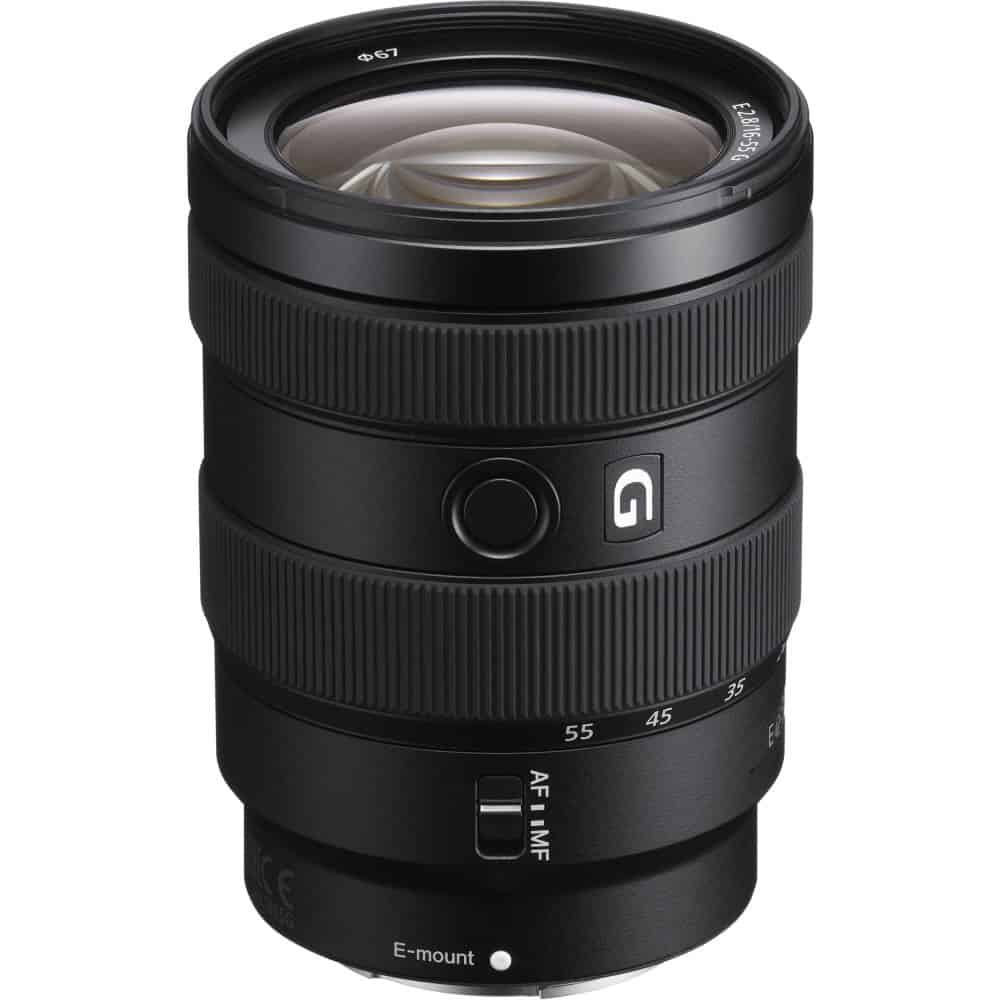
Not wanting to lag behind the competition in the APS-C sensor segment, Sony launched the flagship Sony E 16-55mm F2.8 G lens with impressive image quality and high-end finishing.
The design of the Sony E 16-55mm F2.8 G is very compact at the same time-494g and 73 x 100 mm. Although the entire body is finished in metallic imitation paint, good weather resistance has been ensured by rubber rings. The negative aspect comes from plastic predominating so that the lens is a light one. In the hand, the Sony E 16-55mm F2.8 G is very comfortable compared to its competitors’ lenses of equal focal length. When combined with an E-mount body, the Sony E 16-55mm F2.8 G becomes compact and contributes greatly to making the photographic system a light, manageable, and versatile one.
Of the current crop lenses, the E 16-55mm F2.8 G focuses and tracks fast subjects with exceptionally high precision via XD linear motor borrowed from the G Master series. All the writer can say is that the Sony E 16-55mm F2.8 G focuses quite speedily. The Hold Focus button is really useful for locking focus on a subject being photographed; with the algorithm for quick focusing and continuous eye focus given to models A6400 and forward, this button is almost useless.
Considering the flagship lens for Sony’s crop sensor camera line, it is clear that the E 16-55mm F2.8 G renders an incredible sharpness, low distortion, and no aberrations even under complex lighting conditions. It shall be no exaggeration to say this is The King of Crop Lens from Sony, an excellent bargain in its class.
Sony E 16-55mm F2.8 G Lens SEL1655G Standard Zoom for APS-C E-Mount Cameras Bundle with 67mm Deluxe Photography Filter Kit, Deco Gear Backpack Case and Accessories: Buy it now
Optical Performance
Image Quality
The Sony E 16-55mm F2.8 G lens achieved the very best performance one would expect in terms of optics, providing excellent sharpness and detail throughout the entire zoom range. Advanced optical technologies are used by this lens to reduce aberration and distortion effects to produce high-quality results in a vast shooting scenarios.
Sharpness: It is notable that the lens maintains sharpness from edge to edge with very good performances in maximum aperture f/2.8. The images throughout the zoom range capture amazing crispness and detail such that the lens becomes effective for landscape and portrait photography at the same time.
Contrast and Color: The lens adds this effect by producing saturated colors and high contrast, thus resulting in very lively, vibrant images. Chromatic aberration and color fringing are easily controlled to match an exact color reproduction at the same time.
Distortion and Vignetting: The lens is minimally distorted and vignetted, an effect very well controlled over the entire zoom range, keeping images pretty much to their intended composition and framing without significant optical artifacts.
Bokeh and work with DOF
This enables a subject to have a shallow depth of field. This is especially valuable for achieving good bokeh and separating a subject from the smoothly creamy background as well as for enhancing the portraiture and close-up shot images with lovely smooth out-of-focus areas that result in beautiful point effects produced by the lens.
Optical design
Many complex optical concepts exist in the design of highly performing lenses, such as the top ten having:
ED Glass Elements: spill-off or extra-low dispersion (ED) glass elements is used to get rid of chromatic aberration thus enhancing the overall clarity of an image.
Aspherical Elements: Spherical aberration is largely corrected as well as sharpness maintained all across the frame by aspherical lens elements.
Nano AR Coating: This reduces flare and ghosting and improves viewing under harsh lighting conditions.
Autofocus Performance
Speed and Accuracy of Autofocus
The Sony E 16-55 mm F2.8 G lens features an advanced linear motor and an internal focus mechanism to create fast autofocus and highly accurate focusing. This makes this lens ultra-fast, ever-accurate, and matched for quick, moving events. Also, it does extremely well under lighting or conditions of less light, ensuring precision in subject capture.
Focus Acquisition: The lens locks focus fast and with little amount of hunting which is extra beneficial for doing fast-paced action and moving subjects.
Focus Accuracy: Sharpness on the subjected focus is achieved accurately using the AF system.
Manual Focus Performance
Smooth and very nice manual focus ring comprises such a lens, useful for all those users who prefer focusing on their own-their way. Fine adjustments are possible to bring the exact desired focus point. There is also substantial feedback and resistance in the X100T focusing ring, ensuring a very tactile feel during manual focus.
Trackless Operation
The focus works without the sound during an autofocus which could be very useful for video shoots and the other happenings that a noise would find distracting. With a smooth but soundless operation, linear motor plushes and adds up to a much elaborate shooting pleasure.
User-friendliness and Versatility
The Everyday Use of
Flexibility of the Sony E 16-55mm F2.8 G lens for Photography: As focal length of 16-55mm widens to standard zoom, the lens is well fitted for multipurpose photography. The lens suits landscape, portrait, and urban photography excellently, being the kind of gear that is so flexible with different photographic subjects one may want to capture.
Travel and Everyday: The lens is compact, lightweight, highly practical in carrying and using for travel and everyday shooting. Great image quality without all the baggage typically associated with larger zoom lenses makes carrying around simple and efficient in many shooting situations.
Portraiture and Landscapes: Possibility of subject isolation via beautiful background blur makes it a good option for portraits because of its constant aperture of f/2.8. The wide angle also makes it a great candidate for large landscapes and architectural photography purposes.
Compatibility
The lens is designed for Sony’s APS-C mirrorless camera models, like α6000 series, α5000 series, and α6100, as well as the α6600 camera. It cannot be used on full-frame Sony E-mount cameras. This elegant focal-length equivalent of 24-82.5mm provides great versatility in handling multiple photographic applications.
Handling and Design
Mount it on a Sony APS-C body and the balance is right — nothing tips forward, nothing feels front-heavy in your hand. The zoom and focus rings sit exactly where your fingers land naturally, so you’re adjusting without ever looking down at the barrel. And it stays compact enough that the whole rig doesn’t turn into something you dread carrying around all day.
Comparison with Other Lenses
Sony E 18-55mm F3.5-5.6 OSS
Side by side, the 16-55mm F2.8 G just outclasses the 18-55mm. Constant f/2.8 the whole way through means real low-light shooting and actual background blur, the variable-aperture lens can’t touch either. Sharper glass, fewer aberrations too. Price is the only thing going for the 18-55mm; it’s noticeably cheaper, and for someone counting every dollar, that’s still a legitimate reason to pick it.
Sigma’s 18-50mm F2.8 DC DN plays in the same space same constant f/2.8, slightly different range. It’s a genuinely sharp lens with build quality that holds its own against the Sony. Where it loses is zoom range and weather sealing; Sigma skipped both.
Sony E 10-18mm F4 OSS
Different job entirely, this one’s for going wide. F4 constant, broader focal range, but forget matching the 16-55mm in low light or bokeh; it’s just not built for that. What it does well is wide-angle stills and video, and if that’s your use case it’s the better tool. Outside of that, though, it’s the less flexible lens by a wide margin.
Conclusion
This is Sony’s answer for anyone on APS-C who wants a zoom that doesn’t force compromises f/2.8 the whole way through, tough enough that you stop treating it like something fragile after the first week. Autofocus doesn’t lag behind you, images are sharp straight out of the lens, and eventually it just becomes the thing that’s always mounted, the one you stop thinking about. It disappears in your bag when you don’t need it and shrugs off a little rain or dust when you do.
Related Posts





Tech Reviewer & Product Analyst
Định Bia has spent over 10 years testing consumer electronics with a focus on smart technology. He work as a product advisor at Biareview where he helped customers find the right devices for their needs. He personally tests every product featured on this site using a consistent evaluation framework covering quality, durability, and value. All reviews are based on experience, not influenced by the manufacturer.