Design
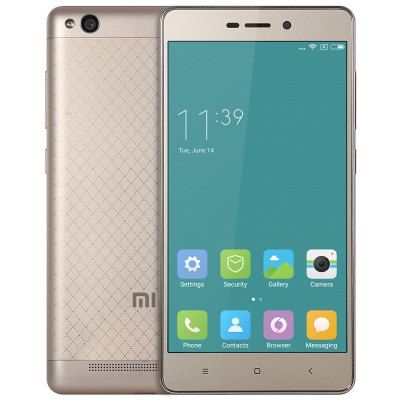
From canning, styling to design, Xiaomi Redmi 3 can be considered a cheap copy of Redmi Note 3 before. The handset still features a soft rounded design, metallic but not solid bezel, and two plastic strips placed on the top and bottom edge for better reception.
Compared to its predecessor Xiaomi Redmi 2, Redmi 3 is a spectacular breakthrough. But if placed next to the Xiaomi Redmi Note 3 was released shortly ago, Redmi 3 is really boring, despite addition decorate, or camera and flash light assembly is placed to the left.
Overall, the design of Redmi 3 shows Xiaomi’s design bottleneck with cheap smartphones. Or maybe, the Chinese manufacturer wants to take advantage of the Redmi Note 3’s previous image, to promote its new Redmi 3.
Display , Screen quality and resolution
The Xiaomi Redmi 3 shipped with a 5.0-inch IPS LCD display, and yeah the resolution was 720 x 1280 pixels, so HD, plus a pixel density around 294 PPI. At the same time, this wasn’t really revolutionary, since Full HD screens started showing up everywhere, but for what the phone cost it still felt pretty adequate. During everyday use, text and images looked sharp enough, like crisp and clear, without that “smudgy” look you sometimes get on cheaper panels.
Also the IPS tech gave wide viewing angles. Colors didn’t do that dramatic shifting thing too much when you tilt the phone left or right, so the Redmi 3’s screen stayed comfortable to look at , even when you’re showing something to someone else or changing the orientation now and then.
Color reproduction and brightness
In terms of color, the Redmi 3 wasn’t wildly off. The colors came out fairly true , with this lively but still kind of natural vibe, i think. It wasn’t maybe the most color-accurate display you’d run into, but it was totally fine for everyday stuff like browsing , streaming, and casual gaming. The screen also supported 16 million colors, which helped with a wider color gamut and made the visuals feel more pleasing overall.
Brightness was also on the decent side, topping out at about 450 nits. That meant readable content in many situations, even outdoors for short periods. Still, in strong direct sun it could get a little tougher to see , and that’s pretty common for budget phones. Xiaomi also added a “sunlight mode” in the settings, it tweaked contrast and brightness to help outdoor readability, though honestly it wasn’t as strong as what you get from displays that simply go brighter.
Touch response and user experience
With the Redmi 3’s display, the touch response felt really smooth and pretty accurate too, like it was doing what it should, and the screen kept registering touches reliably . It also supported as much as 10-point multitouch , which is honestly more than enough for most everyday stuff, from gaming to doing multiple things at once.
On the software side Xiaomi’s MIUI offered a decent pile of options for tuning the display feel, not just the basics, and there’s a reading mode for example, that trimmed down the blue light emission so nighttime reading felt less harsh . People can also dial in the color temperature and contrast levels based on preference , so the whole thing feels a bit more tailored to your own eyes and taste.
Grip experience
With a screen size of just 5 inches, the Redmi 3 feels kinda more compact all around than the earlier Redmi Note 3, honestly. Like , the Redmi 3 dimensions come out 139.3 x 69.6 x 8.5 mm , so it is roughly 0.2 mm thinner than the Redmi Note 3. It’s not a massive difference, but still you can notice it a bit if you pay attention, especially in the hand.
In addition, the weight of the machine is 144 g, also lighter than the Redmi Note 3. Overall, the grip is easy, lightweight, compact in the palm of the user. If you bring these two smartphones out compare, we will see that, Redmi 3 almost fall short compared to Redmi Note 3.
In addition, the texture of the back of the Redmi 3 is plated, sanded, smooth, no feeling of handcuffs, when tilted to create a sparkling effect quite fancy. Left, the magnesium alloy on Redmi 3 is said to be durable, or harder than Redmi Note 3 does not bring a strange experience.
Features and configurations
Because Redmi 3 is a cheap phone version, the machine is not equipped with fingerprint security technology as on the Redmi Note 3, unlocked completely through the password. Thereby, Redmi 3 configuration is also significantly reduced, with 5 inch screen, HD resolution, 2 GB RAM.
Through the actual test, the screen of Redmi 3 is quite bright, good viewing angles, and cool tones. So when used in dark conditions, users should refine the smartphone screen avoid eye strain, or affect the eyesight.
Although possessing the processor is Snapdragon 616 from Qualcomm, the performance point of Redmi 3 is just as usable. The power of this processor is mainly CPU, while the GPU graphics support for the game is not high, far behind the Helio X10 processor on Redmi Note 3 before.
Finally, with the Redmi 3 smartphone, users will get the return of the microSD memory card slot. To say that this is one of the rare smartphones of Xiaomi that support this feature. Previously, the mid-range product Mi 4c and Redmi Note 3 also did not support memory cards.

Xiaomi Redmi 3 Android Smartphone – Android OS, Dual SIM 4G, Octa Core CPU, 13MP Camera, 4100mAh Battery, 2GB RAM: Buy it now
Xiaomi Redmi 3 Smartphone – Octa Core CPU, 2GB RAM, Dual SIM 4G, 4100mAh Battery, Android OS, 13MP Camera (Gold): Buy it now
Camera
It can be said that the camera is considered the biggest improvement on the Redmi 3 smartphone. Xiaomi claims to have applied new technology to this camera cluster, but it is not clear what. Just know, the Redmi 3’s camera gives you a more detailed picture, especially with HDR shooting.
In addition, the phenomenon of color blindness on the camera Xiaomi also be overcome thoroughly. When shooting in deep blue sea, these details are not tilted to the blue of the blue. Or when shooting in HDR mode, the image is not pushed too brightly in bright enough conditions.
However, the camera on Redmi 3 also has certain weaknesses. First of all, under low light conditions, the camera is severely noise, and the picture is blurred. Also, when shooting selfie, focus camera is not really good, selfie shooting quality not as expected.
Pin
If the configuration of Redmi 3 is not the highlight, the battery capacity of 4,100 mAh on this smartphone is worth the attention of the user. According to the manufacturer, the battery more 25% usage time than the previous generation, using the same 5V – 2A charger.
Compared to some of Xiaomi’s recent low-cost smartphones, the 4,100mAh battery is not exactly a big improvement. However, if combined with the screen only 5 inches, the resolution is also HD, the user can fully expect, Redmi 3 will give approximately 2 days of battery life.
Performance and Hardware
Processor and GPU
If you peek under the hood, the Xiaomi Redmi 3 ran on the Qualcomm Snapdragon 616 chipset. it is an octa-core setup , basically four Cortex-A53 cores at 1.5 GHz along with another four Cortex-A53 cores at 1.2 GHz . For visuals and graphics processing , you got the Adreno 405 GPU doing most of that heavy work.
At launch, the Snapdragon 616 was considered a mid-range chip, and compared to the Snapdragon 410 inside the Redmi 2, it felt like a real step up. With the octa-core design, multitasking became more , “easier” i guess, because the lower-clocked cores took care of everyday stuff. meanwhile the higher-clocked cores could wake up for tougher apps , or more intensive scenarios, like gaming or heavier interface animations.
RAM and Storage
As for memory, the Redmi 3 shipped with 2 GB of RAM and 16 GB of internal storage. For that price class, this was pretty typical at the time. 2 GB can cover basic multitasking and normal daily use , but when you stack multiple heavier apps, or run a game plus background services, it can start to feel a bit restrictive.
Storage wise, 16 GB is not exactly huge either. apps grow, photos pile up, and media files take more space than people expect , so limitations show up sooner than later. Still , there is a microSD expansion option , up to 128 GB, which helps a lot if you keep installing stuff. The catch is , the hybrid SIM tray means you generally have to trade the second SIM slot for the microSD card, so it’s a little bit of a balancing act.
Everyday Performance
For day to day use, the Redmi 3 felt smooth enough for most things. It went through routine chores like web browsing, social media ,and messaging in a pretty straight forward way. Apps did open at a decent pace, and jumping between them was usually seamless, yet sometimes there were brief pauses, especially once heavier apps were running or the phone was under more load.
The Adreno 405 GPU was fine for casual gaming, not for some serious marathon sessions. Titles such as “Subway Surfers” and “Clash of Clans” worked without much fuss, while the more demanding games, for example “Asphalt 8” and “Modern Combat 5”, were still playable but with lower visual choices, like reduced graphics. So, even if it wasn’t built for hardcore gaming, it still managed popular mobile games pretty well during that period.
Benchmark Performance
When it comes to benchmark testing, the Xiaomi Redmi 3 posted some results that were honestly pretty solid for its specific category. In AnTuTu , which is this commonly used general performance test , the Redmi 3 landed around 33,000 to 35,000 points ,so it stayed in the mid range bracket . Overall it looked like a pretty steady deal rather than anything wild. It s basically not bad, like you’d expect. That number was pretty fair for a budget phone, and it basically showed it could manage a wide mix of tasks without falling into heavy slowdowns.
Then in Geekbench ,which focuses on CPU speed, the Redmi 3 scored roughly 630 points on the single core part and about 2,500 points on the multi core part. These results matched what you’d expect from other devices built on the Snapdragon 616, which basically confirms the Redmi 3 was a credible mid range performer.







Tech Reviewer & Product Analyst
Định Bia has spent over 10 years testing consumer electronics with a focus on smart technology. He work as a product advisor at Biareview where he helped customers find the right devices for their needs. He personally tests every product featured on this site using a consistent evaluation framework covering quality, durability, and value. All reviews are based on experience, not influenced by the manufacturer.