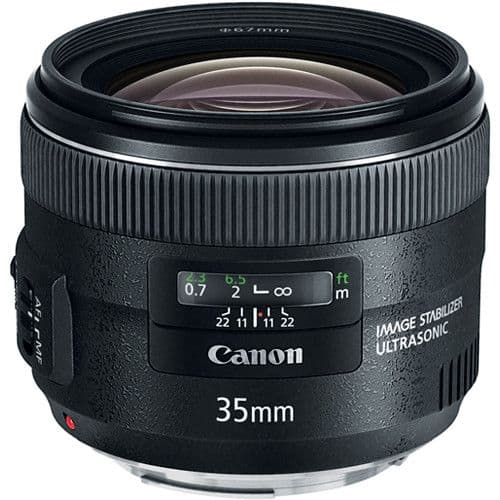
Canon EF 35mm f2 is one of the few lenses to have been produced since 1990 but so far no alternative version.
Users love Canon cameras are often heard of the legendary Canon EF 35mm f1.4L USM lens, but not many people know the standard lens with a focal length of 35mm, f2 open but cheap. This is one of the few lenses produced since 1990 but so far no alternative version.
The EF 35mm f2 has some disadvantages, such as the lack of a supersonic focusing motor, aberrative handling and color, but with the advantages of a compact design, versatile focal length, price Cheap and good image quality compared to the price (about 350 USD), probably unprofessional users will choose this lens for the needs of shooting instead of expensive EF 35mm f1.4L USM (about $ 1400 USD).
Canon EF 35mm f/2 Wide Angle Lens for Canon SLR Cameras (OLD MODEL): Buy it now
Canon EF 35mm f/2 IS USM Wide-Angle Lens: Buy it now
Canon EF 35mm f/2 IS USM Lens with UV Filter + Hood + Cap Keeper + Cleaning Kit for EOS 6D, 70D, 5D Mark II III, Rebel T3, T3i, T4i, T5, T5i, SL1 DSLR Cameras: Buy it now
Canon EF 35mm f/2 IS USM Lens with Sling Backpack + 3 UV/ND8/CPL Filters + Hood + Cleaning Kit for EOS 6D, 70D, 5D Mark II III, Rebel T3, T3i, T4i, T5, T5i, SL1 DSLR Cameras: Buy it now
Canon EF 35mm f/2 IS USM Lens with 3 UV/ND8/CPL Filters + Hood + Tripod + Cleaning Kit for EOS 6D, 70D, 5D Mark II III, Rebel T3, T3i, T4i, T5, T5i, SL1 DSLR Cameras: Buy it now
68 x 56mm, 270 grams — you genuinely forget this lens is on your camera. Small enough to live in a jacket pocket, light enough that your neck won’t complain by the end of the day.
It’s mostly plastic with a metal mount, and yeah, that’s part of why it’s this light. Matte black finish, resists scratches and fingerprints reasonably well. Nothing about the design is trying to impress you. It’s just there to work.
The focus ring feels good — smooth, precise, easy to grip despite the small barrel. Autofocus is the older micromotor type, not USM, so it’s noisier and a touch slower than what Canon puts in newer lenses. Not a dealbreaker. Just noticeably less refined if you’re used to something quieter.
Where this lens actually earns its reputation is image quality. Stop it down to f/4 or f/5.6 and it’s excellent — sharp corner to corner. Wide open at f/2, the center holds up fine, corners take a beat to catch up. Colors are accurate, contrast is good, and the whole thing gives you images that look clean without needing much rescue in editing. Distortion is basically a non-issue, which makes it a decent pick if you’re shooting anything with straight lines you care about — buildings, mostly. Chromatic aberration is well handled too, though wide open in high-contrast light you might spot a hint of purple fringing. Nothing that ruins a shot.
Bokeh wide open is smooth and creamy — the seven-blade aperture keeps those out-of-focus highlights rounded instead of jagged. Between that and the 35mm focal length, you get real subject separation at f/2, enough to pull someone out of a busy background without overdoing it.
The wide aperture pulls its weight in low light too — faster shutter speeds, lower ISO, less strain on the sensor. How that plays out in practice still depends on the body it’s attached to, but the lens itself does its part.
Street photography is really where this thing lives. 35mm gives you a natural field of view, nothing exaggerated, and the small size means you’re not the person carrying the lens that makes strangers nervous. It’s not built as a portrait lens, but f/2 gives enough blur for environmental portraits, and the wider view adds context a longer lens would crop out. For landscapes and architecture, the sharpness and lack of distortion do most of the work. For travel, it’s just easy — solid image quality without the bulk.
Stack it against Canon’s own EF 35mm f/1.4L II USM and the newer lens wins on paper everywhere — wider aperture, better-controlled optics, weather sealing, a build that can take real abuse. It also costs a lot more and weighs a lot more. The RF 35mm f/1.8 IS Macro STM, built for mirrorless, throws in stabilization and actual macro range. Sigma’s 35mm f/1.4 Art is the wildcard — genuinely excellent glass, priced and built to match.
None of that changes what the f/2 is good at. It’s the cheaper, older, simpler option — and for plenty of people, that’s the whole appeal.
Here’s the trade you’re making: sharp images, accurate color, a lens you stop noticing you’re carrying — in exchange for slower and noisier autofocus, a plastic build that won’t survive being dropped down stairs, and no stabilization at all, so you’re on your own in low light. If you need the best 35mm Canon makes, buy the L-series and pay for it. If you just want something small that gets the fundamentals right without asking much of you, this one’s been doing that for years, and it’s still doing it.
Related Posts


Tech Reviewer & Product Analyst
Định Bia has spent over 10 years testing consumer electronics with a focus on smart technology. He work as a product advisor at Biareview where he helped customers find the right devices for their needs. He personally tests every product featured on this site using a consistent evaluation framework covering quality, durability, and value. All reviews are based on experience, not influenced by the manufacturer.