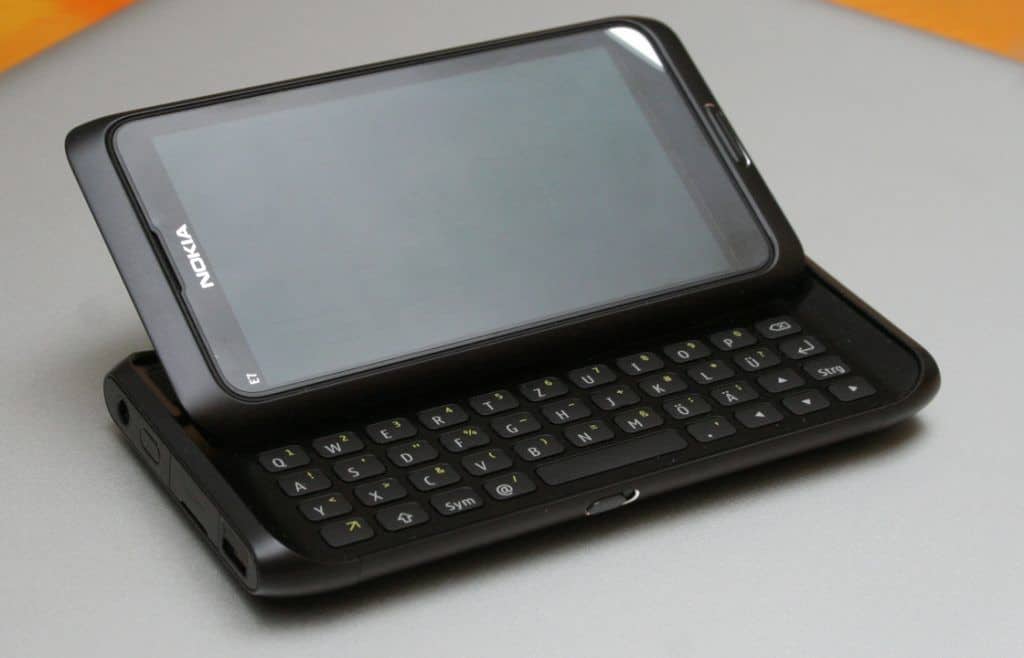
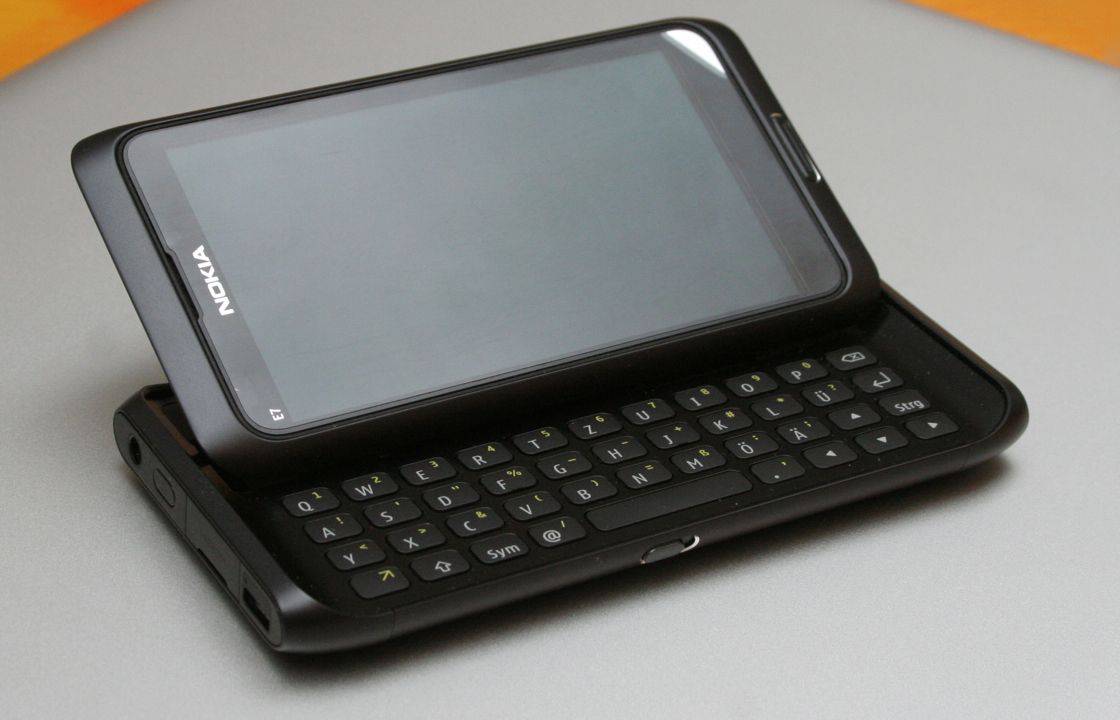
Beginning in the genuine segment last week, the Nokia E7 is the successor to the E-series. However, the slide-out keyboard design, wide screen makes it easy to relate to the legendary Communicator models that ended with the Nokia E90.
Nokia E7 owns a good design, nice screen. The first evaluation can immediately see the slowdown of Nokia in the processor upgrade, in addition, the interface is not as new as iOS, Android. However, using the fact Nokia E7 shows that this is still a business user model can be selected by the dedicated support that Nokia brings.
Points of interest of Nokia E7:
4 inch screen, 16 million colors, ClearBlack AMOLED capacitive touchscreen, 640 x 360 pixel resolution, Gorilla mirror surface.
It does quad-band GSM, plus 3G connectivity with HSDPA 10.2 Mbps and HSUPA 2 Mbps, so yeah fast enough for most stuff back then.
It runs the Symbian^3 operating system.
Processor sits at 680 MHz ARM 11, 256MB of RAM, and 16GB of internal memory.
You get standard Wi‑Fi connectivity, GPS, and Bluetooth 3.0 too.
For media there’s an 8 megapixel camera with LED flash, 720p HD video recording up to 25 fps.
Extras include an electronic compass, a 3.5mm headphone jack, plus support for DivX and also XviD.
And yes, the full office suite.
Design and build quality, kind of premium vibe with practical intent, like it’s trying to look sophisticated but still useful everyday.
Design and build
With dimensions of 123.7 x 62.4 x 13.6 mm and a weight of 176 grams, the Nokia E7 felt big, it’s a sizable device, reflecting its robust build and large display. The phone’s design was more on the sturdy construction side, and you can spot that professional look right away.
The E7 it also came with a sleek aluminum body, which gave it that more premium feel while helping with durability. Overall the build quality was solid, and the materials that were used kind of convey reliability and a touch of sophistication even at first glance.
The Nokia E7 kind of boasted a 4-inch AMOLED touchscreen, with a resolution 360 x 640 pixels, and you could really feel it in day to day use. This screen was pretty famous for its vivid hues and those deep blacks, mostly because AMOLED tech tends to handle contrast in a strong way. Brightness looked solid too, and the contrast was excellent , so it worked well for everything from reading text, to checking photos, and even just watching videos when you weren’t too picky.
That display also used a capacitive touchscreen, so multi-touch gestures were supported which made moving around the Symbian^3 interface feel smooth and natural, not clunky. Sure, the resolution wasn’t as sharp as later phones but for its size it was adequate, and overall it delivered a clear, enjoyable viewing experience, most of the time.
Design Elements
A big part of the Nokia E7’s design was the full QWERTY keyboard, it slid out from underneath the display. The slide action was smooth and durable , and the keyboard was clearly made to boost typing efficiency for business minded users. The keys were spaced out nicely, and they had that tactile feedback, so typing felt comfortable , and surprisingly accurate.
On the front, you got the display up top, and under it there were three physical buttons , Home , Menu, and Back. Then the power button plus the volume controls were on the sides of the device, while the 3.5mm headphone jack and the micro-USB port were placed along the top and bottom edges respectively.
On the back of the E7 there was this 8-megapixel camera setup, with a dual LED flash, and honestly the Nokia logo was placed so it was pretty easy to notice right away. The battery cover came off, so you could get to the battery , the SIM card slot, and also the microSD card slot. All in all the way Nokia approached the E7 felt like some kind of mix between elegance and practicality, like it was trying to give you a premium user experience without making things too complicated.
Display and Touchscreen
The display on the Nokia E7 was sort of a highlight, it showed vibrant colors and you got good visibility for a bunch of different tasks.
Screen Size and Resolution
You had a 4-inch AMOLED display that gave users a fairly big , immersive viewing area. The resolution was 360 x 640 pixels which worked out to around 184 pixels per inch (PPI), and that number was good enough for the screen size. Sure, it wasn’t as detailed as later smartphones, but it still delivered clear and crisp visuals for most apps, also for media.
Touchscreen Performance
The touchscreen was capacitive, and it handled multi touch gestures, so interaction with the operating system felt smooth. The touch response was mostly accurate and kind of fluid, and there was usually minimal lag when navigating , or when you were entering text and doing commands. The responsiveness mattered a lot for things like web browsing, gaming, and everyday app usage, because you really want the screen to react quick, and the E7 tried to do that too.
Display Quality
The AMOLED tech used in the E7 screen really did show some strong color reproduction, like deep blacks and a lot of contrast. In day to day use, the display looked bright, clear, and pretty dependable across different lighting situations, even when the environment changed. It was especially noticeable while looking at photos , watching videos, and basically any other multimedia stuff, the whole panel just seemed to hold up nicely.
Out in direct sunlight it still kept decent visibility, although yeah, in super harsh brightness it could get a bit tricky. Still overall the E7’s display quality helped make the experience feel smoother, and it made the device’s multimedia side feel more capable than you’d expect.
Camera Performance
The Nokia E7 showed up with an 8 megapixel rear camera and a dual LED flash, basically built for solid photography along with video recording. The whole point was that, you’d get more steady results, without having to mess around too much.
Image Quality
With its 8 MP sensor, the camera could produce photos that looked detailed and fairly lively. The overall performance was generally good, the colors were mostly accurate, and the sharpness was decent too. When the lighting was good, images came out clear and packed with visible detail, though the results weren’t always the same—depending on the scene, and how the light sat around the subject, the quality could change a little.
In low-light situations, the dual-LED flash helped a bit, but honestly the results were kind of limited. A lot of the photos i n low light still came out with noise, and details felt, like, missing. The phone also had different shooting modes—auto, portrait, landscape, and macro—so there was some flexibility depending on what you were trying to capture.
Video Recording
The E7 could record video up to 720p, max resolution. For its time the quality was decent enough, with mostly smooth frame rates and fairly okay clarity. Still, the absence of advanced options like optical image stabilization really toned down the overall feel, even if it was good for casual recording.
Front Camera
On the front, the Nokia E7 had a VGA camera meant mainly for video calling and self portraits. It worked for basic needs, but the resolution and overall output were limited compared to the rear camera, no big surprise there.
Performance and Hardware
The Nokia E7 came with hardware meant to keep things smooth and responsive, and it leaned on Symbian^3 as its operating system.
Processor and RAM
The E7 ran on a 680 MHz ARM 11 processor, it was enough for Symbian^3, and it handled the everyday smartphone stuff alright. It also had 256 MB of RAM , so apps could stay fairly fluid and switching between tasks didn’t feel too sluggish. Sure, compared with later phones it wasn’t the strongest setup, but for the E7’s purpose it still did what was needed.
Storage
The Nokia E7 included 16 GB of built in storage, that gave plenty of room for apps, photos, music ,and the rest of your stuff. Plus there’s a microSD card slot, and it let you expand storage up to 32 GB, which is handy when your files start stacking up. This kind of expandability was basically a safety net for users who wanted extra space without swapping devices.
Battery Life
Inside the E7 there was a 1200 mAh removable lithium ion battery. In real use, battery life was pretty decent, usually lasting through a day if you kept things moderate like browsing , watching media, and regular calls. If someone used it more heavily, then yeah it could run down sooner, but the removable battery helped because you could simply bring a backup.
Software and User Interface
The Nokia E7 ran Symbian^3, which was an update to Nokia’s older Symbian system, and it was built to feel more up to date and more approachable. The general idea was a smoother user experience, and a layout that made normal navigation less of a chore.
Symbian^3
Symbian^3 kinda arrived with a bunch of improvements over earlier builds, like an refreshed interface, a stronger kind of multitasking, and extra guidance for touch interactions , sort of. The whole thing also felt a bit more polished too, with upgrades in performance and everyday usability at the same time, even though it still kept that classic vibe.
On the E7 side of things, the interface had a customizable start screen, with little widgets and shortcuts, so you could reach important features faster. Multitasking was supported too, meaning you can move between applications and juggle tasks around at the same time. In practice the day-to-day feeling was pretty fluid and responsive, though, sometimes it was less intuitive than what you’d expect from newer operating systems.
Nokia Customizations
Nokia added its own touches to the Symbian^3 experience as well, including pre-loaded Nokia applications and those built-in widgets. The point of these changes was pretty clear: to boost what the system could do, and to hand users extra tools and services right away, without much setup.
Some of the Nokia-specific things were Nokia Maps, for navigation, and the Nokia Ovi Store, for downloading apps. There were also Nokia email and messaging applications in the mix. Together, these updates made the whole experience feel more complete and more connected, for everyday use, even if you had to learn the layout a bit.
Application Ecosystem
The Symbian^3 operating system had a kind of expanding ecosystem of apps and services, plus access to the Ovi Store for grabbing more applications. At first the app selection was a bit thin compared to other platforms ,but it still had a mix of popular and genuinely helpful tools, for productivity, entertainment, and social networking.
Also there was a smooth sort of tie-in with Nokia services, so you could get extra functionality like navigation, music, and media management, pretty handy in day to day use. The Ovi Store itself brought a variety of apps, although it did have to deal with the competition from older, more established app marketplaces.
Connectivity and Network
The Nokia E7 supported several connectivity options, so users could remain connected and reach different services without too much hassle.
Network Connectivity
The phone worked on GSM networks across the 850, 900, 1800, and 1900 MHz bands, and it also had 3G connectivity for the 900 and 2100 MHz bands. So it could play nice with a broad group of carriers, which helped keep things dependable not only for voice calls but also for data transfers too.
Wireless Connectivity
The E7 came with Wi-Fi 802.11 b/g/n support, which made it possible for users to hook up to local wireless networks and get quicker internet access, plus, less data usage overall. it also had Bluetooth 3.0 built in and that helped for wireless pairing with accessories like headphones and also speakers, basically the usual kinds of gear.
GPS and Navigation
On the navigation side, the Nokia E7 included aGPS, so it could deliver location services for maps, and for other location based apps too. there was an integration with Nokia Maps, and that gave access to both mapping plus navigation tools with offline map support and turn by turn directions. In general the GPS performance was pretty solid, with stable location tracking and dependable guidance.
Multimedia Capabilities
The Nokia E7 seemed tuned for media time, with a set of features and options that were meant to boost multimedia consumption without too much hassle.
Music and Audio
For music, the device offered a built in music player that could handle a range of audio formats like MP3, AAC, and WMA. The player also had a straightforward interface , for sorting through tracks and playing them, including playlist creation and browsing by artist, album, or genre.
The E7’s built-in speakers provided clear and loud audio for casual listening, although the overall quality wasn’t as high as what you’d find on more recent devices, with advanced audio technology i n them. The 3.5mm headphone jack gave flexibility for people who like using their own headphones or external speakers.
Besides the music player, the E7 also supported FM radio, so you could catch live radio broadcasts. There was also an FM transmitter included, which is a pretty standout thing , it lets you broadcast your music to nearby FM radios. That can be useful in cars or in other audio setups where you don’t really want to connect cables.
Video Playback
The Nokia E7 handled video playback up to 720p, so users could watch high-definition style content straight on the phone. The big 4-inch AMOLED display was actually nice for watching video, it gave vibrant colors and a solid contrast, you know, the usual good screen behavior.
The video player supported this bunch of formats like MP4, AVI and WMV, so it was pretty versatile for lots of different video files. Performance was usually smooth, but every now and then some folks might hit limits with high bitrate or high resolution videos, and then you could see the playback stutter, or just get a little lag.
Camera Features
The Nokia E7’s camera was meant to produce solid photos and videos, with several options kind of built in to make taking pictures feel better.
Camera Interface and Modes
The camera interface felt pretty user-friendly , with access that was simple to get to for a bunch of shooting modes and settings. Most users could just go with options like Auto, Portrait, Landscape, Macro, and more like that. Also, the camera app had a few extra things going on, for example scene modes, white balance tweaks , and image effects, so people could personalize their photos, based on what they liked best.
Photo Editing
The E7 brought along the more basic photo editing side of things. You could crop, rotate , and apply filters to your photos right there. Sure, it wasn’t as advanced as what you see in later smartphones, but it still gave users some breathing room, for improving their images directly on-device, without needing extra steps.
Nokia E7-00 Silver made in Finland Unlocked GSM Phone, QWERTY Keyboard, Easy E-mail Setup, GPS Navigation, 8 MP Camera (International version, No Warranty): Buy it now
Strength
– Rigid design, sturdy slide mechanism
– A good QWERTY keyboard
– 4 inch ClearBlack AMOLED screen, nice display
– Full office features
– Ovi Maps adds many new gadgets
– Powerful connectivity with 3G high-speed, GPS, Wi-Fi standard
– Good security
Weak
– Simple interface
– Speed is not fast
– Camera does not have autofocus




Tech Reviewer & Product Analyst
Định Bia has spent over 10 years testing consumer electronics with a focus on smart technology. He work as a product advisor at Biareview where he helped customers find the right devices for their needs. He personally tests every product featured on this site using a consistent evaluation framework covering quality, durability, and value. All reviews are based on experience, not influenced by the manufacturer.