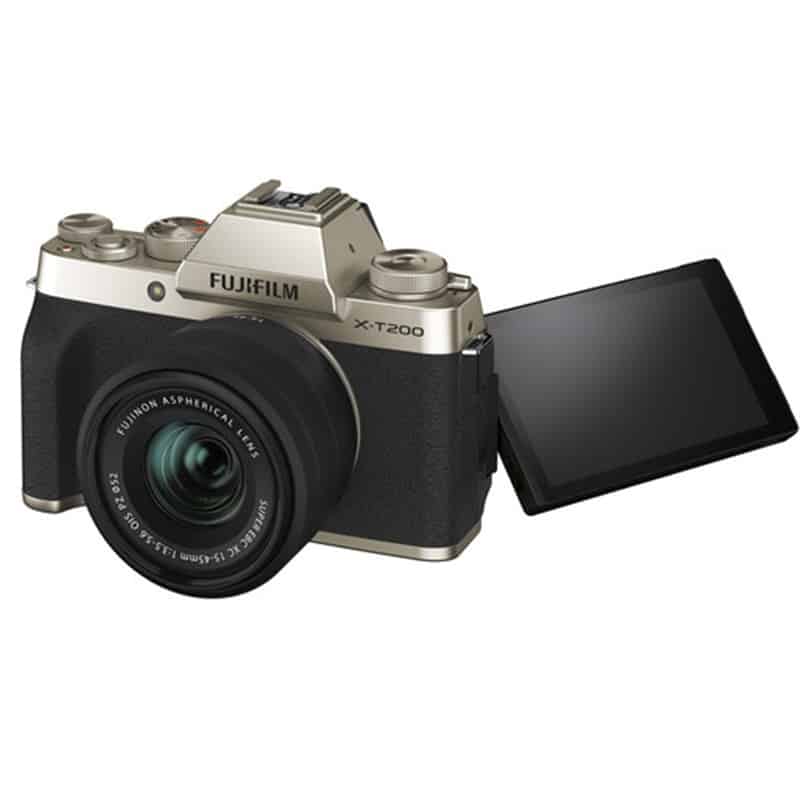
A beginner’s entry level X-A camera model in terms of X-T cameras is also brought to detail by Fujifilm in a sequence of three-digit XC series, such that the differences better define the selection in the event that a user needs to further advance their skillset. Mid section price wise yet combining two basic features and advanced ones, the Fujifilm X-T200 would also be a good choice for someone who really wants to hone their skills quite fast while getting into the field of photography.
Of course, Fujifilm designed the X-T200 with a quite square body with a protruding flash area with the words Fujifilm on it along with similarities of design to the X-T100 brothers. While this camera is boxed along with all those for beginner photography users similar to the XA series, this camera is intended for entry level novices together with semi-pros so it has feature set to cater those two end user segments. Most prominent of those are that it has a viewfinder and even though it’s said to be reducing the operations on the machine, Fujifilm still retained a lot of function buttons for the user to customize.
The X-T200 cuts quite a few of those wonderful function buttons found on the higher X-T versions, for the entry level shooting user. Though the X-T200 still retains its tarator, the right side has two dials for adjustment of EV and aperture. The left multi-function dial allows the setting of other functions for the user that may not like what the standard setting does to change their Fujifilm’s color profile.
Most of the new novice users’ functions have hardly changed to ISO, AE-L, … have “add” into the machine’s touch screen. Fujifilm also cut down on the D-Pad by only two Menu and Back buttons but swapped used by the manufacturer to incorporate the Joystick button focused on using one touch to choose the focus area. Again, it is quite fortunate that Fujifilm did not remove two Fn buttons in the back of the device but keep the “white button” for users to assign their most favorite functions.
X-T200 comes with a 3.5-inch tilting touchscreen with a resolution of about 2,780k points. The users are free to shoot at angles, and video users will also notice the “bonus” from this screen using the X-T200. Fujifilm also offers this very good-featured X-T200 with a USB-C cable and Bluetooth connection.
On the inside, the X-T200 is somewhat like an X-A7 with a Bayer APS-C sensor of 24.2MP, ISO range from 200 to 12,800. The X-T200 has two shutter options: a mechanical and an electronic shutter. The maximum speed offered by the machine’s electronic shutter is 1/32,000 sec. The camera also boasts impressive video recording features, with 4K/30fps and 1080P120fps, a new HDR Video feature for high-contrast shooting situations, and yet another “Digital Gimbal Function” mode that supports hand-held novices to limit shaking.
Photographing with the X-T200 is, in consdierable measure, similar to operating the X-A7, depending on the touch screen. But sincerely, it is upon more great luck that Fujifilm still offers white Fn buttons to set custom functions, which can be easier and quicker for semi-professional users to manipulate them. A point to be stressed that users should be learning over X-T200 rather than the X-A7 is that it is a bit heavier and that the grip of the camera juts out more. The very viewfinder allows users to compose accurately; hence, it is more professional and satisfying to get a photo.
While the X-T200 does use the same sensor like the X-A7, its imaging capabilities have found a totally new level with the continuous shooting speed of eight pictures per second. The setup with extremely fast focusing capabilities and high accuracy when it comes to focusing on faces and eyes is still maintained.
The machine’s capabilities in noise reduction are also impressively rated. The comparison of some and two numbers with the X-T series is quite difficult, but at ISO 6400, this machine is quite good. However, one should actually consider limiting ISO to 12800 as the maximum level since the only reason why ISO can go to 51200 is when the images are shot in JPEG mode anyway; further still, the quality would not be suitable for preserving memories.
Lastly, it’s quite unfortunate the battery life is not so much better than the X-A7 in the X-T200; it’s around 270 shots in Normal mode, but the Economy mode manages an impressive 450.
Though a new machine, the X-T200 performs admirably in contrast under backlit conditions.
Fujifilm X-T200 Mirrorless Digital Camera w/XC15-45mm Kit – Dark Silver: Buy it now
Fujifilm X-T200 Mirrorless Digital Camera w/XC15-45mm Kit – Dark Silver (Renewed): Buy it now
Usability and User Interface
Menu System and Controls
Menus on the X-T200 don’t require a manual to figure out, and the touchscreen means you’re tapping through settings instead of clicking a dial fifteen times to get where you want. There’s a quick menu too, for the stuff you’re actually adjusting mid-shoot instead of once and forgetting about.
Up top, the mode dial does the basics — P, A, S, M — switching fast enough that you’re not hunting for the right mode mid-shot. Beyond that there’s a pile of scene modes and creative filters, which is really where Fujifilm wants beginners spending their time, playing around instead of worrying about manual settings.
Customization and Settings
The X-T200 provides a plethora of customizable features that allow users to tweak their cameras to their design tastes. Assignable settings to modify include button assignment, Function Menu shortcuts, and Display options. The camera also offers a bundle of film simulations that replicate the appearance of Fujifilm’s classic films and thus give creative leeway to images.
Battery and Storage
Battery Performance
Battery’s the NP-W126S, and it’s not going to compete with anything bigger — 270 shots is the number, which is enough for a casual afternoon but not a full day of shooting. Bring a spare if you’re planning on more than that.
Storage and Media
One SD card slot, UHS-I compatible, and that’s it — no second slot for backup shooting or overflow storage. Most people won’t miss it, but if redundancy matters to you, it’s worth knowing upfront.
Pros and Cons
Pros
Small and light enough that you actually bring it places instead of leaving it home.
The 24.2-megapixel sensor pulls its weight — sharp, good color, solid dynamic range for the class.
The vari-angle screen flips out fully, so shooting from weird angles or recording yourself isn’t a fight.
4K Video Recording: The camera supports 4K video recording at up to 30p for improved quality and resolution.
Easy User Interface: The user-friendly interface provided by an intuitive menu system and touchscreen functionality makes the X-T200 very easy to use for beginner and amateur photographers.
Wireless Connectivity: Built-in Wi-Fi and Bluetooth make wireless media transfer and remote control via smartphone apps extremely convenient.
Cons
No Electronic Viewfinder: You’re stuck composing on the LCD screen — some people won’t care, others will find it a dealbreaker, especially outdoors in bright light.
Battery Life: The NP-W126S drains faster than you’d like. If you’re shooting for more than a couple hours, bring backup.
One Card Slot: Single SD slot only. Fine for most people, annoying if you shoot professionally and want a backup card running simultaneously.
Build: It’s not cheaply made, exactly, but it’s more plastic than metal compared to Fuji’s pricier bodies. You can feel the difference in your hands.
Conclusion
The X-T200 does what an entry-level camera should: it doesn’t get in your way, and it actually produces good images. The 24.2-megapixel sensor and 4K video give you more to work with than you’d expect at this price, and the vari-angle screen makes it genuinely useful for anyone recording themselves, not just an afterthought spec.
No EVF and mediocre battery life are the two things holding it back, and depending on how you shoot, either one might matter a lot or not at all. Even so, it’s hard to find much reason not to recommend it if you’re moving up from your phone. Fujifilm’s color science alone makes the jump worth it.
Related Posts

Tech Reviewer & Product Analyst
Định Bia has spent over 10 years testing consumer electronics with a focus on smart technology. He work as a product advisor at Biareview where he helped customers find the right devices for their needs. He personally tests every product featured on this site using a consistent evaluation framework covering quality, durability, and value. All reviews are based on experience, not influenced by the manufacturer.