Design and build quality
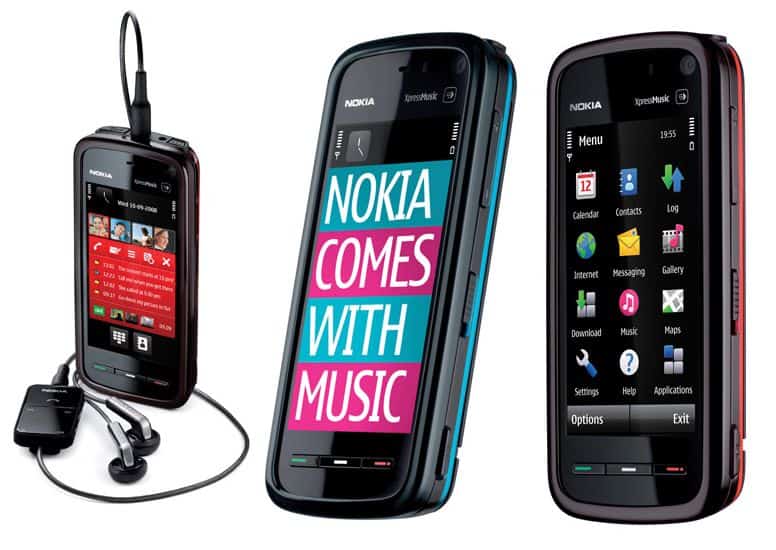
The Nokia 5800 XpressMusic was built with music people in mind, so it came with a sleek compact vibe, but also kind of thicker than a few rival phones, yet still somehow really pocket friendly. You could feel it in the size as well, it measured about 111 x 51.7 x 15.5 mm , and it weighed just 109 grams. so it stayed comfortable to grip even when you used it with one hand, no big drama. The overall look relied on gentle curves and a glossy outer shell , which looks kinda modern and nice at first, but it also collected fingerprints and smudges pretty quickly.
Up front, the main thing was a 3.2-inch resistive touchscreen, and under it you had three physical buttons. Those were for call answer, call end, and the middle menu option. This resistive screen was basically the 5800 XpressMusic signature, since at the time most smartphones were leaning more toward capacitive displays. With resistive, the taps were often less instant, you had to press a little firmer, but it was also more precise , especially if you used a stylus. Nokia did include one, as part of the box so you weren’t left improvising.
On the back side there was a 3.2-megapixel camera , Carl Zeiss optics and a dual LED flash, plus a small speaker grille. The camera bump was slightly raised, and that’s where some users got annoyed, because when you set the phone down flat it could wobble. The back cover itself used plastic, it came off easily enough to reach the battery compartment, the SIM card slot , and the microSD card slot.
On the right side of the device, there were those dedicated volume buttons, a lock unlock slider, and the camera shutter button, all of which felt tactile and actually pretty easy to press, even with one hand. On the left, you’d find the microSD card slot and a SIM card slot, both tucked under plastic flaps, so they stay protected from dust n smudges. Up top, the device had the power button, 3.5mm headphone jack, and a micro USB port, for charging and data moving stuff.
Overall the build quality on the Nokia 5800 XpressMusic felt solid, like a robust construction that could take day to day use without too much drama. Still , the material choices, mainly that plastic back cover, made it feel a bit less premium, compared with other high end smartphones from back then.
Display
The 3.2 inch TFT display on the Nokia 5800 XpressMusic ran at 360 x 640 pixels, which works out to about 229 PPI . For its time, that was a respectable resolution, giving decent sharpness and clarity for text, images,and videos. It could also show 16 million colors, so the visuals looked lively, and kinda bright.
That said, the screen was a resistive touchscreen, meaning it depended on pressure to register your inputs. This touchscreen style was pretty normal in earlier touch devices but it was already being pushed aside by capacitive touchscreens, which react to lighter touches and can do multi touch gestures. With the resistive setup on the 5800 XpressMusic, you usually had to press a little more firmly, and that could get annoying, especially if you’re used to the smoother, more responsive feel of capacitive screens like on the iPhone.
Despite its limitations, the resistive touchscreen did have some advantages , like it seemed more precise when you used a stylus, and Nokia even provided a small stylus that could be attached to the phone’s lanyard loop. That kind of setup made it easier to move around small icons and tiny text on the screen, especially in apps where you really needed precision , or at least something close to it.
As for the display, visibility in direct sunlight was kind of average, with reflections that made it harder to see what was on the screen when the conditions were bright. The viewing angles were also kinda limited, so the colors and contrast would shift pretty clearly if you looked from the side. Still, for indoor use and in normal lighting , the screen held up well enough, with solid brightness and a decent level of color reproduction.
User Interface and Software
The Nokia 5800 XpressMusic ran on Symbian OS v9.4, paired with the S60 5th Edition user interface. Symbian was one of the more widely used mobile operating systems back then , especially across Nokia devices, and the S60 5th Edition was tuned for touch input. This was Nokia’s first real attempt at designing a touchscreen experience for its Symbian line, and while it worked , it also came with its fair share of quirks and restrictions.
The home screen on the Nokia 5800 XpressMusic was sort of customizable, like you could add shortcuts to your favorite applications, plus little widgets and even certain contacts, in a quick-ish way. The main menu stayed there in a grid of icons, kinda like what you saw on other Nokia devices from that era as well. Wiggling through menus and just launching apps was usually done by tapping and dragging , and the stylus gave you a bit more accurate control, if you felt like going that route.
A pretty noticeable bit of the S60 5th Edition was the virtual keyboard for typing. That keyboard worked in both portrait and landscape modes, and in landscape it felt a little more open, honestly, like it was easier to keep up with. Still, the resistive touchscreen meant typing wasn’t as smooth as it would be on capacitive screens. Lots of users had to get used to that small delay before the input actually registered, it was there, you’d notice.
The software package also came with a bunch of pre-installed apps , like the web browser, an email client, a calendar, and a media player. The web browser could load full web pages and it also supported Flash Lite, so users could watch Flash content from compatible sites. But the whole browsing vibe was limited by the screen size, and the lack of multi touch gestures didn’t help much either, so zooming and panning could feel less natural, not as intuitive as people might expect.
One of the key selling points of the Nokia 5800 XpressMusic was its music player , which was really tied in with the software. The music player supported a broad set of audio formats, like MP3, AAC, and WMA, and it brought in extras such as equalizer settings, album artwork display and playlist control . There was also a dedicated music shortcut button on the home screen, so quick access felt sort of effortless, users could just jump in and enjoy their favorite tunes on the go, easy as pie really.
The device also came with Nokia’s Ovi Store, which let users pull in more applications , games, and other content onto their handset. The Ovi Store was basically Nokia’s response to the Apple App Store, but it didn’t match the same level of developer backing and content variety. Still, it gave a practical route to grow what the phone could do, beyond what was already pre installed.
Performance
Under the hood, the Nokia 5800 XpressMusic ran on a 434 MHz ARM11 processor, paired up with 128 MB of RAM. On paper, those specs might look a bit small compared with today’s standards, yet back then , in 2008 they were pretty solid for a mid range smartphone. For most everyday stuff, like web browsing, email checking and music playback, it felt responsive enough. But when you went for heavier applications , or when multiple things were left open at once, it could start to lag, especially if multitasking turned into a habit.
The user interface was mostly smooth, every so often you could notice some lag when you were switching through menus or when you opened an application. The resistive touchscreen also made it feel slower, it kind of needed a firmer touch and sometimes it would miss inputs or give delayed reactions , like you’d tap and wait a second longer than you expected.
In the beginning, the device only shipped with 81 MB of internal storage, and honestly that was pretty tight, especially for a phone that was kind of being pushed as a multimedia thing. Still, it did have a microSD card slot, so you could expand the storage to about 16 GB, which is enough room for music, video files and all the other media you’d want.
Battery life was definitely one of the better parts on the Nokia 5800 XpressMusic. It shipped with a 1320 mAh removable battery, and that gave solid endurance for that era. With moderate use , meaning calls , texting, web browsing and music, the phone could usually get through a full day on one charge. The Symbian OS did a decent job with power management , and since the hardware wasn’t exactly power hungry either, the overall result was a pretty respectable battery performance.
Nokia 5800 XpressMusic: Buy it now
Camera
So the Nokia 5800 XpressMusic came with a 3.2-megapixel rear camera, and it had Carl Zeiss optics to help out. There was autofocus too and a dual LED flash , which sounds familiar, pretty much the usual mid-range smartphone kind of stuff back then. In good light it could still manage decent shots, not mind blowing, but it was alright.
The camera menu felt simple, maybe even a bit plain but easy to work with. You could tweak things like white balance, ISO, exposure, and stuff like that without too much hassle. Usually the focus locked in well, and the Carl Zeiss optics were one of those reasons pictures looked fairly crisp and readable. But when the lighting got worse, it kinda struggled—photos often turned grainy and you could notice less detail, kind of a “soft all over” vibe. The dual-LED flash did help in some moments, yet it also could make scenes look overexposed, like highlights got pushed too far and things looked washed out.
It also recorded video, at VGA resolution, 640 x 480 pixels, running up to 30 frames per second. Video was fine for casual use, though it really wasn’t keeping pace with phones that had higher-resolution video modes. Those clips were good enough for sending around or watching on the phone’s own screen, but the sharpness and clarity were not what you would expect from more serious cameras or dedicated video recorders.
There were also basic edit features built into the software. You could crop, rotate, and nudge brightness and contrast, all right there on-device. These tools were handy for quick fixes, but they stayed rather limited, not really comparable with the more advanced photo editing apps you could find on other platforms.
The front-facing camera on the Nokia 5800 XpressMusic was a VGA (0.3-megapixel) sort of camera , basically meant for video calls, more than for “selfies” back then , which were kind of not as popular. So the front camera quality was pretty plain, it did the job, but there wasn’t much more to it.
All in all, the camera setup on the Nokia 5800 XpressMusic felt adequate for a mid-range device from 2008. It could do decent work for casual snapshots and also for video recording, though it really wasn’t something you’d brag about. It became less impressive once smartphones started putting more weight on higher-quality cameras in the years that came after.
Multimedia and Audio Quality
As part of the XpressMusic line, the Nokia 5800 leaned hard into music and overall multimedia. Its music player was honestly one of the better points, with a fairly easy interface and a good spread of compatible audio formats. You could use MP3, AAC, WMA, and WAV, among others. The player also let you build and handle playlists, show album art, and tune the sound with an equalizer. That equalizer had preset choices, and you could even set up a custom listening profile if you wanted.
The audio quality that came out of the Nokia 5800 XpressMusic was honestly pretty impressive, for a mobile phone back then. I mean it had a 3.5mm headphone jack, so you could connect whichever pair you liked, and the sound output stayed clear, and pretty well balanced too. Also it could do stereo Bluetooth (A2DP) which made it possible to stream audio wirelessly to compatible Bluetooth headsets or even speakers.
There was this dedicated music button on the home screen, kind of like a quick shortcut , so you could jump into the music player whenever you felt like it. The physical volume buttons on the side of the phone made it kind of convenient to control the playback without digging through menus, they responded fast ,which was nice. Also the Nokia 5800 XpressMusic added a built in FM radio, but you had to reach it via the music player application, and wired headphones were required because they basically worked as the antenna .
For video playback, the 5800 XpressMusic handled quite a range of formats like MP4, H.263, and H.264 it seemed . The 3.2 inch display looked fine for videos, but honestly in the end the screen was rather small ,and the resolution wasnt anything wild so the overall “wow” factor stayed pretty limited too. The video player itself felt simple enough, with straightforward controls, plus you could nudge brightness and adjust the aspect ratio when you felt like it.
The speaker quality was another strong point. The 5800 XpressMusic came with stereo speakers placed at the top and bottom of the device, and the result was louder than you’d expect, and still mostly clear. That made it a solid option for music or video, even when you didn’t want to use headphones, but at the highest volume levels the audio could start to get a bit distorted.
Connectivity
The Nokia 5800 XpressMusic came with this kind of pretty full set of connectivity things so it felt more flexible for its time, you know. For the mobile networks, it supported quad band GSM (850/900/1800/1900 MHz) and also a dual band UMTS (900/2100 MHz) which basically meant you could use it across lots of different places, and different operator arrangements. It also handled HSDPA (3.5G) with download speeds up to 3.6 Mbps so mobile internet felt sort of fast for stuff like web browsing , and also file downloading.
Beside cellular, there was Wi-Fi (802.11 b/g), which let people hook into local wireless networks for smoother internet access. The Wi-Fi side was mostly reliable, with decent range and steady behavior, so it was easier to surf, stream media, or download applications when you were on a Wi‑Fi signal.
Then there’s Bluetooth 2.0 , and it included A2DP support. That combination made wireless audio streaming simpler, plus it helped with file transfer to other compatible gadgets. In day to day use the Bluetooth link stayed stable, pairing was usually painless too, whether with headphones, speakers, or even car audio systems.
For wired connections, the phone used a micro‑USB port for charging and data transfer, and at the time that was basically becoming the norm. You could plug it into a computer for syncing music, videos, and other files via Nokia’s PC Suite. The micro‑USB also supported USB On-The-Go (OTG), meaning the phone could serve as a host for USB accessories like flash drives, though honestly that option was not used that often.
One of the more noticeable connectivity tricks on the Nokia 5800 XpressMusic was its GPS, it kind of ran right alongside Nokia Maps (later it got rebranded as Ovi Maps). The GPS receiver gave reliable location awareness and it let people do step by step navigation, plus search for nearby points of interest, and check maps in online and offline situations. Having that built in GPS made the phone feel like a real road companion , especially because the Nokia Maps app was already there, so you did not need extra installs or anything like that.
The device also had TV-out support, using a 3.5mm AV connector. So you could hook it up to a TV or some external display using a suitable cable. In practice this was handy for sharing photos, videos, and other media on a larger screen, though you should expect the output to stay at standard definition, not some high resolution look.
Battery Life
The Nokia 5800 XpressMusic came with a 1320 mAh removable lithium-ion battery, and for its day it actually worked pretty well. The blend of efficient components plus the power management from Symbian OS, helped stretch endurance, particularly because the phone was known for multimedia use.
In everyday life with moderate activity , like calls, text chats, web browsing, music sessions, and the occasional video moment, the Nokia 5800 XpressMusic could manage a full day on one charge without too much fuss. And if someone mostly used it for music and simpler tasks, the battery could stretch to two days, sometimes more, depending on signal strength and screen time , of course.
For music lovers, the device battery stuff was pretty impressive, like really nice. Nokia claimed up to 35 hours of nonstop music playback on a full charge, and that’s why the 5800 XpressMusic felt like such a solid pick for people who wanted a dedicated music player, with long lasting endurance in the background.
Charging it was also surprisingly quick, the included charger could fully top up the battery in just a couple of hours. Plus the removable battery mattered quite a bit , because users could bring an extra cell for longer outings or heavy usage days, which is something you don’t see as often anymore in today’s smartphones where the batteries are sealed tight.
Conclusion
The Nokia 5800 XpressMusic was kinda a milestone device for Nokia, you know, it marked the company’s entry into the touchscreen smartphone market and it also helped set up what came next in mobile technology. It leaned hard into music and multimedia abilities, so it connected with a broad group of music lovers plus tech enthusiasts, giving them a reasonable mix of features, everyday speed, and value.
Even if it had some limits, especially the resistive touchscreen, and well, the Symbian OS that was starting to feel old, the phone still worked as a well-rounded and sturdy smartphone. It basically did what it was supposed to do for its intended audience. The Nokia 5800 XpressMusic still feels memorable in Nokia’s story, it represents a notable step in the company’s path through the always-changing mobile world.
Later on, the smartphone scene kept moving, fast, with new ideas and competitors reshaping everything. Still, the Nokia 5800 XpressMusic stands as a kind of proof that Nokia could craft attractive devices that clicked with consumers, even while the company was dealing with serious problems in a shifting mobile technology environment.

Tech Reviewer & Product Analyst
Định Bia has spent over 10 years testing consumer electronics with a focus on smart technology. He work as a product advisor at Biareview where he helped customers find the right devices for their needs. He personally tests every product featured on this site using a consistent evaluation framework covering quality, durability, and value. All reviews are based on experience, not influenced by the manufacturer.