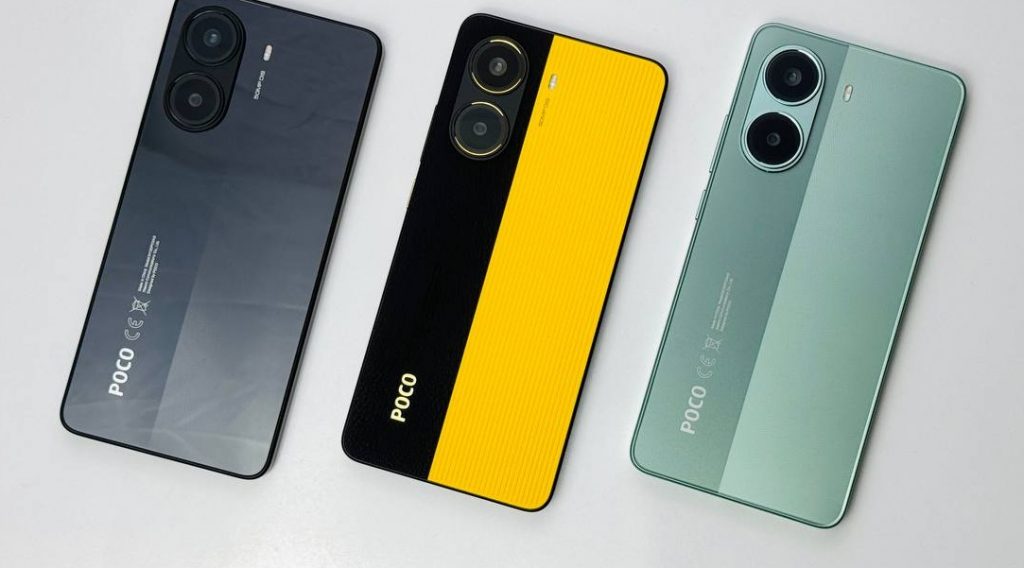
- Design
Although part of the same series, the standard X7 design is quite different from the X7 Pro version. This silver model is the most minimalist version of the X7, featuring a very large brand logo on the back.
Furthermore, Poco hasn’t cut back on any features; it includes all the favorite features except for the headphone jack.
This time, Poco has upgraded the X7’s structure by equipping it with a new internal cushioning layer to enhance its drop resistance.
The phone is IP68 certified for dust and water resistance, the same as the Pro version. The screen glass also uses premium Corning Gorilla Victus 2 glass, further enhancing impact protection.
- Display
The Poco X7 has fairly good display specifications with a manual maximum brightness of 500 nits and a High Brightness mode of 1200 nits. The PWM dimming mode is 1920Hz, which is very good for the eyes when using the phone at night.
In addition, the phone also has an in-display fingerprint sensor. Along with the aforementioned Victus 2 protective glass, there are virtually no drawbacks to the screen at this price point.
If you want a better screen, you’ll have to pay more for a more expensive phone, such as its sibling, the Poco X7 Pro.
- Performance
Budget phones require manufacturers to find ways to lower costs which results in reduced product features. The design of Poco X7 showed which features the company needed to remove for budget purposes. The device reached its performance limit because it uses Dimensity 7300-Ultra chipset which belongs to the mid-range category.
Some mainstream games can still run smoothly, such as PUBG Mobile. The game graphics showed no lag during our testing while power usage and heat production remained at low values. Genshin Impact produced lower performance results because it requires more system resources.
The system handles basic tasks without difficulties while users experience efficient control of system temperature and power usage.
- Camera
The Poco X7 three cameras serve as our preferred choice because they include a primary camera that uses a Sony IMX882 sensor and an 8MP ultra-wide-angle camera and a 2MP macro camera. The company achieved its maximum potential with the camera system.
The camera captures better photos than our initial expectations. The Poco X7 budget phone demonstrates common issues found in similar-priced devices which include purple fringing and loss of clarity in low light conditions. The device delivers satisfying photo results when users maintain moderate expectations which do not involve comparing it to premium flagship devices. The in-sensor zoom mode works effectively for distances beyond 2x zoom which enables users to see objects at greater distances.
The ultra-wide-angle camera performed well for us except for the typical purple fringing problem which occurs in all mid-range devices. The problem exists in all mid-range devices which extends beyond the Poco X7 phone model. The current model has improved night shooting capacity which produces better results than previous Poco devices.
The 2MP macro camera is just adequate. The main camera performs equally well as the macro camera for capturing images and produces superior results. The camera system offers no practical value for photography while its existence should be treated as an unnecessary element to be eliminated.
The Poco X7 front camera system which operates at 20MP delivers unexpected performance. The device produces excellent selfies while enabling users to record 1080P 60fps videos through EIS. The video quality reaches excellent standards because it enables users to effortlessly create 1080P vlogs through the camera.
The main camera supports 4K video recording while the ultra-wide-angle camera only enables 1080P video recording. The video content maintains a smooth workflow at 30 frames per second while delivering satisfactory visual clarity. The 2025 smartphone market offers sufficient specifications for this price point.
- Battery & Charging
Both the Redmi Note 14 Pro and the POCO X7 support 45W charging through their wired charging systems. We achieved a 26% battery charge after 10 minutes and reached a full charge after 55 minutes. The Poco X7 has a battery capacity of 5,110mAh which marks it as a different device from the Redmi Note 14 Pro. The Poco X7 processor uses power at a high efficiency which serves as positive news for users. The Poco X7 battery uses solid-state electrolyte technology according to manufacturer specifications. The device enables voice calling at temperatures reaching -10°C for 24 hours and provides a standby duration of 66 hours.
- Conclusion
The Poco X7 exists as a different device when compared to other Poco smartphones. Most Poco phones emphasize superior performance, but are rather mediocre in other specifications. The Poco X7 delivers decent performance, while everything else in the device operates at a high standard.
XIAOMI Poco X7 5G + 4G LTE (for Tmobile Mint Tello & Global) (256GB + 8GB) Ai Curved 6.67″ 50MP Triple Cam NFC Dual sim Unlocked Model 24095PCADG (Black):
XIAOMI Poco X7 5G + 4G LTE (for Tmobile Mint Tello & Global) (512GB + 12GB) Ai Curved 6.67″ 50MP Triple Cam NFC Dual sim Unlocked Model 24095PCADG (Green):
Xiaomi Poco X7 5G + 4G LTE (for Tmobile Mint Tello & Global) (256GB + 8GB) Ai Curved 6.67″ 50MP Triple Cam NFC Dual sim Unlocked Model 24095PCADG (Silver):
XIAOMI Poco X7 5G + 4G LTE (for Tmobile Mint Tello & Global) (512GB + 12GB) Ai Curved 6.67″ 50MP Triple Cam NFC Dual sim Unlocked Model 24095PCADG (Black):







Tech Reviewer & Product Analyst
Định Bia has spent over 10 years testing consumer electronics with a focus on smart technology. He work as a product advisor at Biareview where he helped customers find the right devices for their needs. He personally tests every product featured on this site using a consistent evaluation framework covering quality, durability, and value. All reviews are based on experience, not influenced by the manufacturer.