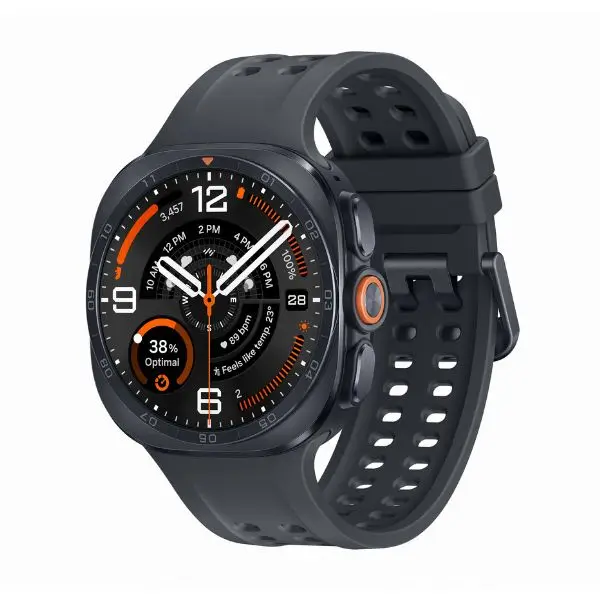
Wearing a smartwatch around the office or reading its spec sheet on paper is familiar ground for all of us by now. This time I wanted a change, so I took the Galaxy Watch Ultra 2 straight out into real terrain. The place I picked for this test was the trail running route at mountain.
Why I took the Galaxy Watch Ultra 2 trail running at mountain
A bit about where I’m coming from: I like being active and I play a lot of different sports. Before this I spent time with the Galaxy Watch 8 at a Galaxy Run event, and I train on a treadmill most days.
Indoor sessions and flat city roads don’t show you what a positioning watch in the Ultra line can really do, though. I wanted to see how it would help an active person stay in control, move easily and stay safe on a real trail run over awkward ground.
The route I ran at mountain is about 6.3 km with roughly 251 m of elevation gain. The gradient is steep and relentless, broken up by long stretches of stone steps, paths that follow a stream, and sections that cut past temples and shrines.
The weather was not on my side. A heavy shower came through and left the hill paths slick. That wet ground and loose rock turned out to be an ideal test for the watch.
Navigating mountain from a GPX file, and the trail running features
On a trail run, positioning and navigation matter more than anything else. Before setting off I went through the running groups online to find a GPX map of the mountain route, then copied it straight onto the Galaxy Watch Ultra 2.
Finding the GPX file and loading it onto the watch was simple, with no fiddly steps. At the trailhead I started the trail run activity, and the first thing that pleased me was how fast it locked onto GPS. It found my position almost instantly and pulled up the GPX route I had loaded, ready to follow for the rest of the run.
Deep in the trees, the Off-track Alarm earned its place. The paths at mountain branch and cross each other in ways that are easy to get wrong, so I deliberately stepped off the planned route to see what would happen.
Three or four metres off the line was enough. The watch buzzed immediately and sounded an alert to tell me I had gone the wrong way, so I could turn back onto the route before getting properly lost in the forest. The moment I stepped back onto the marked line it gave another light buzz to confirm I was back on track, which was reassuring.
On the interface side, the Galaxy Watch Ultra 2 splits things across several screens and widgets. While running, a light swipe is all it takes to move between groups of metrics.
One swipe gets you the gradient chart, another gets you heart rate and distance. Compared with some of the dedicated outdoor watches out there, though, the mapping has one small shortcoming. Navigation here is a breadcrumb line on a dark background. There is no topographic layer showing the streams, hills and tree cover around you in detail.
What it does very well is altitude and live gradient. The watch keeps updating the slope of the ground ahead, showing figures like minus 8% or minus 10% on a descent. Knowing what is coming makes it much easier to ration your effort: when to ease off, when to walk and recover, when to get an energy gel and a salt tablet ready for the next climb.
The sensors also read heart rate, ambient temperature and skin humidity continuously, and the watch prompts you to drink when it decides you are working too hard or losing fluid. That happened to me on a long climb, breathing hard and sweating, when the hydration reminder came up. I stopped at a local rest stop, got a cold drink and cooled down enough to carry on.
The Galaxy Watch Ultra 2 also has TrackBack. It takes all the positioning data recorded on the way out, redraws the route and guides you back to where you started.
If something goes wrong out there, a fall or running yourself empty in the forest, there is the Emergency Siren. The watch speaker puts out a very loud siren so people nearby, or a rescue team, can place you from a distance.
Thinner, lighter, and more comfortable to wear
On looks and feel, the Galaxy Watch Ultra 2 brings a good number of improvements over its predecessor. It still has the chunky, sporty 47 mm titanium case, but the body is about 12% thinner than the first Ultra. That makes the whole watch noticeably neater: bending your wrist or moving hard no longer leaves it feeling bulky or catching on your arm.
The Trail Band is comfortable and doesn’t trap sweat
The Trail Band is another big plus. The default rubber strap on the last generation was thick and stiff, so running in heavy sweat or in the rain left the skin under it hot, itchy and sore. The new Trail Band is a light hook-and-loop fabric strap that breathes well and sits softly against the wrist. Even running through a downpour, with sweat and rainwater pooling under it, the strap dried out fairly quickly and never bothered my skin.
The 5000 nit screen in sunlight, and the durability, are the two things worth paying for on the Galaxy Watch Ultra 2
Outdoors, the 1.52 inch round screen peaks at 5000 nits, which is very high for a smartwatch today. Running through open sections with no tree cover, with the midday sun straight on the sapphire lens, the pace, heart rate and the route map all stayed sharp and readable. Going back into dim, overgrown single track, the screen dimmed itself to something easier on the eyes.
On durability, the watch is rated 10 ATM for water resistance and IP69K for dust and water, with a titanium case and a sapphire lens that take a hit well. On this trip the wet ground had me slipping and falling a few times, and the watch face went straight into dry branches, dirt and loose rock along the way.
After I finished the run and washed the mud off, the glass and the titanium bezel were still smooth, without a single scratch on them. It takes knocks well enough for hard trips.
Smooth performance, solid real world battery, and Gemini
On hardware, the Galaxy Watch Ultra 2 runs the new Snapdragon Wear Elite chip. That processor with Wear OS makes the whole thing respond quickly. Swiping between activity menus, switching widgets and opening apps all happen instantly. What impressed me is that the watch stayed steady even working outdoors for hours, with GPS on and several sensors reading at once until it warmed up, without the lag or frame stutter some other watches get.
The battery is 800 mAh. To see what that means in practice, I charged it to 100% the night before the trip and slept in it, so it could record my sleep and work out an Energy Score for the next day. In the morning I wore it from City out to mountain, then ran with GPS trail tracking on for somewhere between one and two hours. By the time I finished around midday, the watch was reading about 67%.
For mixed use like that, overnight sleep tracking plus continuous outdoor GPS, that is a very good result. For everyday wear, notifications and light training, it will run for three to four days before it needs charging.
Another thing I liked on the Galaxy Watch Ultra 2 is Raise to Talk with Gemini. Running up a slope with both hands on poles or on rock, I could just lift my wrist and ask Gemini a question without pressing anything.
When my calf started to feel tight, I lifted my wrist and asked Gemini what to do about cramp while running, and it came back with advice on easy stretching and electrolyte drinks. Before the climb I could also ask about the weather at mountain over the next few hours and pack a rain jacket accordingly.
The Double Pinch gesture is handy too. It let me pause music, answer calls or trigger the camera on my phone remotely, without putting a finger covered in mud on the touchscreen. Everything the watch collected on the trip synced across to Samsung Health on my phone, so I could go back through the heart rate graph, the sleep analysis and my daily Energy Score.
In short
After a real trail run at mountain, the Galaxy Watch Ultra 2 looks like a well judged refinement of Samsung’s sports smartwatch line. It fixes the weak points of the last model: the thinner, lighter body, a Trail Band that is comfortable and doesn’t leave your skin raw, a 5000 nit screen that stays readable in hard sun, and battery life long enough for a long day out.
As I see it, this watch suits anyone who trains regularly, from the basics through to hardcore sports. It works as a modern smartwatch for everyday wear, and as a health tracker and navigation device you can rely on when you go out into the hills.
Samsung Galaxy Watch Ultra2, Titanium Gray, 47mm LTE Smartwatch: Check Availability on Amazon
Samsung Galaxy Watch Ultra2, Titanium Silver, 47mm LTE Smartwatch: Check Availability on Amazon
Samsung Galaxy Watch Ultra2 (2026) 47mm LTE Smartwatch, Titanium Casing, Advanced Sleep Coaching, Running Coach, Energy Score, Heart Rate Tracking, GPS Latin American Stock – (Silver): Check Availability on Amazon
Related Posts


