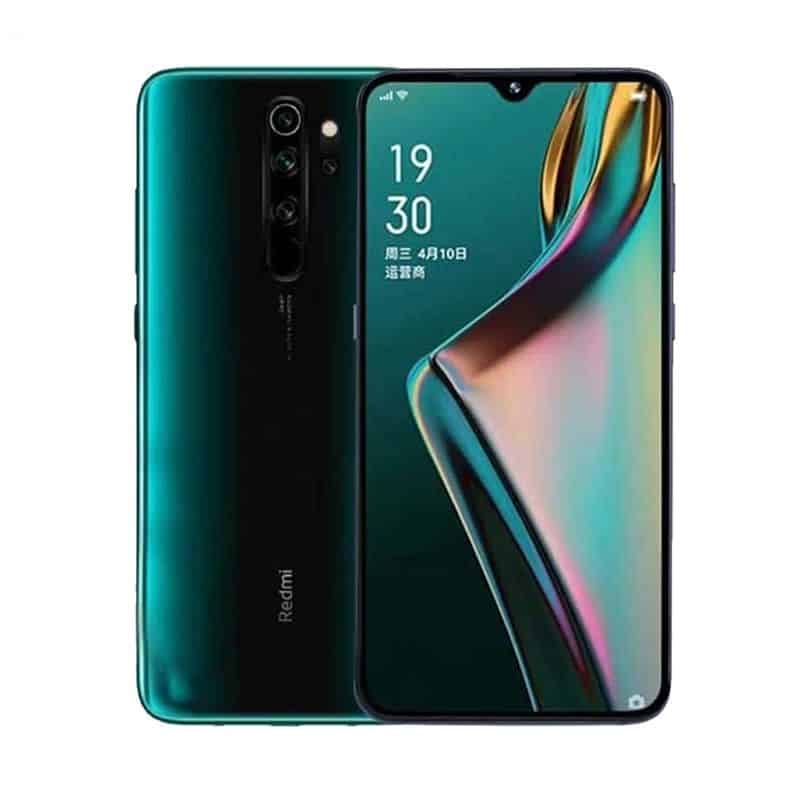
Design: “beauty queen” of Redmi Note series
Xiaomi used to be quite lazy to change the design of the Redmi Note series. However, the company has impressed with the design makeover in the Redmi Note 7 with glossy glass back. On the Redmi Note 8 Pro, Xiaomi continues to change very visually.
If you’re a Xiaomi fan , you can sort of see where the design of the Redmi Note 8 Pro starts to look a lot like the newer Mi 9T. It still keeps the glass back and plastic frame that we saw on the Redmi Note 7 , but it’s been tweaked so it looks more eye catching , and kind of more “classy” than before.
The back itself is curved , it sits just right in your palm, and it actually holds your hand well. Still , the Redmi Note 8 Pro also feels a bit bulky , and yes, heavier than you’d expect. At 8.8mm in thickness and about 200g , it’s noticeably thicker and weightier than the Redmi Note 7 Pro (8.1mm, 186g). Bigger displays, larger batteries , and an extra rear camera cluster are the obvious reasons behind the bulkier builds. But honestly, that might not be the whole story either.
On the front, the Redmi Note 8 Pro has a selfie screen, not a full screen with a front-facing camera that looks like the Mi 9T in the higher price segment. The screen border of the device is quite thin, the display / front ratio is 85%, slightly better than competing product Realme 5 Pro (84%).
Overall, it can be said that the Redmi Note 8 Pro is currently the most beautiful product in the Redmi Note series so far. However, the product also has a few small minus points like a smooth grip, a fingerprint sensor located in a slightly high position, especially for users with small hands and a slightly protruding rear camera assembly.
Screen: good quality, see clearly in the sun, including HDR
Redmi Note 8 Pro uses an IPS LCD screen with water droplets on it. The screen is sized at 6.53 inches, Full-HD + resolution, 19.5: 9 aspect ratio, Gorilla Glass 5 protection and HDR support, a rare feature at this price range.
The screen of this phone has high brightness, enough for comfortable use outdoors. Similar to Samsung devices, the brightness in the automatic brightness adjustment mode of Redmi Note 8 Pro can be pushed to a higher level than the maximum brightness in manual mode. So when using in the sun, you should turn on the automatic brightness adjustment mode.
The display quality is also very good, natural color, high contrast and wide viewing angle. In particular, this screen supports HDR content, so watching HDR-enabled videos on YouTube is more vivid.
The color temperature in the default mode of the screen feels kind of blue, at least for me, but Xiaomi lets users tune the color temperature and contrast, so it can match different needs, you know. On top of that, the Redmi Note 8 Pro screen also has a dark mode, which helps reduce eye strain when you’re using it at night.
Performance wise, it’s more like a cut above in the mid-range segment.
In recent years, the Redmi Note lineup has usually leaned on Qualcomm processors. Here on Redmi Note 8 Pro, Xiaomi moved over to a Mediatek chip though, and the brand kinda goes all in on the Helio G90T. They treat it as a clear selling advantage. The Helio G90T comes with eight processing cores: 2 high-performance Cortex-A76 cores running at 2.05Ghz , and 6 more energy-friendly Cortex-A55 cores running at 2Ghz. The Helio G90T graphics chip inside is Mali-G76 3EEMC4 clocked at 800MHz with HyperEngine technology to improve the gaming experience. MediaTek itself promoted this as a gaming chip.
On performance measurement applications, Helio G90T proves the overall power superior to the same-priced smartphones using the Snapdragon 712 (Realme 5 Pro) or Exynos 9610 (Samsung Galaxy A50s). In terms of graphics processing, which has not been a strength on Mediatek chips for a long time, G90T also scores significantly better than Qualcomm’s mid-range chip, Snapdragon 712 and outperforms the competition. The mid-range Exynos 9610 chip is used by Samsung on many A and M series smartphones of 2019.
In practical experience, Helio G90T along with 6GB RAM proves that Xiaomi is not wrong when promoting this chip as a product strength. It responds well to everyday activities on the phone, applications open fast and smooth experience.
With the game, Redmi Note 8 Pro also plays the most graphically heavy games on Android today. Specifically with PUBG Mobile, the phone reached 39 fps with 92% frame stability when playing in the highest graphics mode, according to the GameBench frame measurement application. Helio G90T has slightly better gaming performance than Snapdragon 712 on Realme 5 Pro but still slightly inferior to Snapdragon 730 on Xiaomi Mi 9T.
However, the gaming process, the machine heats up quite quickly and the heat level is perceived to be significantly higher than the Realme 5 Pro in the same playing time. The hottest area is the rear camera cluster. Coolers are quite fast after a period of time to stop playing, but this can be considered a minus point in the product. The hot phenomenon not only causes discomfort during gaming but also causes the product to drain the battery faster. Perhaps understanding this, Xiaomi has increased the battery capacity of the product to 4500 mAh, not 4,000 mAh as other similar price products.
In terms of software, the Redmi Note 8 Pro comes pre-installed with MIUI 10 based on Android 9. This is a very familiar software package for Xiaomi fans with many of the manufacturer’s specific features included as the 2nd space to contains private data; dual applications to run in parallel 2 accounts Facebook, Messenger or Zalo; lock apps that need to be protected with a password, fingerprint …
Xiaomi Redmi Note 8 Pro 64GB, 6GB RAM 6.53″ LTE GSM 64MP Factory Unlocked Smartphone – Global Model (Mineral Grey): Buy it now
Xiaomi Redmi Note 8 Pro 128GB, 6GB RAM 6.53″ LTE GSM 64MP Smartphone – Global Model (Mineral Grey): Buy it now
Xiaomi Redmi Note 8 Pro 128GB, 6GB RAM 6.53″ LTE GSM 64MP Factory Unlocked Smartphone – Global Model (Ocean Blue): Buy it now
Battery time: enough peace of mind to use during the day
Redmi Note 8 Pro uses a 4500 mAh battery and Helio G90T chip on the 12nm process is quite energy efficient. In the familiar surfing tests, movies and games of BiaReview, this phone gives a decent usage time, enough to use it during the day with normal demand but still inferior to some 4,000 mAh smartphone using Qualcomm chip. That kind of shows the Helio G90T chip is delivering some pretty impressive performance, but it is not that optimal in practice if you think about power saving too much.
When it comes to charging time, the phone supports MediaTek’s 18W Pump Express fast charging standard. With the included charger, the overall charge time for the Redmi Note 8 Pro comes in at around 2 hours, and in that span the first 30 minutes takes it to 35%, while after 1 hour you’re at roughly 70%. This charging result is similar to the charging time on phones using Qualcomm’s Quick Charge 3 / 4.0 charging standard.
The camera quality is good even in low light but don’t expect too much
Redmi Note 8 Pro has up to 5 cameras including 4 rear cameras and one front camera. We should not be too overwhelmed by the number of cameras because 2MP macro camera does not bring much meaning in practice. However, compared to the Redmi Note 7 Pro with only two rear cameras, it is clear that the camera on the Redmi Note 8 Pro is also an upgrade, the most notable of which is the addition of ultra-wide angle camera capable of autofocusing dynamic. Super wide-angle cameras on many smartphones of the same price range currently support only fixed focus, not capable of adjusting focus like Redmi Note 8 Pro.
– Main camera: 64MP, f / 1.9 , 0.8 micron pixel size, 1 / 1.7 inch, phase focus , Samsung ISOCELL GW1 sensor
– Wide-angle camera: 8MP, f / 2.2 , 120 degrees, pixel size 1.12 microns, ¼ inch sensor
– Macro camera: 2MP, f / 2.4 , pixel size 1.75 microns, 1/5 inch sensor.
– Depth camera: 2MP, f / 2.4 , pixel size 1.75 microns, 1/5 inch sensor.
– Front camera: 20MP, f / 2.0, 0.9 micron pixel size.
When it comes to image quality , the 64MP main lens gives a ton of detail, strong contrast, and colors that look pretty natural. In brighter situations, the HDR mode does a solid job, it sort of balances the bright zones with the darker parts. Still, sometimes you can notice some quirks in the photos, like they are not always managed super smoothly.
By default, the 64MP camera captures at 16MP resolution, it uses a 4-pixel method that merges everything into one shot , but you are also able to shoot in full 64MP. That said, the gap between the two resolutions feels almost pointless, kind of like how the 48MP setup behaved on the older Redmi Note 7 Pro.
Meanwhile, the image size in 64MP mode sometimes up to 15-16 MB compared to 16MP mode usually only 4-7 MB.
The main camera also supports 2X digital zoom. This is a cropped image from a 64MP camera, it is unclear whether it is a crop from the original 64MP image or a 16MP mode image. Looking at the 2X zoom images below you can see that the image processing in this mode is no different from the normal image from color to contrast and detail.
In font deletion mode, the Redmi Note 8 Pro uses a 2MP camera to capture depth support for the main 64MP camera. The photos show that the camera recognizes the subject border to remove the background quite well, less blurry and the background can adjust the level of deletion after shooting. In addition to adjusting the level of font deletion after shooting, Xiaomi also introduces interesting effects for the photo-removing fonts similar to the lighting effects on the iPhone.
Low-light photos from the 64MP camera of Redmi Note 8 Pro are similar to rivals using Sony’s 48MP camera like Realme 5 Pro or Galaxy A50s. The image is a bit grainy but the colors are nice and the noise control is quite good. It also supports 64MP shooting in low light but the image is no different than the default 16MP. In general, you should shoot in the default mode of 16MP both bright and underexposed, photos are light and the quality is not different.
Night Mode of Redmi Note 8 Pro helps to improve the overall image quality, sharper photos, more detailed especially dark areas. But everything is improved to the right, not being as outrageous as “turning night into day” like some other phones. Therefore, photos in night mode are sharper but still look natural.
The ultra wide-angle camera offers interesting shooting angles. In particular, this camera supports focus so you can use it to take close-ups. The treatment of colors is similar to the main camera but with less detail and narrower light bands. In bright enough conditions, photos from ultra-wide angle camera for quality to be used for sharing on the network but lack of light, the image is clearly visible.
The 2MP macro camera takes pictures at very close distances, only about 2-3cm. This is the shooting distance perhaps in terms of practical usefulness is not much. However, in bright enough conditions, this camera is quite clear image.
The 20MP front camera gives photos with good detail. HDR mode works well in images with complex lighting scenes such as differences and backlight. The font deletion mode also identifies and separates the subject relatively smoothly. However, this camera only produces good photos in bright enough conditions (outdoors or indoors with light). If there is no light, the photo is noticeably noisy and blurry.
Summary
The choice of Helio G90T processor is a change that helps the Redmi Note 8 Pro stand out in terms of performance compared to other devices of the same price range. Besides performance, the remaining elements of the product are also quite full. Although the number of 4 cameras on the back is only meaningful in terms of number, with the main marketing goal, in return, the 64MP main camera and wide-angle camera that supports autofocus are very positive points. Besides, this phone also has a large screen high brightness, relatively battery life and eye-catching design.
In the international market, Realme XT is the formidable opponent of Redmi Note 8 Pro with the advantage of AMOLED screen, in-screen fingerprint sensor and similar performance power.
Related Posts






Tech Reviewer & Product Analyst
Định Bia has spent over 10 years testing consumer electronics with a focus on smart technology. He work as a product advisor at Biareview where he helped customers find the right devices for their needs. He personally tests every product featured on this site using a consistent evaluation framework covering quality, durability, and value. All reviews are based on experience, not influenced by the manufacturer.